A daily rate multiplied by 30 does not equal a monthly lease, and neither one matches a catering quote for your party. That single fact trips up almost everyone pricing a taco truck rental, because the word “rental” gets slapped on three jobs that measure completely different things: a truck parked at your event for an afternoon, a vehicle you run as a business for months, and a per-head catering booking. Confuse them and your budget is wrong by thousands of dollars before you’ve bought a single tortilla. This guide separates the three, hands you the numbers each one actually carries, and tells you which path fits a one-off party versus a market test versus a committed business.
Quick answer: A taco truck rental is priced three non-comparable ways. For an event, expect a flat minimum of roughly $800 to $1,500 plus $10 to $25 per guest, with drinks billed separately at $1 to $5 a head. As a business, a daily rate runs $200 to $500; a monthly rental sits around $2,000 to $3,000, dropping to just over $1,000 for a six-to-twelve-month lease. Buying new is the big capital outlay that renting lets you avoid. Match the term to the use: event minimum for a party, short-term monthly for a test, long-term lease if you’re committed.
The event quote: a flat minimum plus per-guest, and why 50 and 80 guests can cost the same

When you hire a truck to feed a private party, you’re not paying by the day or the month. You’re paying a catering rate, and it has two parts. Roaming Hunger, the largest US food-truck catering marketplace, prices this from its own booking data: a savory truck such as a taco or burger truck runs $800 to $1,500 to rent for an event, with per-guest pricing of $10 to $25 per eater on top. Its taco-specific city catering tables tighten the floor to a $1,000 minimum at $10 to $15 per person.
Here’s the part that catches hosts off guard. The minimum is a floor, not a discount schedule. According to Roaming Hunger, if you have fewer guests – say 50 people – you still pay the minimum of $800. Fewer heads does not mean a proportionally smaller bill.
That creates a break-even guest count, below which the per-person math is irrelevant. Divide the flat minimum by the per-person rate and you find the point where the two pricing halves meet. At a $1,000 minimum and $10 a head, that’s 100 guests; below it, you’re paying for empty capacity either way. A 50-guest party and an 80-guest party can land on the same $1,000 because both sit under that line. For a ~40-person backyard event, assume you’re buying the minimum, roughly $800 to $1,000, not 40 × $15.
Drinks are their own line. Roaming Hunger notes drink costs are usually separate, at $1 to $5 per person. Budget them; don’t assume the taco quote folds them in. For the fuller picture on hosting figures, see our taco truck for parties breakdown and the taco truck wedding numbers for 150 guests.
Daily, monthly, and event rates are three different rulers – convert nothing between them
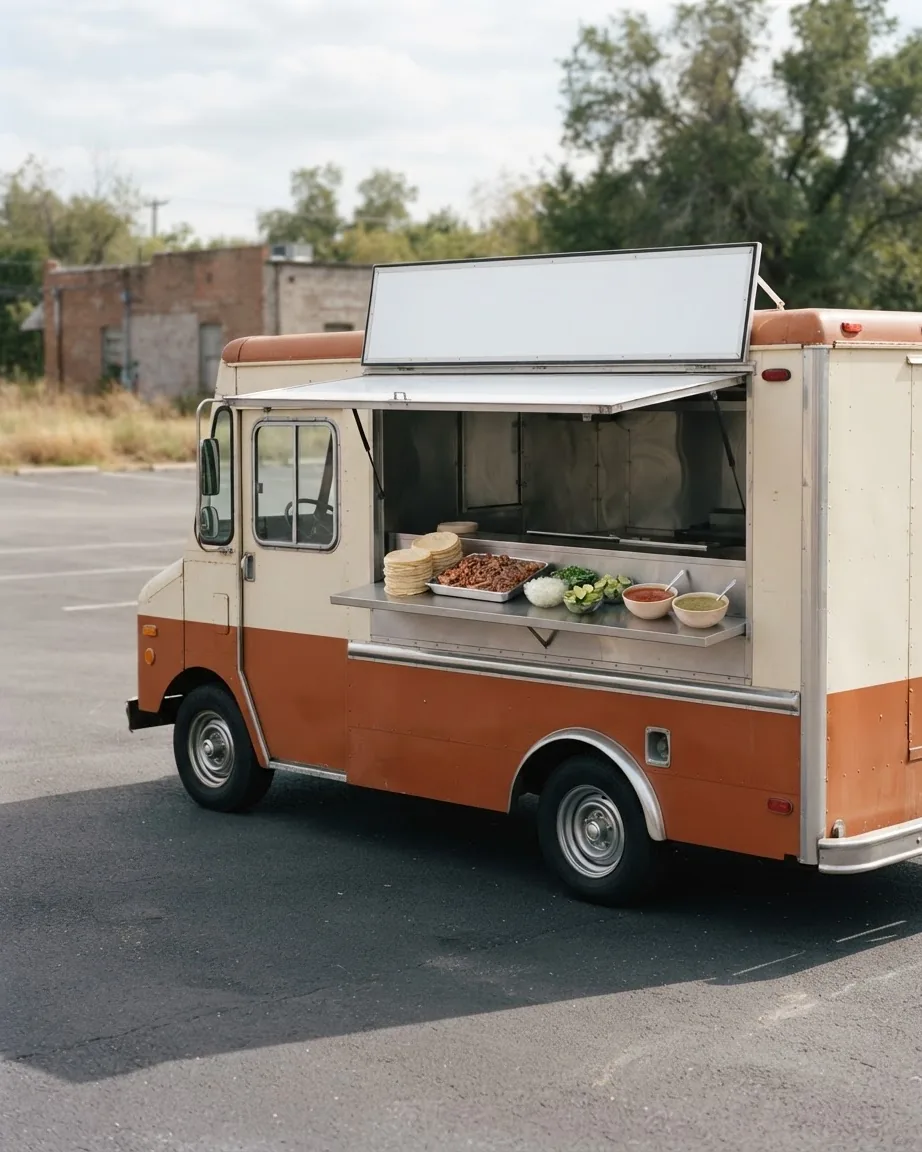
If you’re renting to run a business rather than host a party, you’ll see two more bases, and they don’t translate into each other. FatboysOffroad, writing on general rental ranges, puts daily rates at $200 to $400 for a 24-hour period, widening elsewhere to $200 to $500 a day. Monthly, the same source lists $2,000 to $5,000+ depending on the truck’s specifications and amenities.
Resist the urge to multiply. A daily rate times 30 does not reconstruct the monthly figure, and the monthly figure is not an event catering quote. Each ruler measures a different commitment: the daily rate prices access for a shift, the monthly prices a continuous operation, the event minimum prices a one-time service with food and labor baked in. Lining them up side by side is the fastest way to misbudget.
- One-off event: use the event minimum plus per-guest ($800 – $1,500 + $10 – $25/head).
- Market test or short stint: use the daily rate ($200 – $500/day) or a premium short-term monthly.
- Committed operation: use a long-term monthly lease (see below).
“Rental” vs “lease”: same dollars, different labels – pin the term before you sign
The naming across the industry is inconsistent, and it costs people money because they compare quotes that aren’t the same product. Toast, the restaurant-tech company, states on its rental cost guide that renting a taco truck generally costs between $2,000 and $3,000 per month. On its buy-side companion page, Toast labels that identical $2,000 to $3,000 range as a “lease.” Same number, two words.
7shifts, the restaurant workforce-software company, splits it more usefully by term. Its guide reports that for long-term leases of around six months to a year, you can find rental taco trucks for just over $1,000 per month. The read: short commitments carry a premium and the $2,000 – $3,000 figure; a six-to-twelve-month lease roughly halves that to the $1,000 neighborhood. Before you quote anyone against anyone, ask whether their “rental” is a flexible short-term arrangement or a committed lease – the gap between the two is about $1,000 a month.
The real monthly burn a taco truck rental does not erase

Rent is the headline. It is not the bill. The stacked recurring costs are what separate operators who budgeted from operators who ran out of cash, and no single page assembles them – so here’s the full stack, drawn from 7shifts’ itemized breakdown and Toast’s figures.
- Security deposit: most rental agreements require one to three months’ rent upfront. For a $3,000-per-month rental, 7shifts notes an entrepreneur may need $3,000 to $9,000 upfront just for the deposit.
- Commissary kitchen: a licensed prep base can add as much as $1,500 to your monthly expenses, per 7shifts – and it may or may not be bundled into your rental.
- Permits and licenses: 7shifts puts the total for licenses and permits at nearly $2,000 to $28,000 per year, depending on local regulations.
- Upkeep: even when the rental company covers big failures, 7shifts says operators must still budget around $500 to $1,000 monthly for routine upkeep.
- Insurance: figures vary. Toast gives $1,000 to $5,000 annually for taco-truck insurance, depending on the truck’s value and your location. Treat it as a range, not a single point.
Stack those against a $2,000 – $3,000 base and the true monthly burn can double before you’ve sold a taco. The commissary line alone can rival a long-term lease payment.
What’s included vs billed separately: the fridge line that surprises first-timers
Read the agreement for who owns which cost, because the splits aren’t intuitive. The good news first: 7shifts reports that major mechanical repairs, such as engine replacements or transmission work, are typically covered by the rental company. That’s real risk off your plate.
The traps are smaller and sneakier. If your rental truck doesn’t include a fridge, 7shifts says you can purchase one for around $1,000 to $3,000 – a cold-chain line that wrecks a tight budget when it’s assumed to be standard. And FatboysOffroad notes that permits, health inspections, and business licenses are usually the responsibility of the renter, not the truck owner. Before signing, confirm in writing: Is refrigeration included? Is the commissary bundled? Who pulls the event or health permits? Each “no” is a cost you just inherited.
- Usually the rental company’s job: major mechanical repairs (engine, transmission).
- Often yours: a fridge if not fitted (+$1,000 – $3,000), routine upkeep, insurance, permits, possibly the commissary.
Rent, lease, or buy: the $21,000 truck a real operator started with
Renting exists to let you skip a big capital outlay. Toast’s buy-side guide anchors what you’re avoiding: a brand-new taco truck and a used one both sit well above a long-term lease. Against a long-term lease at just over $1,000 a month, those are the two ends of the decision.
One operator, quoted by Toast, grounds the low end: “When I start this truck business, I start with $40,000 to $50,000, my small truck cost me $21,000. If I want to do the restaurant, it’s nearly $200,000.” A $21,000 truck inside a $40,000 – $50,000 total startup is a different universe from the six-figure new build – and a reminder that buying used can undercut years of rent.
Don’t force a clean break-even between renting and buying. They aren’t the same kind of money: a purchase is one-time capital that holds resale value, while rent is pure expense with nothing to show at the end. The honest decision rule is term-based, not a spreadsheet crossover point:
- One-off event: book catering; own nothing.
- Testing the concept: rent short-term and pay the monthly premium for the flexibility.
- Committed for the long haul: lease long-term near $1,000/month, or buy used if you have the capital and want an asset.
Toast’s featured operator ran a truck customized with professional-grade cooking and refrigeration gear – the kind of spec that explains why a new build climbs into six figures. If you want to think about the broader concept before committing a dollar, browse the wider cuisine coverage.
Sales tax on a taco truck rental booking: how Texas treats the food, the tip, and the gear
Taxes on a booking are set state by state, and most quotes ignore them. Texas is the one state with clear published rules worth walking through; if you’re elsewhere, treat this as the shape of the questions to ask, not your answer. The Texas Comptroller of Public Accounts, in publication 94-117, settles several lines on a taco booking.
- The food: ready-to-eat food is typically taxable even when it is sold – so the taco line on your invoice carries tax.
- Voluntary tips: no tax is due on any voluntary gratuity the customer pays in addition to the price of the meal.
- Mandatory service charge, 20% or under: no tax is due on a mandatory gratuity of 20 percent or less, provided it is separately and clearly labeled on the bill.
- Mandatory service charge above 20%: mandatory gratuities exceeding 20 percent are taxable.
- Equipment you rent for the business: equipment rentals and leases for less than one year are taxable in Texas – relevant if you’re renting the truck or gear short-term rather than being hired as a host.
That last point draws a line the labels blur: the per-person price a host pays to book a truck is a food-and-service transaction, while a short-term equipment lease a food business takes on for itself is a separate, taxable category. Which one you’re in changes what gets taxed.
Match the rental term to the job, in plain numbers
Everything above collapses into one decision: what are you actually doing with the truck, and for how long? The term you pick sets which price base applies, and picking the wrong base is how budgets blow up.
- Feeding a party once: event catering. Budget the minimum first (~$800 – $1,000 for a small party, up to $1,500), add $10 – $25/guest only above the break-even count, and add $1 – $5/head for drinks.
- Trying the business for a few weeks: daily ($200 – $500) or short-term monthly rental ($2,000 – $3,000), accepting the premium for not committing.
- Running it for real: long-term lease just over $1,000/month – but budget the full burn: deposit of one to three months, commissary up to $1,500/month, permits up to $28,000/year, upkeep $500 – $1,000/month, insurance $1,000 – $5,000/year.
- Staying in it for years: compare that lease against buying a truck, where an operator-style $21,000 small truck can sit inside a $40,000 – $50,000 startup.
Your break-even guest count: below this number, extra guests are free
Every event quote has a flat minimum and a per-guest rate, and the minimum is a floor rather than a discount. That means there is a break-even guest count – divide the minimum by the per-head rate – below which you pay the same bill no matter how many people show up. Every figure below is pulled straight from the ranges in this guide; only the division is ours.
- $800 minimum ÷ $10 per head = 80 guests. At the cheapest savory rate, anyone up to 80 eaters pays the same $800. Your 50th and 80th guest cost nothing extra.
- $800 minimum ÷ $25 per head = 32 guests. At the top per-head rate the minimum is absorbed fast – past 32 guests, each additional eater adds to the bill.
- $1,000 taco minimum ÷ $10 per head = 100 guests. This is why a 50-guest and an 80-guest party can both land on $1,000: both sit under the 100-guest line.
- $1,000 taco minimum ÷ $15 per head = ~67 guests. At the taco table’s upper rate the break-even drops to about 67.
- $1,500 minimum ÷ $10 per head = 150 guests, and ÷ $25 per head = 60 guests. The span of break-even points across the whole range runs from 32 to 150 eaters.
The practical read: find where your headcount sits relative to these thresholds. For a ~40-person backyard party you are under every break-even line, so you are simply buying the minimum. An $800 minimum spread over 40 guests works out to $20 per guest in effect – and remember drinks are billed separately at $1 to $5 a head, so budget up to 40 × $5 = $200 on top. Below your break-even count, negotiate on the minimum, not the per-person rate, because the per-person rate isn’t what you’re paying.
Frequently asked questions
Why does a 40-person taco party cost almost the same as a 60-person one?
Because the flat minimum dominates below the break-even count. At a $1,000 minimum and $10 – $15 per head, any guest total under roughly 70 – 100 people is still buying that floor. Roaming Hunger confirms 50 guests pays the $800 minimum regardless. Extra heads only start raising your bill once per-person charges overtake the minimum.
Does the monthly rental price include the commissary kitchen?
Not always, and that gap can add up to $1,500 a month on top of rent, per 7shifts. A commissary is a separate licensed prep base that may or may not be bundled. Always ask the rental company directly which recurring costs are inside the quoted figure versus billed on their own line.
Who pays for a blown transmission on a rented taco truck?
Typically the rental company. 7shifts states that major mechanical repairs, including engine replacements and transmission work, usually fall to the owner. Routine upkeep is still yours, budgeted at $500 to $1,000 monthly. Confirm the repair split in the agreement, since a fridge that isn’t fitted can cost you $1,000 to $3,000 to add.
Is the tip on my taco catering invoice taxed?
In Texas, it depends on the type. Per the Comptroller’s publication 94-117, a voluntary tip carries no tax, and a mandatory service charge of 20 percent or less is tax-free when separately and clearly labeled. A mandatory charge above 20 percent becomes taxable. Other states set their own rules, so verify locally before invoicing.
How much upfront cash does a monthly rental really demand?
More than one month’s rent. Agreements commonly require a deposit of one to three months upfront. 7shifts illustrates that a $3,000-per-month rental can mean $3,000 to $9,000 in deposit alone, before permits ($2,000 – $28,000/year) and first-month commissary fees. Line up that cash reserve before you commit to any monthly or lease term.