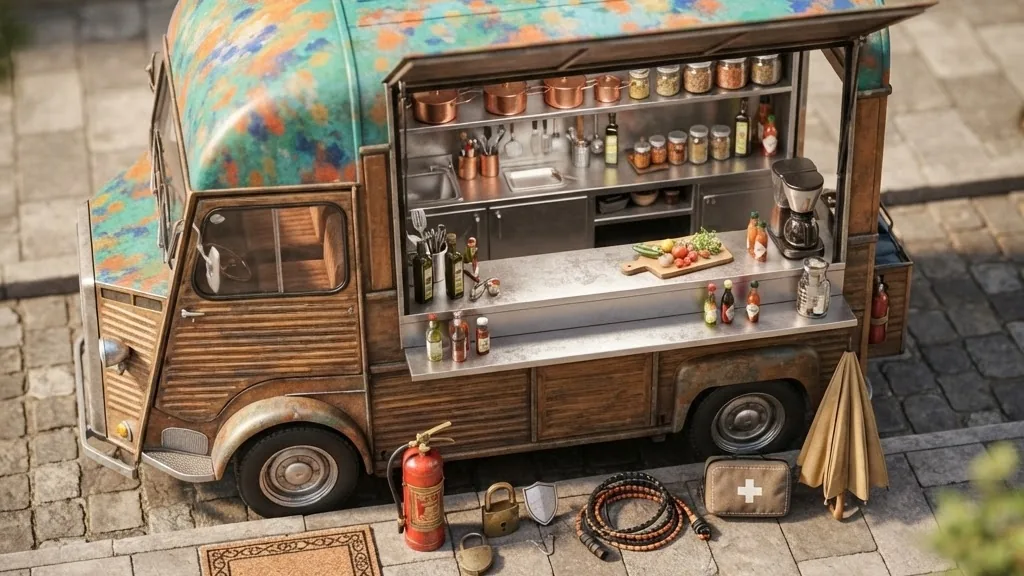
Food truck insurance is not a single policy you buy off a shelf. It is a bundle of separate coverages stitched together because your business does two dangerous things at once: it cooks over an open flame and it drives on public roads. A brick-and-mortar restaurant stays put. Your kitchen moves down the road, then parks next to a crowd, then cooks over propane. That combination is why underwriters treat food trucks as a distinct risk class, and why a plan that looks cheap on a landing page can leave you exposed where it hurts. This guide breaks down every policy, the real median prices from claims data, and the legal obligations that decide whether you can even open the window.
Quick answer: Food truck insurance is a package of policies, not one product. Core pieces are general liability, commercial auto, and property or equipment coverage, often bundled into a Business Owner’s Policy. Median general liability runs about $42 per month per Insureon, a BOP about $84 per month, and commercial auto near $170 per month. A realistic startup package sits around $443 per month per MoneyGeek. Commercial auto and workers’ comp are legally mandated in most cases; general liability is usually demanded by venues and cities through a certificate of insurance.
What food truck insurance actually covers
Food truck insurance describes a set of policies bought together to protect a mobile kitchen against the specific ways it can lose money. Because a truck is both a vehicle and a commercial cooking operation, no single policy covers everything. You assemble the pieces. The National Association of Insurance Commissioners defines each coverage type in neutral terms, and that framework is useful precisely because it comes from a regulator rather than a seller. The core stack usually includes liability for injuries you cause, protection for the vehicle and the gear bolted inside it, and coverage for the food itself when a refrigerator dies overnight.
The most common building blocks operators combine are:
- General liability: covers third-party injury and property damage, including the classic slip-and-fall at your service window.
- Product liability: covers foodborne illness claims and unlabeled allergen incidents tied to what you served.
- Commercial auto: covers the truck itself plus equipment permanently fixed inside it.
- Business Owner’s Policy (BOP): bundles general liability with property coverage at a lower combined price.
- Workers’ compensation: required in most states the moment you hire an employee.
Beyond that core, operators layer on equipment breakdown, spoilage coverage for perishable food when a compressor fails, business interruption when a wreck sidelines you for weeks, and cyber coverage if your point-of-sale system handles card payments. If you plan the interior badly, several of these get more expensive, which is one reason a smart dimensioned guide to food truck kitchen layout pays off before you ever request a quote.
What food truck insurance really costs, by policy and by state
Food truck insurance costs vary far more by policy type and location than most landing pages admit. Pulling the numbers together from independent claims data gives a clearer picture than any single quote engine. Insureon reports a median general liability premium around $42 per month, roughly $500 per year, with a typical $1 million per-occurrence limit and $2 million aggregate. A Business Owner’s Policy carries a higher median near $84 per month, about $1,007 per year, usually with a $1,000 deductible. Commercial auto sits highest among the core three at roughly $170 per month, per Insuranceopedia citing Insureon.
The full range across policy types stretches wide. MoneyGeek’s 2026 figures put individual policies anywhere from $19 to $439 per month, with a realistic startup bundle of commercial auto plus general liability plus property landing near $443 per month. Entry-level pricing exists too: FLIP advertises policies starting at $25.92 per month, or $299 per year, and NEXT Insurance markets coverage for as little as $25 per month. Those headline numbers rarely reflect a real operator who fries food over propane, so treat them as a floor, not a forecast.
Here is where the biggest single variable hides: your state.
| Coverage or scenario | Amount | Source |
|---|---|---|
| General liability median | ~$42/mo (~$500/yr) | Insureon |
| BOP median | ~$84/mo (~$1,007/yr) | Insureon |
| Commercial auto average | ~$170/mo | Insureon |
| Auto low vs high state | $62/mo (PA) to $235/mo (MI) | MoneyGeek |
That spread of about $62 per month in Pennsylvania against roughly $235 per month in Michigan comes straight from MoneyGeek, and the driver is Michigan’s no-fault auto system. Fry-heavy menus, a rough driving record, more employees, a pricier truck, and the number of states you cross all push premiums up. Cold-prep concepts like an ice cream food truck startup with its own permit math generally sit lower on fire risk than a propane griddle operation, and underwriters price that difference.
What is legally required versus what is merely recommended
Food truck insurance mixes hard legal mandates with contractual demands that feel just as binding. Getting this distinction right keeps you from over-buying in one place and dangerously under-buying in another. Two coverages are genuinely mandated by government. Commercial auto is required by your state Department of Motor Vehicles or transportation department because the truck is a vehicle used for business. Workers’ compensation is required by state workers’ compensation boards the moment you hire employees, though the exact trigger threshold varies by state, so confirm your own before your first hire.
General liability is a different animal. No statute forces you to carry it, yet you cannot operate without it in practice, because the people who control where you park demand proof. City permit offices, festival organizers, private venues, and commissary kitchens routinely require a certificate of insurance, or COI, naming them as additional insured before they let you set up.
A working compliance checklist looks like this:
- Commercial auto: mandated by the DMV for a business-use vehicle.
- Workers’ compensation: mandated by the state board once you have employees, with OSHA setting the employee-safety backdrop.
- General liability plus COI: demanded by cities, festivals, and venues before you get a slot.
- Health department permit and commissary: required to prep and store food legally.
- Fire marshal inspection: required to confirm suppression and extinguishers.
Your personal auto policy will not cover a business vehicle, and it will deny a claim the instant it learns the truck was in commercial use. That gap is one of the most expensive mistakes new operators make. The Small Business Administration’s general guidance on business insurance is a reasonable starting point for the framework, but the binding requirements come from your state agencies, not federal ones. Naming and branding decisions intersect here too, since some registrations reference your legal entity, which is worth reading up on when you sort out taco truck names, trademarks, and what works.
The fire and propane risk that quietly sets your premium
Fire is the single largest loss driver behind food truck insurance pricing, and propane is the reason. According to the National Fire Protection Association, roughly 68 percent of food truck fires are linked to propane, either a leak or a structural failure of the tank. That statistic is not abstract. On July 1, 2014, the Parrillada Chapina truck in Philadelphia suffered a propane explosion that hurled a tank about 95 feet, produced a fireball roughly 200 feet across, killed two people, and injured more than ten. That disaster triggered the first NFPA code written specifically for food trucks, and it reshaped how the whole industry thinks about mobile cooking safety.
Underwriters read fire codes closely because compliance affects both your premium and whether they will insure you at all. The relevant standards from the National Fire Protection Association are worth knowing by name:
- NFPA 96: governs ventilation and grease-handling for commercial cooking.
- NFPA 58: governs LP-Gas and propane storage and handling.
- NFPA 1 section 50.7: covers temporary cooking operations.
- NFPA 17A: governs wet chemical fire-suppression systems.
Practically, that means a working suppression system over your cooking line and the right extinguishers on board: a Class K unit for grease fires plus an ABC unit for everything else, per NFPA guidance. Your local fire marshal inspects for exactly these items. Keeping suppression current and documented does two things at once. It lowers your fire-claim odds, and it makes you eligible for better rates, because an out-of-date system can bump you into a higher risk tier or get coverage declined outright. Powering that equipment safely matters too, which is why a proper look at a food truck electric generator sizing and code guide belongs in the same planning conversation as your insurance quotes. The Federal Emergency Management Agency and food-safety regulators like the FDA and USDA address foodborne risk, but on the truck floor, fire is the loss that shows up in claims.
Permits, inspections, and food-safety compliance that shape eligibility
Permits and food-safety compliance sit upstream of food truck insurance, because an operator who cannot pass inspection is an operator no underwriter wants. Several bodies govern this space, and each one costs you time or money in a different way. The Food and Drug Administration writes the model Food Code that most local health departments adopt, setting the temperature, handwashing, and storage rules your inspector checks. The United States Department of Agriculture, through its Food Safety and Inspection Service, oversees meat, poultry, and egg products, which matters directly for a burger or barbecue concept.
The practical cost of compliance shows up before you serve a single plate. Health departments require a permit and, in most jurisdictions, a commissary or base kitchen where you prep and store food and clean the truck. That commissary is a recurring monthly expense, not a one-time fee. The Centers for Disease Control and Prevention tracks foodborne illness outbreaks, and its data on allergens and pathogens is exactly what product liability coverage exists to answer when a customer claims your food made them sick.
Where to send your questions depends on the topic:
- FDA and the Food Code: temperature control, sanitation, labeling rules your health inspector enforces.
- USDA and FSIS: meat, poultry, and egg sourcing and handling standards.
- CDC: outbreak surveillance and allergen guidance behind product liability claims.
- FoodSafety.gov and Nutrition.gov: plain-language consumer and operator references.
- Local health department and fire marshal: the inspectors who actually sign off.
You can read the federal consumer-facing rules directly at the FoodSafety.gov safe minimum internal temperature charts, which is the same temperature logic your spoilage and product liability exposure hangs on. If your menu leans on specific sourcing standards, the sourcing discipline behind a halal truck cooking and safe scaling approach maps neatly onto what inspectors and insurers both want to see: documented, traceable, temperature-controlled food.
Ingredient decisions ripple outward here. Operators building menus around dietary niches lean on resources like this rundown of gluten free foods and what actually belongs on your plate to keep allergen labeling defensible, which is precisely the paperwork that keeps a product liability claim from turning into a settlement. Clean sourcing and honest labeling are cheap insurance in their own right.
How to buy coverage and cut your premium without cutting protection
Buying food truck insurance well comes down to preparing the right documents, bundling smartly, and matching coverage to how many months a year you actually operate. Insurers price on data you supply, so the cleaner your file, the better your quote. Have your vehicle identification number, the truck’s value, your driving record, employee count, menu type, and a list of states you plan to work in ready before you request quotes. Because a new truck costs between $50,000 and $200,000 per Insurance.com, the property side of your coverage is not optional padding; it is protecting your single largest asset.
The most reliable premium reductions do not involve gutting coverage:
- Bundle into a BOP: combining general liability and property usually beats buying them separately.
- Add storage or seasonal coverage: trucks running under 12 months a year can drop to a reduced off-season rate.
- Keep fire suppression current: a compliant, documented system lowers your fire-risk tier.
- Protect your driving record: commercial auto is your priciest line, and clean records earn the deepest discounts.
- Raise deductibles carefully: a higher deductible cuts the premium if you keep cash reserved to cover it.
Menu choices matter more than operators expect. A fry-heavy, propane-driven concept prices higher than a cold-prep one, so if you are weighing a burger truck with real cost and margin math against something griddle-light, factor the insurance delta into your numbers. Business planning discipline helps too; running quotes against a solid set of templates that actually run a food truck keeps your revenue assumptions honest when a business-interruption rider asks what a shutdown really costs you.
Comfort-food concepts prove the point about menu risk. A dish like this cheesy baked mostaccioli comfort food recipe or a slow-simmered ham and lentil soup slow cooker method with safety notes leans on oven and holding heat rather than open-flame frying, and that lower fire profile is exactly the kind of operational detail that nudges a quote downward.
The real numbers behind common food truck losses
Loss data, not marketing copy, explains why food truck insurance is priced the way it is. FLIP’s claims figures give the clearest window into what actually goes wrong, though the underlying dollar breakdowns aren’t published in detail. That is why general liability is the coverage venues insist on: your customers gather on wet, greasy pavement, and someone eventually goes down.
Theft is the other quiet drain. FLIP’s 2023 claims report, cited via Insuranceopedia, found roughly 13 percent of food truck claims tied to theft, whether of the truck, the equipment, or cash. Combined with the propane fire data, the picture is consistent: your biggest exposures are people getting hurt, things getting stolen, and the kitchen catching fire.
Sound loss control looks like this in practice:
- Slip-and-fall: mats, drainage, and a clean service zone directly reduce your most common claim.
- Theft: locks, alarms, and secure overnight storage lower both your risk and your quote.
- Fire: current suppression and Class K plus ABC extinguishers per NFPA cut the costliest loss.
Pizza and other high-heat concepts carry their own risk math, so pairing this loss data with a build-focused read like a pizza truck build, cook, and profit guide helps you see where a claim could originate before it happens.
Where the recipe network overlaps with truck economics
Menu design and premium size are linked more tightly than most operators realize, because ingredient choices decide your fire, allergen, and spoilage exposure. A high-protein, batch-cooked lineup can be built for the road, and drawing from a library of high protein recipes lets you plan holding temperatures and portioning that keep spoilage claims rare. Frozen prep components can shorten line time and reduce open-flame minutes; techniques from a guide to air fryer frozen foods recipes translate into a lower-flame service model that underwriters reward.
Even your dry storage matters. A disciplined approach to pantry basics reduces waste and spoilage exposure, which is the loss your perishable-food coverage would otherwise absorb. Small operational habits become measurable savings when they show up on your claims history.
Frequently asked questions
How much does food truck insurance really cost?
It depends heavily on policy and state. Insureon puts general liability near $42 per month and a BOP near $84 per month, while commercial auto averages about $170 per month. MoneyGeek’s 2026 data shows a realistic startup bundle around $443 per month, with individual policies ranging from $19 to $439 per month depending on your menu, record, and coverage.
Is food truck insurance legally required?
Parts of it are. Commercial auto is mandated by your state DMV because the truck is a business vehicle, and workers’ compensation is required by state boards once you hire employees. General liability is rarely required by statute, but cities, festivals, and venues demand a certificate of insurance before they let you operate, so it is effectively mandatory too.
Will my personal auto policy cover a food truck?
No. A personal auto policy excludes commercial use, and once the insurer learns the vehicle was operating as a business, it will deny the claim. You need commercial auto coverage, which also protects equipment permanently fixed inside the truck. Relying on personal coverage is one of the costliest gaps new operators leave open.
Why is commercial auto so much more expensive in some states?
State law drives the gap. MoneyGeek reports food truck commercial auto running about $62 per month in Pennsylvania versus roughly $235 per month in Michigan, and the difference traces to Michigan’s no-fault auto system. Your driving record, the truck’s value, and how many states you cross also move the premium up or down.
How can I lower my premium without losing protection?
Bundle general liability and property into a BOP, add seasonal or storage coverage if you run under 12 months a year, and keep your fire suppression current and documented. A clean driving record cuts your commercial auto line, your priciest coverage. Higher deductibles help only if you keep cash reserved to actually pay them.
Insurance rules, workers’ compensation thresholds, and premium figures change by state and over time. Confirm current requirements with your state agencies and named sources before you buy, and treat the numbers here as sourced reference points rather than quotes.