Food truck electric generator decisions get made backward. Most owners treat the purchase as a shopping problem, pick a wattage off a retailer blog, then discover during a Saturday lunch rush that the unit nuisance-trips every time the fridge compressor kicks in. The harder truth is that this is a permit decision, a fire-code decision, and a running-cost decision long before it is a horsepower decision. Get the sequence right and the machine outlives the truck. Get it wrong and a fire marshal can shut you down with a clipboard.
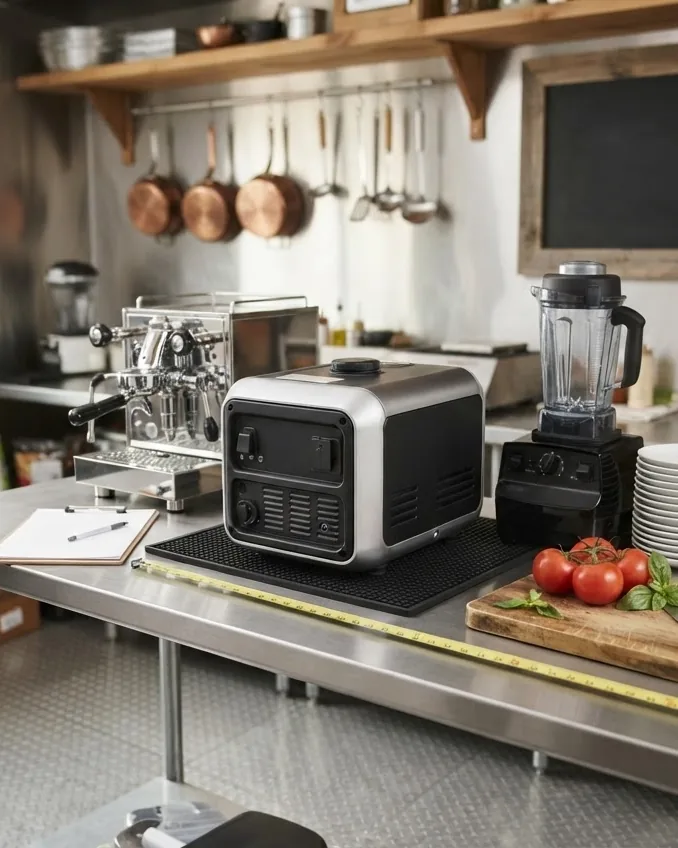
The phrase itself is ambiguous, and that ambiguity matters. “Electric generator” can mean a fuel-burning unit that produces electricity for the truck, or an electric battery power station sold as a generator replacement. Both readings are legitimate, both are covered here, and the choice between them now carries a legal deadline in at least one state.
Quick answer: A food truck electric generator should be sized to the sum of every appliance’s running watts plus the single largest starting surge, then given headroom so it never runs continuously at full rated output. Fryer-free and coffee builds often live under 4,000 W; a full electric-cooking line with air conditioning can need 8,000 W or more. Beyond watts, the unit must satisfy your fire marshal on separation distance, extinguishers, refueling and carbon monoxide placement. Fuel type drives cost per service day, and California law changes what you may buy new by model year 2028.
Reading the two meanings of “electric generator”
The single most common mistake starts at the search bar. An electric generator for a food truck can be one of two very different machines, and the answer to “which one do I need” depends entirely on which you mean. The first is a fuel-fired genset running on gasoline, propane, or diesel that produces alternating current for your appliances. The second is a battery power station, usually built on lithium iron phosphate cells, marketed as a silent, fumeless stand-in for the fuel unit. Retail buying guides tend to pick one meaning and quietly drop the other half of the question, which leaves half of every audience unserved.
Why does the distinction change your whole build? A fuel genset delivers effectively unlimited runtime as long as you keep feeding it, which suits long high-load days with electric griddles and fryers. A battery bank delivers silence and zero on-site emissions, which suits coffee carts, dessert trailers, and urban pitches with shore power nearby. The wrong pick is not a preference error. It is a capacity error you feel at hour seven of a festival.
- Fuel genset: unlimited runtime, refueling and noise, exhaust and code obligations.
- Battery station: silent and clean, but capped by stored kilowatt-hours per charge.
- Shore power: the cheapest option of all when the venue provides a 30A or 50A drop.
Sizing: running watts, starting watts, and the headroom rule
Sizing a food truck electric generator correctly means separating two numbers that appliance tags rarely explain. Running watts are what a device draws once it is up and stable. Starting watts, also called surge or peak, are the brief spike a motor or compressor pulls at the instant it fires, driven by locked-rotor amperage. A commercial reach-in compressor or a half-horsepower exhaust fan can demand two to three times its running draw at startup. Sum only the running figures, as the popular retailer method does, and you will buy a unit that trips under real conditions. The correct target is the total of all running watts plus the single largest starting surge, with headroom left over.
Where do you find the numbers? On the data plate. When a plate lists volts and amps but not watts, multiply them: watts equal volts times amps. A device tagged at 120 volts and 12 amps draws roughly 1,440 running watts.
Never plan to run continuously at 100 percent of rated output. That is how you cook a generator and brown out a compressor at the same time. Stagger your startups instead: bring the fridge up, let it settle, then the freezer, then the cooking line. Soft starters on the biggest motors flatten the surge and let a smaller unit carry a bigger truck.
A note on 120V versus 240V
If any single piece of equipment is 240-volt, you need a 120/240V split-phase unit, and you need to balance amperage across the two legs so one side does not overload while the other loafs. A 120V-only genset simply cannot power a 240V appliance, no matter how many watts it claims.
Generator types, fuel, and why harmonic distortion matters
Three archetypes dominate the food truck electric generator market, and they are not interchangeable. Conventional open-frame portables are cheap and loud and produce dirtier power. Inverter units cost more, run quieter, and deliver clean electricity with low total harmonic distortion, which protects sensitive loads like point-of-sale terminals, variable-frequency drives, inverter-compressor refrigeration, and induction cooktops. Vehicle-mounted commercial gensets, such as the Cummins Onan line, integrate into the chassis and are built for daily commercial duty. Fuel choice layers on top: gasoline, propane, diesel, and dual- or tri-fuel machines each carry different burn rates, storage needs, and code implications.
Propane deserves special attention because of shared-fuel architecture. A liquefied-petroleum genset can draw from the same tank feeding your cooking line, which simplifies logistics. The catch is vaporization rate: a tank can only turn so much liquid to gas per hour, and a heavy combined draw can outrun it, so regulator and tank sizing become real engineering, not an afterthought.
For build-side decisions that intersect with menu and equipment planning, the sizing logic carries over to any high-heat concept, from a full burger truck cost and margin breakdown to a stone-deck pizza truck build and profit plan where oven load dominates the wattage sheet.
Will your generator pass a fire marshal inspection?
This is the layer nobody selling generators wants to discuss, and it is where operators lose the most money. Passing a fire marshal inspection is not about buying a legal-to-sell unit. It is about placement, clearances, extinguishers, refueling procedure and wiring, all governed by codes your local authority having jurisdiction adopts. The National Fire Protection Association publishes the backbone: NFPA 1, the Fire Code, whose Chapter 50 on mobile and temporary cooking operations was new in the 2018 edition and built on NFPA 96 and the Liquefied Petroleum Gas Code, NFPA 58. The International Code Council contributes the International Fire Code, Section 319 on mobile food preparation vehicles, which many cities adopt nearly word for word.
Here is what those clauses require in practice, and every one of them shows up on real inspection checklists:
- Separation. NFPA 1 (2018 edition), section 50.7.1.5, requires mobile or temporary cooking operations to be separated from buildings, combustible materials, vehicles, and other cooking operations by a minimum of 10 ft (3 m).
- Generator guarding. Later-edition numbering (section 50.8) as cited on AHJ checklists calls for the generator to sit 12 ft from combustibles and from the truck, with a physical barrier, fence, or approved enclosure protecting the public, and exhaust directed away.
- Extinguishers. Where a generator or fuel-fired appliance is present, a minimum 2A:10BC extinguisher is required in addition to the Class K unit that covers the grease cooking line.
- Refueling. No refueling until the unit is shut off and both engine and tank surfaces are below autoignition temperature, per fire-code technical bulletins.
- Wiring. All wiring must comply with the National Electrical Code, NFPA 70; some adoptions require exposed conduit for units placed in service after a stated date.
The stakes are not abstract. The National Fire Protection Association estimates cooking equipment causes 61 percent of fires in eating and drinking establishments. Your final authority is always the local AHJ, meaning the fire marshal, backed by the state fire marshal. Section numbers shifted between editions, so confirm which edition your jurisdiction adopted before you quote a clause to an inspector. On the health-department side of the permit, the FDA Food Code governs equipment power and temperature control, and NSF International certifies the sanitation rating of the appliances your generator has to feed.
You can read the federal engine and safety framing directly from the source at the US EPA nonroad spark-ignition engine standards, which sit underneath everything a manufacturer prints on a compliance label.
Carbon monoxide: the hazard that actually kills operators
Carbon monoxide is the deadliest failure mode of any fuel-burning food truck electric generator, and the numbers are stark. The US Consumer Product Safety Commission estimates about 85 people die per year in the United States from carbon monoxide poisoning caused by gasoline-powered portable generators, an annual average drawn from its 2017 to 2019 data, with later public pages citing figures around 100. Over 1,300 people died from portable-generator carbon monoxide poisoning between 2004 and 2021, with roughly 77,000 more injured across that period. A single portable generator produces as much carbon monoxide as hundreds of cars.
Placement is the primary defense. The Consumer Product Safety Commission advises operating portable generators outdoors only, at least 20 ft from the structure, away from windows, doors and vents. The agency found many user manuals specify as little as 5 ft, far below its own 20 ft recommendation, so do not trust the manual over the safety agency.
Two standards address the machine itself. UL 2201, from UL Solutions, sets a carbon monoxide emission-rate and shutoff standard, while the Portable Generator Manufacturers’ Association publishes the competing voluntary ANSI/PGMA G300. Commission staff concluded UL 2201’s mitigation is more effective, and estimated that units meeting G300 would avert nearly 87 percent of those deaths. Both standards adopted carbon monoxide requirements in 2018. Whatever unit you run, put a carbon monoxide alarm inside the truck.
What actually changes in 2028: emissions law without the fear
California’s emissions timeline is widely misreported, and the misreporting drives bad buying decisions. The California Air Resources Board regulates Small Off-Road Engines, defined as spark-ignition engines rated at or below 19 kW (25 hp). Assembly Bill 1346, authored by Assemblymember Berman, was signed by Governor Newsom on October 9, 2021, and the board approved the implementing amendments in December 2021. The rollout runs in two phases: model year 2024 tightens generator and large-pressure-washer standards by 40 to 90 percent, and model year 2028 sets a zero-emission standard for generators.
Now the part that corrects the fear. The regulation applies to the manufacture and sale of new equipment in California only. Existing compliant gasoline units may be operated indefinitely, used resale is permitted, and there is no requirement to dispose of, replace, or retrofit anything. The rule does not touch stationary generators.
The scale explains the policy. Bill findings note that in 2020, California’s Small Off-Road Engines emitted an average of 16.8 tons per day of nitrogen oxides and 125 tons per day of reactive organic gases, higher than the state’s light-duty passenger cars. There is money on the other side too: the CARB Clean Off-Road Equipment voucher project put $30 million toward sole proprietors and small businesses buying new zero-emission equipment. The US Environmental Protection Agency handles federal certification, which is why you see both “EPA” and “CARB compliant” labeling on the same tag.
Noise: why dB(A) ratings lie without a distance
Noise is the underserved commercial angle, and a decibel figure without a distance is marketing, not data. A rating quoted at 23 ft is not comparable to one quoted at 10 ft or 50 ft, so always normalize before you compare. Decibels are logarithmic: an increase of about 10 dB is perceived as a doubling of loudness. That matters because festival contracts and farmers-market rules routinely include “quiet generator required” clauses, and the National Park Service 60 dB(A) at 50 ft limit has become a de facto industry reference spec that manufacturers design against.
The temptation to build a plywood enclosure to muffle a loud unit is a dangerous one. Homemade boxes trap heat, cause fires, and can backfeed carbon monoxide into the truck. Proper vibration isolation, engineered exhaust routing, and factory-rated enclosures exist for a reason. If your pitch has a noise cap, buy quiet at the source rather than trying to silence a loud unit after the fact.
Operating cost across gasoline, propane and battery
The most useful comparison is cost per service day, and the manufacturer burn rates make it computable. A Cummins Onan RV QG 5500 running on propane consumes 0.4 gal/h at no load, 0.8 gal/h at half load, and 1.1 gal/h at full load. The larger Onan QG 6500 on propane burns 0.52 gal/h at no load, 0.90 gal/h at half load, and 1.5 gal/h at full load. The gasoline Onan QG 5500 uses 0.6 gal/h at half load and can idle without alternating-current output to save fuel. The Honda EU7000iS delivers 6.4 h at rated load and 16.0 h at quarter load on its 5.1 gal tank. Plug your local fuel price into those rates and a ten-hour day resolves into hard dollars.
Run the arithmetic yourself before you trust a vendor. At half load across a 10-hour day, the propane Onan QG 5500 burns 0.8 gal/h multiplied by 10 hours, which is 8 gallons of propane per service day. That is the number that tells you whether propane or gasoline wins at your pump price, not a blog assertion.
Beyond fuel, budget for maintenance intervals: oil, air filter, spark plug and valve lash, tracked against the hour meter. For occasional events, renting beats owning. For any concept where equipment planning gets complex fast, the same discipline that governs generator math shows up in the operational documents behind a working rig, which is why a solid set of food truck planning templates that hold up pays for itself.
Model comparison: three units operators actually buy
Specifications settle arguments that blog prose cannot. The three units below span the practical range of a food truck electric generator, from a premium gasoline inverter to two commercial propane gensets built for daily mobile duty. Note how the propane Onan meets the National Park Service 60 dB(A) at 50 ft limit and carries a USDA Forest Service-approved spark-arresting muffler, both of which matter for festival and forest-adjacent pitches. Read across the fuel and runtime columns rather than fixating on peak watts, because peak watts you can never use continuously tell you very little about a ten-hour day.
| Model | Rated / fuel | Runtime or burn | Noise |
|---|---|---|---|
| Honda EU7000iS | 5,500 W rated, gasoline | 6.4 h at rated, 16.0 h at 1/4 | 58 dB(A) at rated |
| Onan QG 5500 LP | 5,500 W, propane | 0.8 gal/h half load | 66 dB(A) at 10 ft |
| Onan QG 6500 LP | propane | 0.90 gal/h half load | meets 60 dB(A) at 50 ft |
The Honda EU7000iS runs 120/240V, weighs 263.2 lb dry, and pairs to a second unit for up to 14,000 W. The Onan QG 5500 LP weighs 288 to 290 lb, is CARB and EPA compliant for sale in all 50 states, and the QG 5500 and 6500 are tested to start and operate from -20 F (-29 C) to 120 F (49 C). Retailers publish size buckets of small up to 4,000 W, medium up to 6,000 W, and large up to 8,000 W, while some vendors push 12 kW or more for the same query. That contradiction is exactly why you size from your own load sheet, not from a bucket.
The battery decision: who should switch and who should wait
Battery power stations tempt every operator who has stood next to a screaming genset, but the kilowatt-hour math is unforgiving for high-load builds. A lithium iron phosphate bank is capped by what it stores per charge, and electric fryers and griddles drain that budget fast. The honest split: coffee and dessert carts, fryer-free trucks, and urban pitches near shore power are strong candidates today. A truck running an electric fryer plus a griddle plus air conditioning across a ten-hour festival day is not, at least not on battery alone.
Shore power is the quietly cheapest option of all. When a venue offers a 30A or 50A cordset drop, a properly wired changeover lets you skip fuel entirely for that gig. Plan for it and carry the cordsets.
Menu-driven power planning shows up across concepts, from a halal truck sourcing and safe scaling guide to the branding and permit work behind good taco truck naming and trademark strategy, where the electrical load sheet quietly shapes what the menu can support.
For adjacent kitchen technique that informs equipment load, home-scale references are surprisingly transferable: a walk through stocking pantry basics clarifies what a prep station really needs, guidance on cooking frozen foods in an air fryer maps neatly onto low-wattage electric cooking, and the physics in this look at the science behind coffee extraction explains why espresso rigs spike a power draw the way they do. Cross-concept dishes tell the same story, whether that is a tray of cheesy baked mostaccioli that leans on a holding cabinet or a batch of crispy air fryer fried rice that runs entirely off a modest electric load.
Installation, integration and a redundancy plan
Where the generator physically sits changes both safety and stability. Common mounts include a front rack, an underbody bay, a tongue tray on a trailer, or a slide-out platform, each with weight and axle consequences for your gross vehicle weight rating and weight distribution. Whatever the mount, the unit needs vibration isolation, a bay with real cooling airflow inlet and outlet, weather protection, and theft deterrence through cages or cable locks. The electrical side demands a transfer switch or interlock so you never backfeed shore power into a running genset, correct chassis bonding, and attention to floating versus bonded neutral, which is the usual culprit when a portable trips a ground-fault circuit interrupter.
Then plan for failure, because a revenue-critical asset will eventually die mid-service. Decide in advance what you do when the unit quits at 12:30 on a Saturday: a rental relationship, a small backup for the refrigeration line, or a shore-power fallback. The redundancy plan is cheaper than the lost day.
Branding and exterior work intersect with the generator bay more than people expect, since a food truck wrap that pays for itself has to leave ventilation and access clear, and event bookings like a caterer’s guide to wedding truck bookings often come with venue noise and power constraints written into the contract.
Frequently asked questions
How many watts does a food truck use?
It depends entirely on your appliances. Retailers publish rough buckets of small up to 4,000 W, medium up to 6,000 W, and large up to 8,000 W. A coffee or dessert cart can sit at the low end, while a full electric-cooking line with air conditioning pushes past 8,000 W. Build a load sheet listing every device’s running and starting watts, then size above the total.
What size generator do I need for a food truck?
Size to the sum of all running watts plus the single largest starting surge, then add headroom so the unit never runs at 100 percent continuously. Retail buckets top out at 8,000 W, yet some vendors recommend 12 kW or more. That gap exists because only your own appliance load sheet, including compressor and motor surge, gives an honest answer.
Does California ban gas generators in 2028?
No. Assembly Bill 1346 sets a zero-emission standard for the manufacture and sale of new Small Off-Road Engine generators in California from model year 2028. It does not ban use of existing units, does not prohibit used resale, and does not touch stationary generators. You may keep running compliant gasoline equipment you already own indefinitely.
How far from the truck must a generator sit?
NFPA 1 (2018 edition) requires 10 ft (3 m) of separation for mobile cooking operations, and AHJ checklists citing later-edition numbering call for the generator to sit 12 ft from combustibles and the truck, behind a public barrier. The Consumer Product Safety Commission separately advises at least 20 ft for carbon monoxide safety. Confirm your local fire marshal’s adopted edition.
Is a battery generator good enough for a food truck?
For coffee carts, dessert trailers, fryer-free trucks, and urban pitches near shore power, a lithium iron phosphate bank can work well today. For a truck running an electric fryer, griddle, and air conditioning across a long festival day, the stored kilowatt-hours drain too fast. Match the battery to the actual load before you switch, not to the marketing.
One closing reminder: section numbers in the fire code shifted between editions, fuel prices move weekly, and your final authority is always the local fire marshal, backed by the state fire marshal. Size from your own load sheet, confirm the adopted code edition in your city, and treat carbon monoxide placement as non-negotiable. Do that, and the generator becomes the least dramatic part of the build, which is exactly what you want it to be.