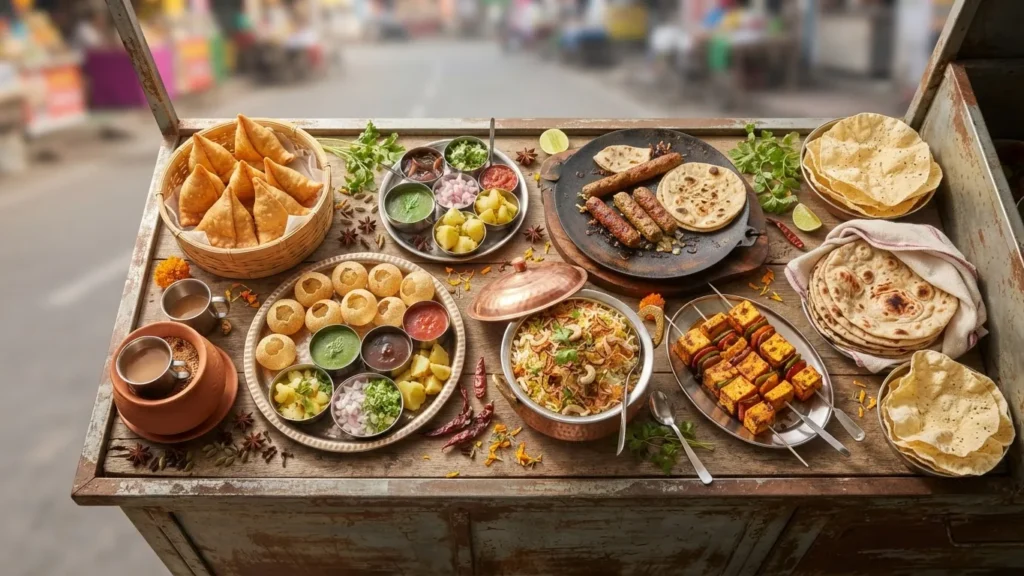
Two authentic vada pav recipes, measured the same way, land nowhere near each other on sodium. That gap tells you something an Indian street food food truck operator has to internalize before the first service: “street food” is not one dish with one profile. It is a category of components, each with its own fry window, its own hold life, and its own failure point. Get those right and the menu runs fast at the window. Guess at them and you plate soggy vada or a bhaji that broke apart in the pan.
This guide works the concept the way a line cook works a prep list: what each dish is built from, which step is make-or-break and why, how long each item holds, and then the US licensing layer that quietly decides whether you can legally serve any of it where you want to park.
Quick answer: An Indian street food food truck works best on a short, component-based lineup – vada pav, pav bhaji, a wrap, a chaat – built around items you can plate in under five minutes. Keep the menu to 8 – 12 items. Hold lives split the menu for you: fried vada freezes up to 2 months, cooked bhaji keeps 2 to 3 days refrigerated, and assembled chaats are eat-immediately. Chutneys prep 2 to 3 days ahead, then you fry and assemble to order. US permits are jurisdiction-specific; your city and county set the binding rules, not any national standard.
Vada Pav: Why the Fried Center Breaks and How to Hold the Crisp
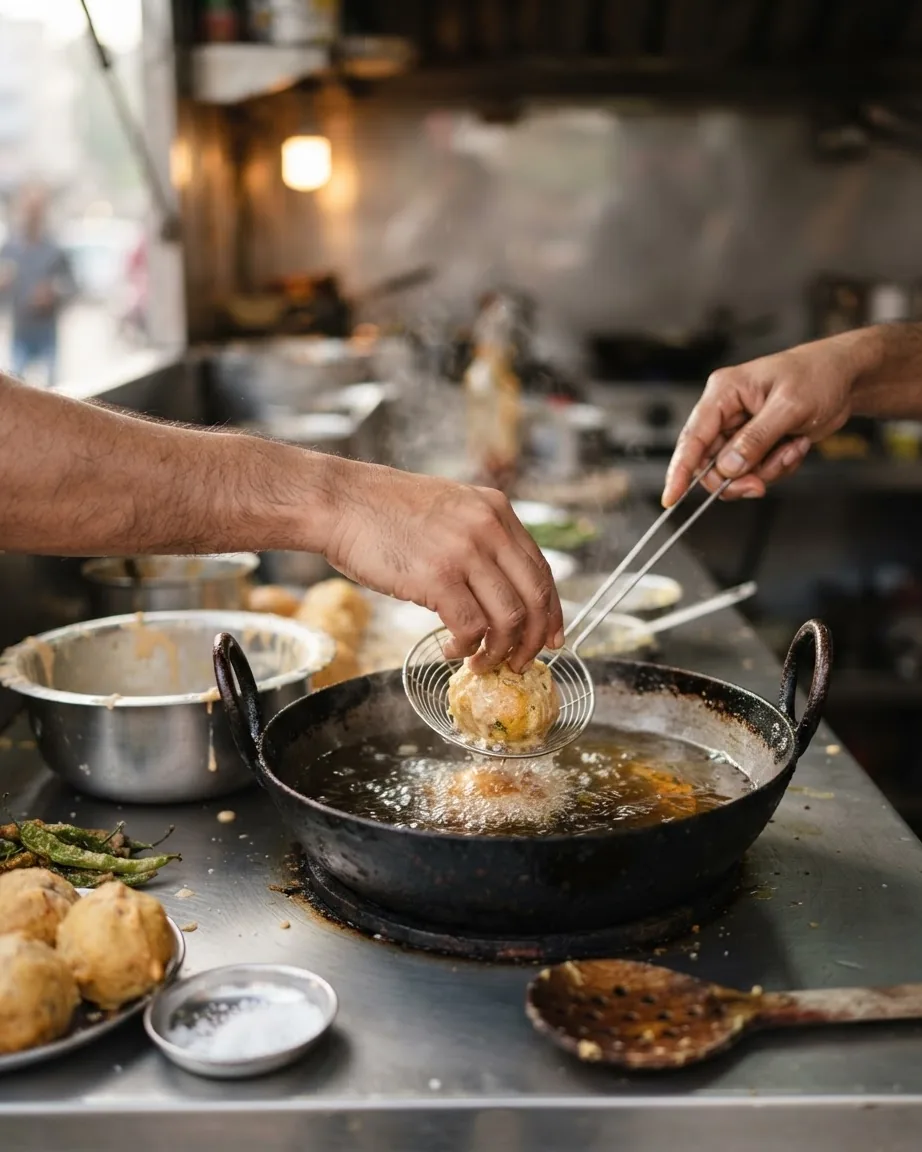
Vada pav is a spiced mashed-potato ball dipped in a besan (gram flour) batter, deep-fried, and tucked into a soft bun with chutneys. It is the workhorse of this concept because almost every component prepares ahead and the only live step at the window is the fry and the assembly.
Two levers decide whether a vada comes out whole and crisp. First, the fry itself: Swasthi’s Recipes instructs that once the vada hits the oil you “do not disturb them for 2 minutes, until they firm up,” and that single clause is the make-or-break – move the ball before the batter sets and it sloughs off into the oil, taking the shape with it. Second, crispness. Ministry of Curry adds a tablespoon of rice flour to the gram flour batter specifically for extra-crispy vadas, and frying on medium heat for 3 to 4 minutes until lightly golden. The other quiet failure cause is chili seeds bursting in the oil, which is why deseeding before the mix matters.
Yields are a condition, not a single number, because these are separate recipes. Swasthi’s method divides the potato mixture into 7 to 8 portions; Ministry of Curry shapes 10 to 12 vadas about 2 inches wide. Use whichever recipe’s full method you follow – don’t blend the two counts into a target that neither recipe actually supports.
For a truck, the storage math is the gift. Chutneys and components can be made 2 to 3 days ahead and refrigerated, per Swasthi’s Recipes. Fried vada, per Ministry of Curry, keeps refrigerated for 2 to 5 days or frozen up to 2 months. That lets you batch-fry on a slow day, freeze, and reheat into a rush instead of frying every order from scratch.
The nutrition picture is where you have to be honest with a customer who asks. There is no single “a vada pav” figure. Ministry of Curry’s recipe lists a serving at 493 kcal and 2276 mg sodium. These are different recipes with different serving bases; they cannot be averaged into one honest number. If you post nutrition on your truck, post it per your own recipe, not a blended guess.
One small sourcing note that pays off on cost: Ministry of Curry recommends dinner rolls with no more than 2 grams of sugar for the pav, which keeps the bun from browning too fast on a flat-top and tasting like a dessert roll.
Pav Bhaji: The 15-Minute Simmer and the Buy-vs-Make Masala Call
Pav bhaji is a thick mashed-vegetable curry, heavy on potato and tomato, griddled with butter and served with toasted pav. On a truck it earns its slot because the bhaji is a hold item – it tastes fine held and reheated, which almost nothing else on an Indian street food food truck menu does.
The simmer is the step that develops it. Cook With Manali directs letting the bhaji simmer on low heat for 15 minutes at the stage after mashing, which melds the spices into the vegetables instead of sitting on top of them. Rush it and the masala tastes raw.
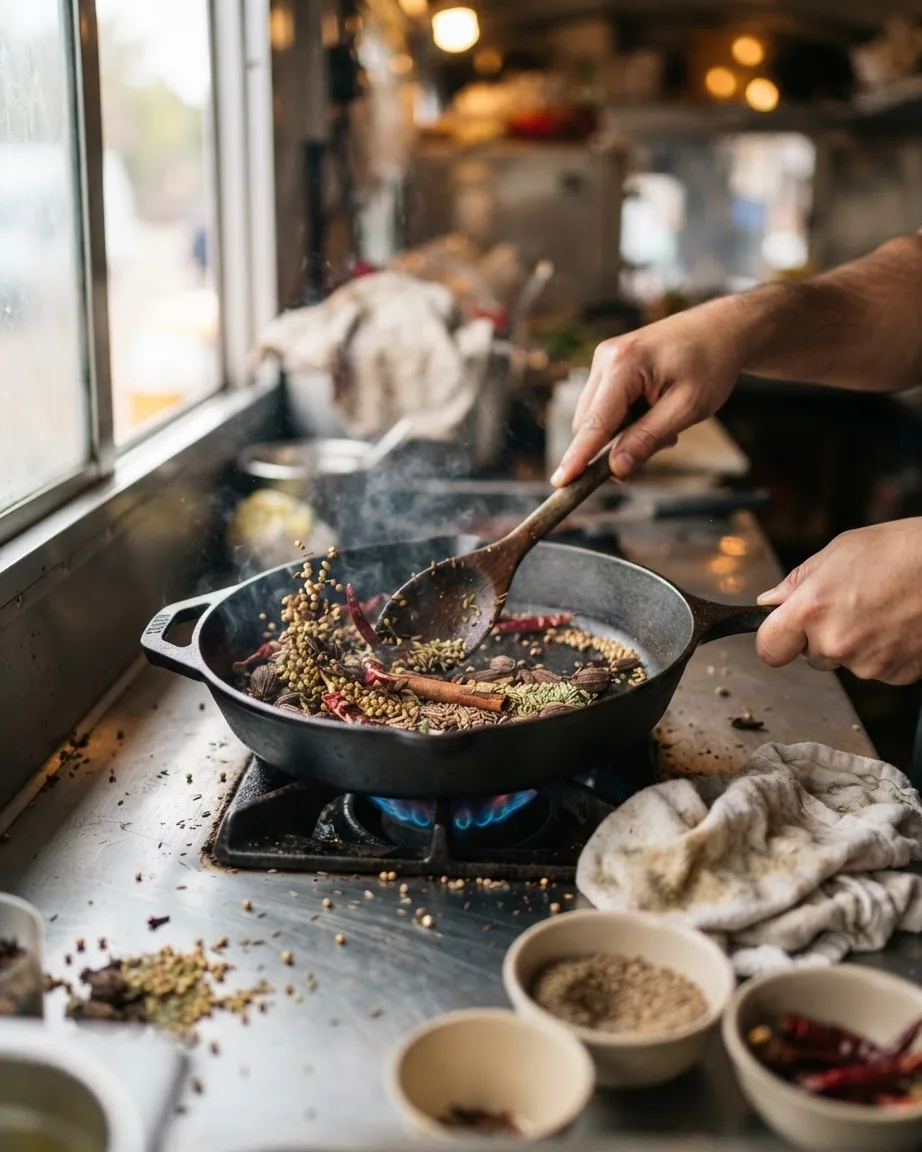
The masala itself is your first real buy-vs-make decision. You can run a jarred pav bhaji masala, or blend your own – Cook With Manali’s homemade blend starts by dry-roasting coriander seeds, cumin, dried red chilies, cloves, fennel, black cardamom, and cinnamon on medium heat until fragrant, around 3 to 4 minutes, and the full recipe yields about 100 grams of masala. For a truck, the honest trade is this: homemade gives you a signature you control, but 100 grams is a small batch, so you’ll be blending often. Jarred frees up prep time and keeps the flavor identical shift to shift. Pick based on whether your brand leans on the spice blend or on speed.
Hold life: leftover pav bhaji keeps in the refrigerator for 2 to 3 days, per Cook With Manali, though the same source notes it tastes best freshly made. One serving of that recipe is listed at 424 kcal with 1274 mg sodium – again, a per-recipe figure, not a universal one.
Chaat, Kathi Rolls, and Dosa: What Each Dish Costs You in Equipment and Speed
“Chaat” is not a dish – it is a category. The word means “to lick,” and it covers a family of savory snacks, which is why “a chaat” never has one build. That matters for menu writing: list the specific item, not the category.
The same clarity problem shows up with the puri-based snack. Pani puri, phuchka, and golgappa are regional names for the same item, so pick one name and stick with it on your board rather than confusing a customer who knows it by a different word. For origins and regional-name context, Globetrove and Travelling Foodie both document the street-food lineup.
Each of these dishes asks something different of your service line, and that is the real selection criterion:
- Chaats (assembled): No cooking at the window – you combine prepped components to order. Fast, but eat-immediately: they go soggy the moment they’re assembled, so they cannot be pre-plated or held.
- Kathi roll: A griddled wrap, originated in Kolkata in the 1930s per Globetrove. Needs flat-top space and a filling that is already cooked and holding, so the only live step is griddle-and-roll.
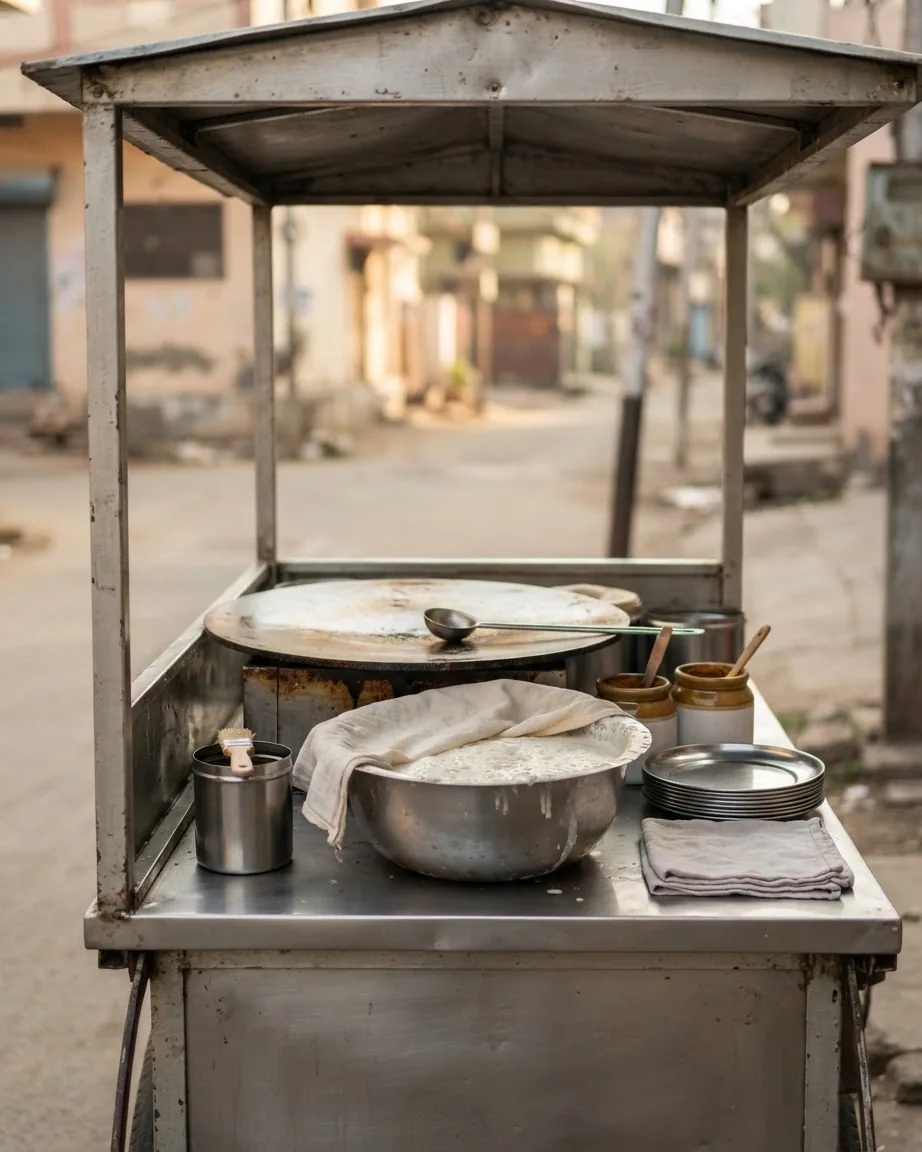
- Dosa: The hidden cost here is time, not equipment. The batter is fermented for 24 hours, per Travelling Foodie. That is a full day of planned lead time before a single dosa hits the griddle – it changes your prep calendar, not your service speed.
Pav bhaji itself carries a story worth knowing for your menu copy: Travelling Foodie credits its origin to the mill workers of Mumbai, tied to the cotton demand around the 1850s American Civil War era. Travelling Foodie and Globetrove both describe these dishes but do not publish full step-by-step methods for pani puri, kathi roll, samosa, or dosa – for a documented dosa or chaat method, you’ll want a dedicated recipe source rather than a travel guide.
Building the 8-12 Item Menu by Hold Time, Not by Taste
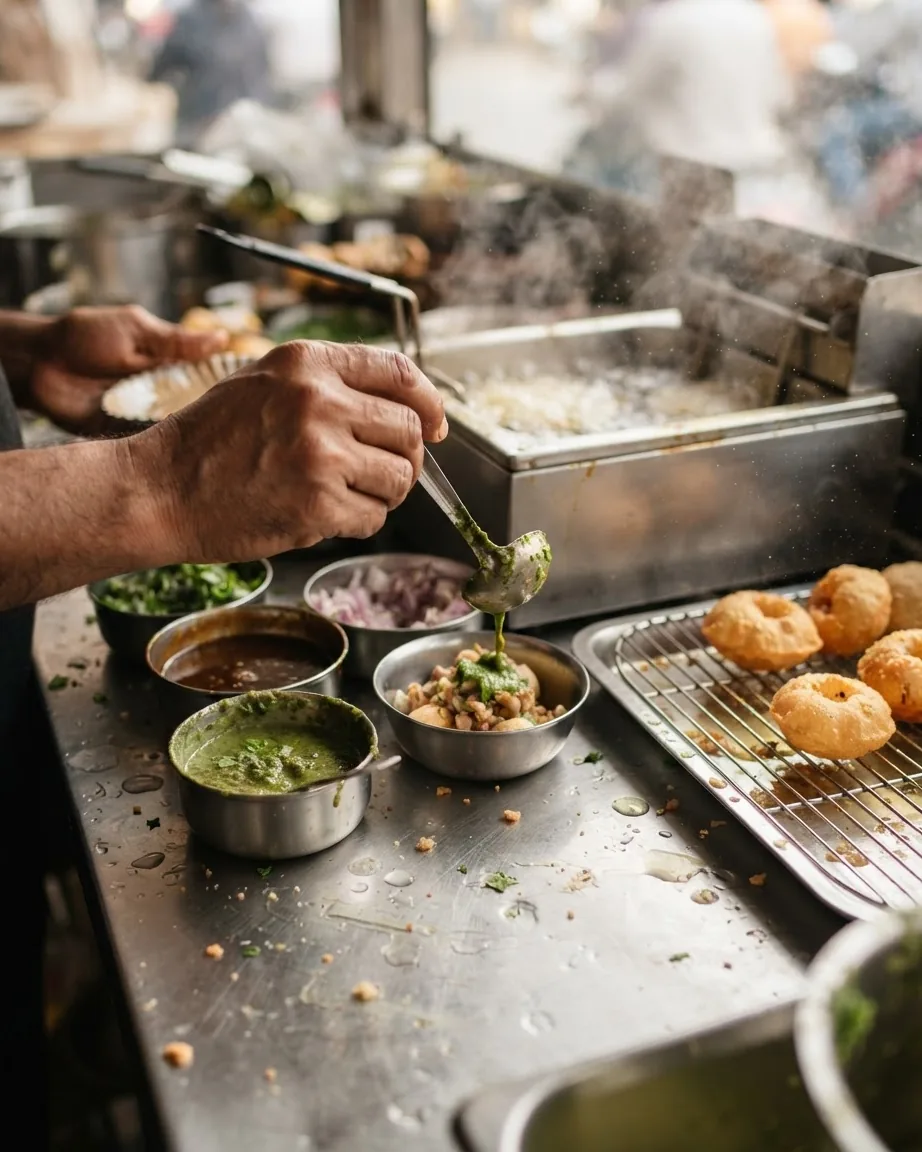
The smart way to size this menu is to sort candidate dishes by how they behave after cooking, then fill the board so your line isn’t trying to fry, simmer, and assemble all at once during a rush. The business guidance from DineOpen is to keep a street-food truck menu to 8 – 12 items maximum and choose items preparable in under 5 minutes, aiming for a 60 – 70% gross margin.
Mapped against the hold lives above, your menu sorts into three service lanes:
- Freeze-and-reheat anchor: fried vada, which holds frozen up to 2 months. Batch it ahead so the fryer isn’t your bottleneck.
- Hold-and-reheat body: pav bhaji, good 2 to 3 days refrigerated. This is your “already ready” item that absorbs a sudden line.
- Made-to-order finishers: chaats and rolls, assembled live because they can’t wait.
A balanced board leans on one anchor and one hold item so that two of your lanes are effectively pre-made. If every item on your menu is a made-to-order finisher, you will stall at the window the first time ten people show up together. The make-ahead split – chutneys and components 2 to 3 days ahead, fry and assemble to order – is what keeps the under-five-minute promise honest.
A note for readers weighing this concept against the broader category: the economics of a single-cuisine Indian truck differ from a general one, and our Indian food truck breakdown runs that profit math. For how a short board costs out item by item, see our Food Truck Ideas piece. This article sits in our wider cuisine section.
US Mobile Food Permits: Why the Same Truck Needs Different Licenses by State
Here is the part that catches first-time operators: there is no single national license for an Indian street food food truck. The U.S. Food and Drug Administration publishes the Food Code, and it matters – the 2026 Food Code, issued September 17, 2026, introduces a new mobile food establishment definition. But per the FDA, it is “a model code that is not required,” even though it has been widely adopted by agencies that regulate more than one million restaurants. The binding rules come from your own city and county.
The categories themselves don’t even map onto each other across jurisdictions, which is why you can’t copy one state’s setup into another. LA County calls it a “Mobile Food Facility.” Texas uses “Mobile Food Vendor.” Minnesota says “mobile food unit.” The FDA’s 2026 term is “mobile food establishment.” Same truck, four names, four rulebooks.
Fee structure differs just as much, and these numbers are not like-for-like – compare them as examples of different models, never as cheapest-to-priciest:
- New York City: The Mobile Food Vending License full-term (two-year) fee is $50.00, with a separate $53.00 fee for the required Mobile Food Vendor Food Protection Course, per NYC Business. Note there is no license fee for honorably discharged U.S. Veterans or their surviving spouse or domestic partner. This is a photo-ID vendor license on the person.
- Texas: Beginning July 1, 2026, all mobile food vendors must be licensed with the Texas Department of State Health Services at the state level – a structural shift to a single statewide license. DSHS lists a Type III application fee of $876 plus a $500 pre-licensing inspection fee, and that license expires one year from the date of your successfully completed pre-licensing inspection.
- Minnesota: The Minnesota Department of Agriculture charges a $50 Pre-Licensing Applicant Form fee – an application-stage fee only, not the full license.
So a New York operator budgets around a person-based vendor license, a Texas operator budgets for a state establishment license with a four-figure inspection cost, and a Minnesota operator starts with a small form fee and a plan review. Don’t carry one state’s expectation into another.
Commissary, Water Tanks, and the Rules That Decide Where You Park
Two local requirements shape your startup budget and your daily route more than the license fee does, and both are worth pricing before you buy a truck.
The commissary. LA County defines a Mobile Food Facility as a vehicle used in conjunction with a commissary or other permanent food facility, per LA County Public Health. That linkage isn’t optional there: the California Health and Safety Code, as reproduced on Justia, requires that all food be stored at the commissary or other approved facility at the end of each operating day. A commissary is a recurring monthly cost, so factor it in before you commit.
Water and location limits. Minnesota requires that water come from an approved public water supply system – it cannot come from a residential well – and that a waste water holding tank be sized at least 15 percent larger in capacity than the water supply tank. Minnesota also caps a mobile food unit at operating no more than 21 days annually at any one place unless it’s tied to and at the site of a permanent business. That 21-day cap is a routing constraint: a single lucrative spot can’t become your permanent address there. Minnesota further requires plans and applicable fees submitted for review at least 30 days before construction begins, so a build-out can’t start the week you decide on it.
These are the facts that turn a parking plan into a legal one. For how a truck’s physical build has to answer to these water and tank rules, see our Food Truck Layout guide.
The India Context: Rupee Startup Costs That Don’t Convert
If your research turns up Indian food-truck startup figures, keep them in their own lane – they are India-jurisdiction, in rupees, and not comparable to US fees. DineOpen puts most food truck launches in India at roughly Rs 5 lakh to Rs 15 lakh. Registration there runs through the FSSAI: trucks with annual turnover up to Rs 12 lakh need a Basic FSSAI Registration (Form A), which costs just Rs 100 and is valid for 1-5 years. DineOpen also advises spending 2-3 weeks scouting potential locations before you start operations.
The location-scouting advice travels across borders even when the fees don’t – knowing your foot traffic before you commit a route is sound anywhere. The money figures do not. A US operator who sees “Rs 100 registration” and expects a cheap permit at home is reading the wrong rulebook; the NYC, Texas, and Minnesota numbers above are the ones that apply stateside.
Can I average the two vada pav sodium figures into one number for my menu?
No. The figures come from two distinct recipes with different and partly unstated serving bases. Averaging them would invent a value neither recipe supports. Post nutrition based on the exact recipe you cook on your truck, and re-measure if you change the salt, the bun, or the portion size.
Which Indian street food dish should I avoid putting on the board first?
Dosa, if speed is your early concern. Its batter needs 24 hours of fermentation lead time, so a sold-out dosa can’t be replaced that same day. Launch with items that batch and reheat, add dosa once your prep calendar can absorb a full day of planned lead on the batter.
Do I need a commissary everywhere in the US?
It depends on the jurisdiction. LA County ties a Mobile Food Facility to a commissary and requires end-of-day food storage there. Other places structure it differently. Because food codes are enforced locally, confirm the commissary rule with the specific city and county you’ll operate in before signing a lease on either the truck or the kitchen.
Why does Texas cost so much more upfront than New York?
They license different things. New York’s $50.00 fee is a two-year photo-ID vendor license on the person, plus a $53.00 course. Texas’s Type III $876 application plus $500 inspection is a state-level establishment license for the vehicle, new as of July 1, 2026. Comparing the totals treats two unlike permits as the same product.
What One Vada Actually Carries: Per-Vada Sodium From the Ministry of Curry Batch
The article warns you to post nutrition per your own recipe, not a blended guess – but the Ministry of Curry figure is listed per serving, and that recipe serves 6 while making 10 to 12 vadas. A serving is not a vada. If you label your window board by the piece, do the arithmetic the recipe forces: multiply the per-serving sodium across all six servings, then split it over the actual number of vadas you shaped.
- Full batch sodium: 2276 mg x 6 servings = 13,656 mg across the whole batch.
- Per vada at 12 vadas: 13,656 mg / 12 = about 1,138 mg of sodium in one vada.
- Per vada at 10 vadas: 13,656 mg / 10 = about 1,366 mg in one vada – so shaping fewer, bigger vadas pushes each one roughly 230 mg higher.
That single decision – 10 larger vadas versus 12 smaller ones from the same batch – is a per-piece sodium swing you control at the prep bench, and it is the number a customer who asks “how much sodium is in one?” actually wants, not the serving figure printed on the recipe card.