At a cinnamon-sugar price of $6 a bag, one concession trailer can clear $50,000 to $150,000 in revenue at a single 10-day fair, selling nothing but one SKU. That figure, from VendorLoop’s donut-truck startup guide, is what pulls people toward a mini donut food truck in the first place. But the same guide puts net profit at 18 to 28 percent after commissary, labor, fuel, oil, and permits. Those two numbers describe completely different things, and sorting out which one lands in your pocket is where this whole concept lives or dies.
The short version: minis carry the lowest food cost in mobile food, but your money comes from venue booking and crowd timing, not from the batter. Get the sequence right and it’s one of the cleanest small concepts going.
Quick answer: A mini donut food truck costs roughly $35,000 to $60,000 for a turnkey trailer, with equipment under $15,000 realistic. Cake-and-mini batter runs $0.10 to $0.20 per donut, giving a 5 to 12 percent food cost, the lowest in mobile food. Net margin lands at 18 to 28 percent after real overhead. The constraint isn’t cost, it’s demand: your sellable hours are about half a savory truck’s. Revenue follows fairs and events. A machine like the Lil’ Orbits SS-1200 fries minis only, never glazed yeast donuts.
Why the gross-profit number on mini donuts is real and useless
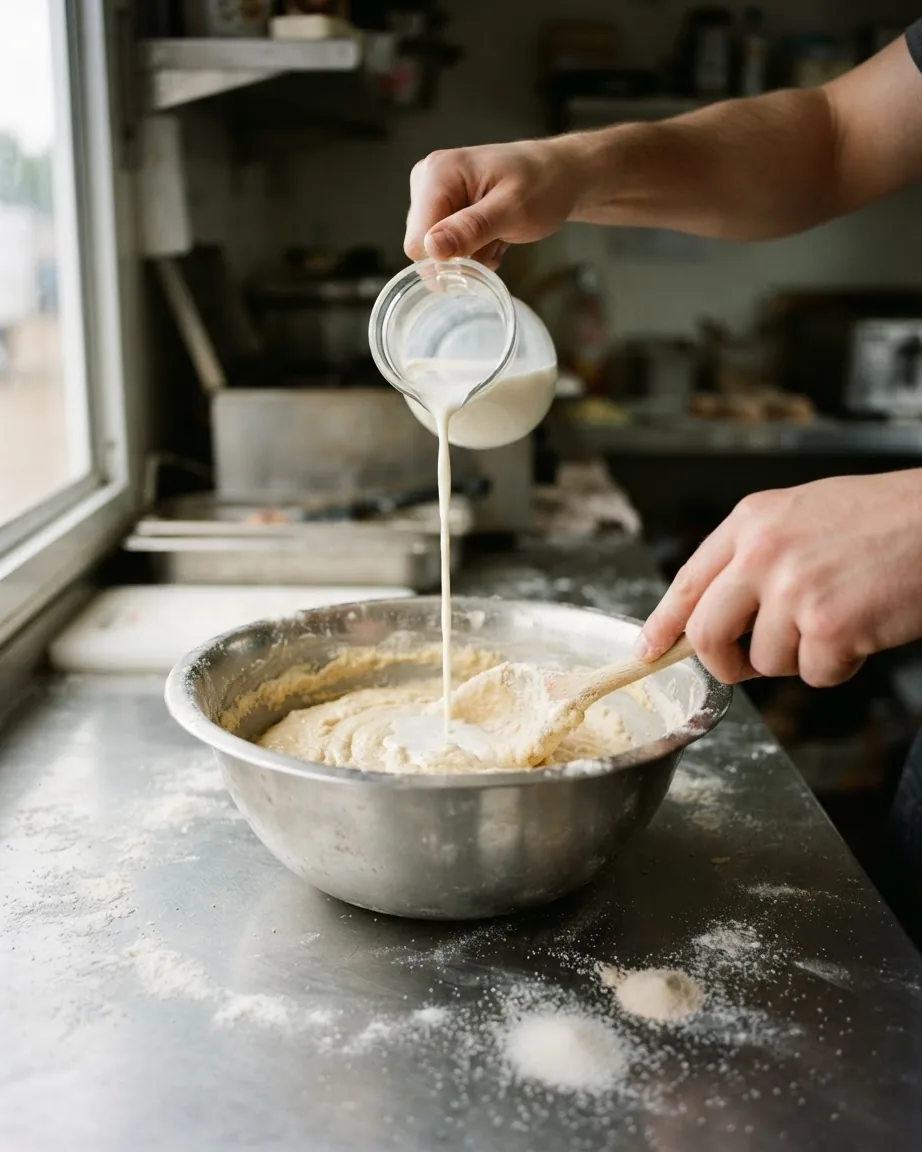
The headline gross figure comes straight from Lil’ Orbits’ own profit worksheet. Their example sells 2,400 mini donuts (200 dozen) at $6.00 a dozen. Mix cost: 31 lbs at $1.28 per pound. The worksheet lands on a gross profit of $1,135.64. That’s where the big percentage comes from.
Read the footnote. Lil’ Orbits states the figure does “not include any other operating costs, such as on-site utilities, rent or labor costs.” So it’s gross on ingredients only. It is not lying; it’s just measuring batter-to-bag, which is where this concept genuinely shines.
The number that matters after you pay a booth fee, a staffer, fuel, and a commissary is the net. VendorLoop pegs that at 18 to 28 percent. These two figures are not in conflict and should never be averaged or reconciled, one counts only ingredients, the other counts everything. Budget off 18 to 28 percent. Treat the gross figure as proof your food cost is low, nothing more.
Mini donut food truck startup cost and where the money actually goes
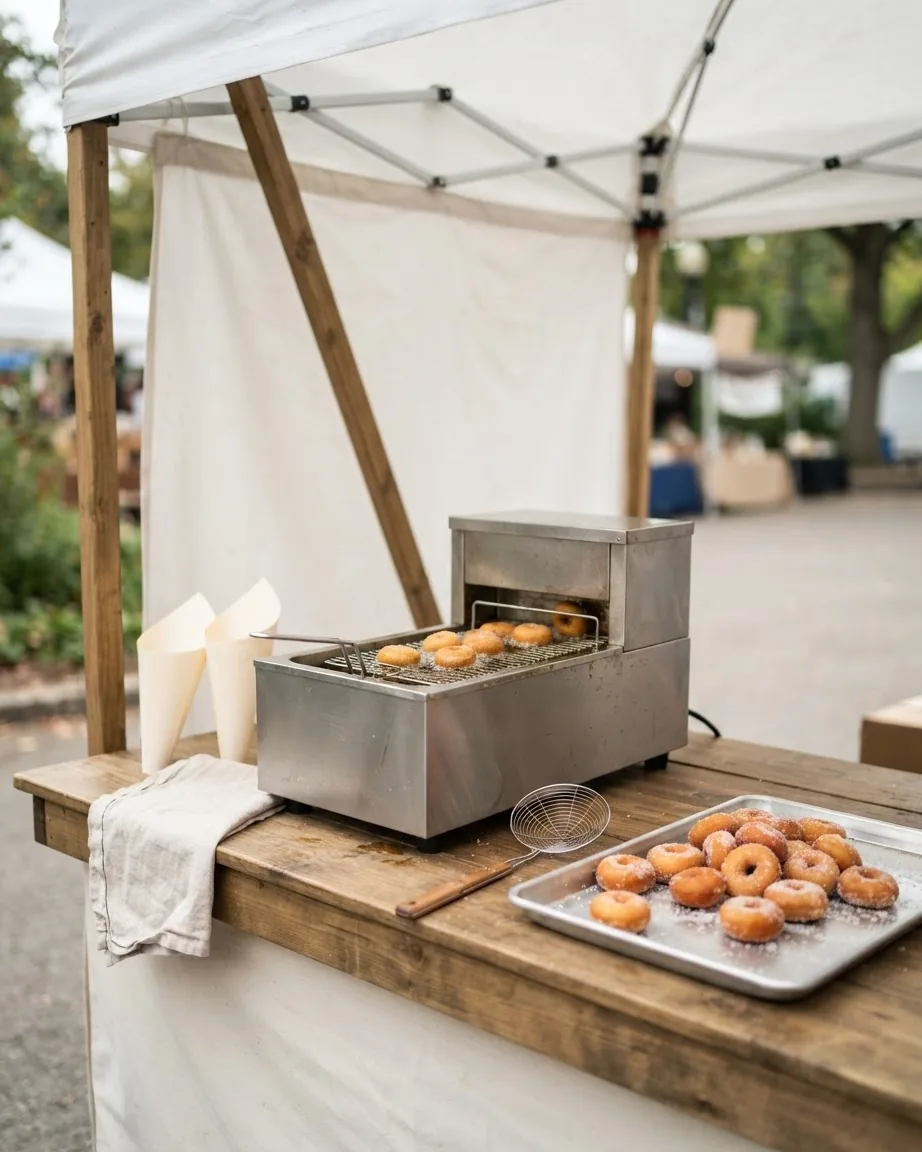
Build cost here is the lowest in the category. VendorLoop puts a turnkey donut trailer at $35,000 to $60,000, and says total equipment under $15,000 is realistic. The machine itself is cheap relative to the rest: a Lil’ Orbits SS-1200 runs $3,500 to $5,500.
Where does the rest of the trailer money go? A big slice is ventilation and fire. A Type I hood plus ANSUL fire system runs $4,000 to $8,000 per VendorLoop, and you’re frying, so this isn’t optional. Concession Nation, which sells donut units, describes builds with a 5-foot hood and fire suppression sized for the machine. Note that fire and hood requirements are set locally, so confirm yours before you buy a build.
If $35,000 to $60,000 still feels steep for a one-SKU gamble, you’re reading the risk correctly. Operators on r/foodtrucks put it bluntly: “Investing so much money into a niche concept it’s extremely risky.” The low-risk entry is a tent or stand with a countertop machine, which lets you test demand before you fabricate anything.
A note on footprint: fixed mini-donut shops can be tiny. Mini Donut Company says its franchise stores “are all less than 400 square feet.” That’s a different business format from a mobile trailer, not a cheaper version of one, so don’t use shop numbers to budget a truck.
Concession machine vs. craft machine: one unit cannot do both
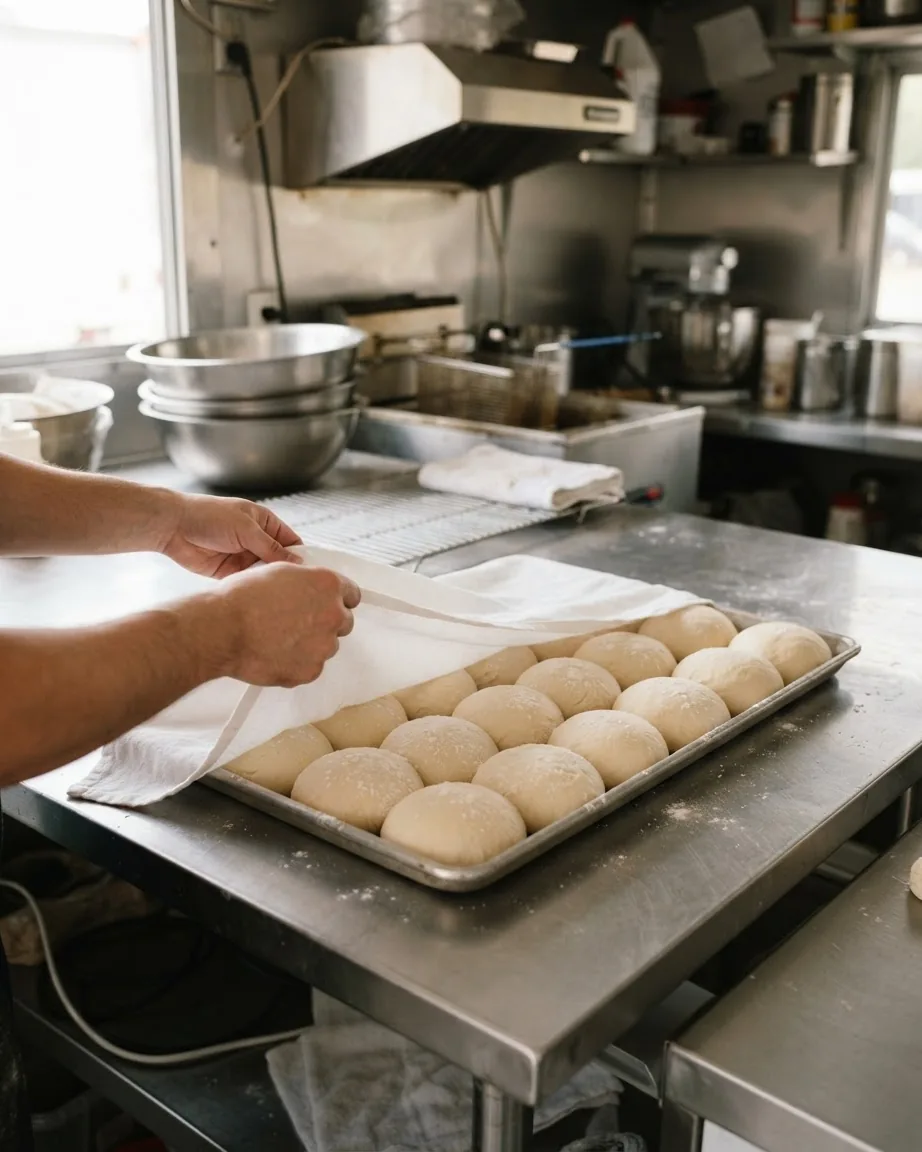
This is the decision that locks in your whole menu, and most first-timers don’t realize it’s permanent. A Lil’ Orbits SS-1200 cannot make glazed yeast-raised craft donuts. It ejects ring-shaped mini donuts onto a conveyor at 1.5 to 2.5 dozen per minute and holds about 12 to 15 lbs of batter. That’s a concession machine: cake batter, baking-powder leavening, no proofing, fried and bagged.
Craft is a different animal entirely. A Belshaw Donut Robot Mark V runs $15,000 to $20,000, and yeast dough needs bulk fermentation of about 24 hours plus a final proof of 45 to 60 minutes before it ever hits oil. That proofing step is make-or-break: it’s what builds the open, airy crumb a yeast donut is sold on, and you can’t shortcut it on a truck line during a rush.
The economics split too. VendorLoop puts cake-and-mini COGS at $0.10 to $0.20 per donut (5 to 12 percent food cost) versus yeast-raised craft at $0.25 to $0.45 per donut (8 to 15 percent food cost) once you factor proofing time, glazes, and decorations.
Here’s the practical call for a first-timer:
- Concession (SS-1200, minis): cheapest build, fastest line, one bag SKU, best fit for fairs and events. Pick this if you want volume and simplicity.
- Craft (Belshaw-class, yeast): higher ticket per donut, far more labor and timing, needs proofing space and planning. Pick this only if your venue rewards a premium product.
You buy one machine for one concept. Lil’ Orbits’ SS-1200 line does offer a quick-change hopper that makes four donut sizes plus holes, but that’s size variety within minis, not a jump to yeast donuts. Plan the menu before you plan the purchase.
Why a donut truck earns less per day than a taco truck despite better margins
Here’s the trap. Your food cost is the lowest in mobile food, and yet your daily ceiling is lower than a taco truck’s. VendorLoop names the cause directly: it calls the demand window “the single biggest constraint on donut truck revenue,” noting your sellable hours per day are roughly half what a savory truck has.
People buy donuts in the morning and as a treat at an event. They don’t buy a bag of cinnamon-sugar minis for dinner the way they’ll buy tacos at 9 p.m. So the right way to think about a mini donut food truck isn’t “how good is my margin,” it’s “how many high-traffic hours can I book.” That reframes the whole business as a venue and scheduling problem.
Which is also why the revenue story is so lumpy: $50,000 to $150,000 at a single fair, then quiet stretches. Your job is lining up fairs, festivals, farmers markets, and events that pack your limited hours. An operator on r/foodtrucks summed up the timeline: “You will probably need a couple summers to make a profit but this is good margin and fairly simple to execute.” Plan for seasonality, not a steady weekday curbside grind. If events are your revenue engine, our food truck events breakdown is worth a look next.
Pricing mini donuts so customers don’t walk away from the window
Perceived value sinks more donut operators than food cost ever will.
VendorLoop’s concession guidance follows the same logic with a tiered bag ladder.
Treat these as a range across markets, not one fixed rate, fairs support higher pricing than a neighborhood market. The principles that hold everywhere:
- Price in tiers so the bigger bag is the obvious value, nudging the average ticket up.
- Make the smallest size look generous. A count that reads as “a few donut holes” for a premium price kills the sale before it starts.
- Lead with one strong SKU. Lil’ Orbits has sold machines to fair vendors since 1974, and the one-bag cinnamon-sugar model clearing $50,000 to $150,000 per fair runs on exactly one well-priced item.
Daily oil filtration: the quiet task that decides your donut quality
This is the operating habit that separates a trailer with a line out front from one with sad, greasy donuts, and almost no startup guide mentions it. VendorLoop is blunt: within three days of unfiltered service, oil darkens and donuts come out greasy and over-browned.
Dark oil is the enemy of a good mini. As frying oil breaks down, it browns the surface faster than the inside cooks and the donut absorbs more fat, so your product tastes heavy and looks burnt at the edges while still being raw-ish in the middle. Filtering daily resets that. It’s unglamorous, it happens after a long event day, and it’s the single habit that protects the one thing you’re selling.
Oil cost itself is small, $0.02 to $0.06 per donut depending on absorption and turnover rate, so this is about quality and reputation, not pennies. Build the filtration step into your closing routine the same way you’d build in cash-out. The machine holding 12 to 15 lbs of oil at a time means it’s a manageable daily job, not a drum-sized chore.
Plain vs. filled minis: the cold-hold rule that changes your build
Plain cinnamon-sugar minis are shelf-stable through service; they’re fried, sugared, and sold. The moment you add a filling or topping that’s temperature-sensitive, the rules change. VendorLoop notes those items need cold-hold at 41°F or below.
That’s the line between a non-TCS menu and a TCS one (time/temperature control for safety). Cream fillings, custards, and dairy-based toppings pull you into cold-holding territory and the refrigeration that comes with it. Keep in mind that holding temperatures are enforced locally by your health department, so 41°F is the common standard but confirm the figure your jurisdiction applies, and never treat a hold temperature as a food-safety guarantee on its own.
The planning takeaway: a plain-minis menu keeps your build simpler and your cold-hold needs minimal. Add filled or topped items only when you’re ready to carry and manage the refrigeration they demand.
Minnesota licensing and the fee stack behind a mini donut food truck
If you’re building in Minnesota, the rules are specific, and they’re set by the state, so treat what follows as Minnesota-only; every other state runs its own system. The binding details come from your own city and county regardless.
First, sequencing. Plan review comes before fabrication, not after. The Minnesota Office of the Revisor of Statutes attaches a real penalty to late planning: under Section 157.16, “plans submitted less than 30 days prior to construction are subject to an additional late fee equal to 50 percent of the original plan review fee.” Submit plans, get them approved, then build.
Second, the fee stack is layered, not one line item. Several distinct per-activity charges apply under Section 157.16, covering an annual base fee, a mobile-food-unit category fee, a statewide hospitality fee, and a technology fee. These are separate components, not competing estimates, budget all of them.
Third, the “mobile” definition has a time rule with an exception people miss. Section 157.15 defines a mobile food unit as one “operating no more than 21 days annually at any one place, or operating more than 21 days annually at any one place with the approval of the regulatory authority.” So 21 days is not an absolute cap, you can stay longer at one pitch with sign-off, but without that approval you’d fall outside the mobile category.
Can a donut-only menu skip the sinks? (It can’t)
A one-SKU bag of fried minis feels like it shouldn’t need a full plumbing build. In Minnesota, it does. The Minnesota Administrative Rules spell out requirements that don’t bend for a simple menu.
Warewashing and handwashing are separate, and you need both. Rule 4626.0680 requires a mobile food unit to carry “at least a 3-compartment sink, either freestanding or installed in a counter.” That does not cover handwashing, rule 4626.1070 separately requires “at least 1 handwashing sink” for employee use. One sink does not satisfy the other.
Water and waste are governed too. Rule 4626.1180 requires a sewage holding tank “sized 15 percent larger in capacity than the water supply tank,” and states flatly that “the sewage must not be discharged on the ground.” So size your wastewater tank 15 percent above your fresh-water tank, and plan a legal discharge point. These tanks and sinks are mandated no matter how short your menu is.
Which Minnesota agency licenses your truck (there’s no single answer)
Operators want one office to call. There isn’t one fixed answer. Per the Minnesota Department of Health, menu and operating location determine which agency handles plan review and licensing, so the answer depends on what you serve and where you park. Confirm your specific routing with the state before you submit, because filing with the wrong authority burns the 30-day clock that triggers the 50 percent late plan-review fee.
The practical order: determine your licensing agency first, submit plans at least 30 days before construction, get operational approval, then fabricate and buy. Doing it backwards is the expensive first-year mistake in this concept. For the broader picture of what a mobile build has to clear, see our food truck permits rundown.
What each donut actually costs the customer: the price-ladder math
The pricing section quotes two real windows that make the psychology visible.
- 12 for $6 lands lowest per donut. That shrinking unit price is exactly what makes the big bag feel like the obvious value and pushes the average ticket up.
- Customers don’t run the arithmetic, but they feel it: six tiny rings for the price of what reads like a dinner-sized order, and they leave.
The lesson isn’t the headline bag price, it’s the per-donut slope. A ladder that falls as the bag grows rewards the customer for spending more; a single steep tier signals a rip-off at the window.
FAQ
Is a mini donut food truck a good first concept?
It’s simple to run and carries exceptional food cost, but it’s a niche gamble on a $35,000-plus build. Seasoned operators warn it’s risky money for one SKU and often needs two summers to turn a profit. Testing demand with a tent and a countertop machine first lowers your downside considerably before you commit to fabrication.
How fast can a mini donut machine produce?
A concession-grade unit like the SS-1200 ejects rings onto a conveyor at roughly 1.5 to 2.5 dozen per minute and holds about 12 to 15 lbs of batter at once. That output easily feeds a fair line on a single item, which is why the one-bag model scales to five- and six-figure revenue at a busy multi-day event.
What’s a realistic daily revenue outside of fairs?
Lower than you’d hope, and the reason is clock, not price. Because buyers want donuts mostly in the morning and as an event treat, your productive selling window runs about half a savory truck’s. Steady weekday curbside service rarely pays here; the dollars concentrate at festivals, markets, and bookings that fill those scarce peak hours.
Does Minnesota let a mini donut unit park permanently at one spot?
Not by default. The mobile-food-unit definition caps a single location at 21 days per year, though the regulatory authority can approve a longer stay. Without that sign-off, exceeding 21 days at one place pushes you outside the mobile category, which can change your licensing path entirely. Always secure written approval before planning a long-term pitch.
How much does the oil actually cost per donut?
Between $0.02 and $0.06 apiece, depending on how much the batter absorbs and how often you cycle fresh oil in. The real cost of oil isn’t dollars, it’s neglect: skip daily filtering and within three days your product browns too fast and turns greasy, which drives customers away faster than any price ever will.