
In Texas, the single decision of whether you scoop or sell wrapped novelties changes your upfront license fee from $309 to $618 and tacks on a $400 pre-licensing inspection you’d otherwise skip entirely. That’s the kind of fork a generic startup checklist glosses over. Before you buy a truck or print a menu, the ice cream truck business you’re actually signing up for splits along one line: prepackaged versus prepared. One path is cheaper, faster to launch, and lighter on rules. The other earns more per cup but drags a food-handling inspection and a longer runway behind it. Everything downstream, cost, permits, cash flow, bends around that choice.
The Texas Department of State Health Services publishes those exact fees, and the split tells you more about your first season than any revenue estimate will.
Quick answer: An ice cream truck business costs roughly $10,000 for a used vehicle up to over $60,000 for a new custom build, plus about $500 for starting inventory. A busy day grosses $200 to $400; peak-season months run $5,000 to $10,000; owners net $20,000 to $100,000 a year at 30 to 50 percent margins. Selling prepackaged novelties keeps you in the lowest-risk, cheapest license tier; scooping soft-serve triggers food-handling rules and a pre-licensing inspection. Summer carries the year, so plan for a dead off-season and hedge with flat-fee private events.
Prepackaged Novelties vs. Soft-Serve: A License Decision Before a Menu One
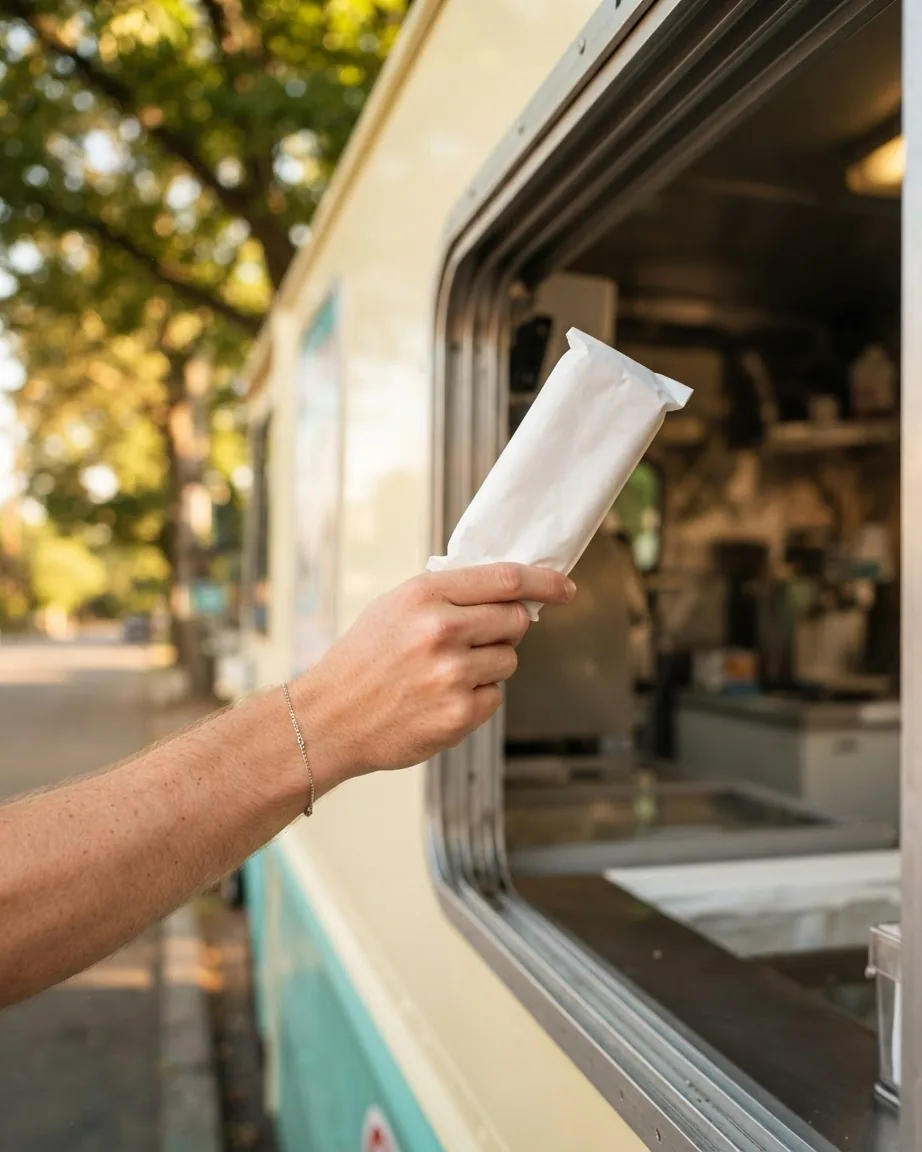
Most people think of this as a flavor question. It’s a regulatory and cash question first. Selling only wrapped, prepackaged ice cream novelties generally keeps you clear of food-handling regulations, according to Lightspeed. The moment you scoop hard ice cream or dispense soft-serve, you’re preparing food, and the rules that govern a food-prep operation apply.
Texas makes the money consequence concrete. Under the Texas Department of State Health Services, prepackaged ice cream vendors fall into Type I, the lowest-risk class, with a $309 application fee and no pre-licensing inspection fee. A Type II vendor pays $618 plus a $400 pre-licensing inspection. So the step from selling wrapped bars to scooping cones isn’t just a labor change at the window; it roughly doubles your state application fee and adds a $400 inspection that has to clear before you open.
One caution worth holding onto: “exempt from food-handling rules” is not the same as “exempt from licensing.” Even a Type I prepackaged vendor in Texas still needs a DSHS license. The exemption buys you lighter operational rules and a faster, cheaper launch, not a free pass.
For a first-season solo operator who wants to open fast and cheap, prepackaged is the cleaner start. If your whole concept is fresh soft-serve, budget the extra fee, the inspection, and the longer timeline from day one rather than discovering it after you’ve bought equipment.
What an Ice Cream Truck Costs to Start, and Where the Money Actually Goes
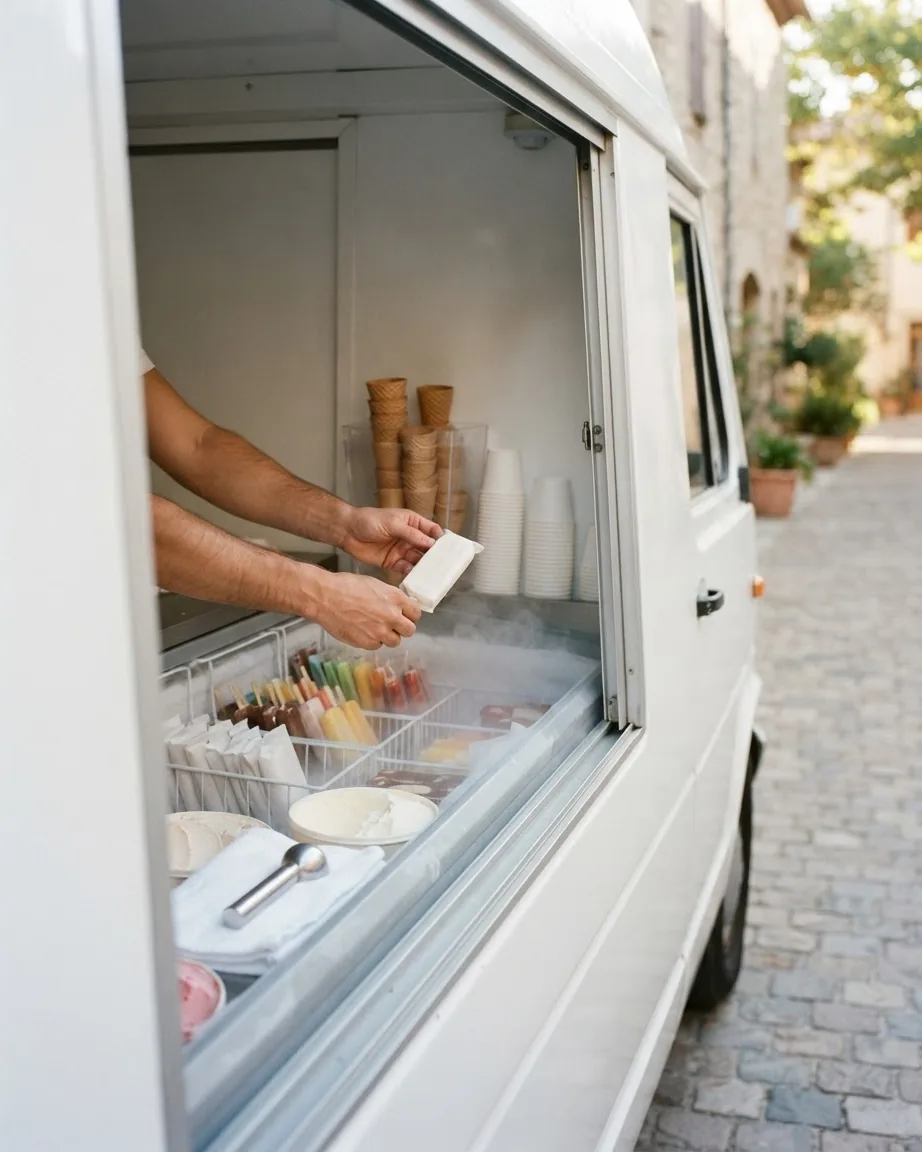
The headline number depends entirely on which vehicle you buy, and two reputable sources describe it differently, so don’t treat either as the whole picture. Lightspeed frames the floor as about $10,000 for a used vehicle climbing to over $60,000 for a new, custom-fitted truck. DeConna Ice Cream gives a tighter figure for the typical used buy: $15,000 to $20,000. These aren’t contradictory. The $10,000 is a bottom-of-range endpoint; the $15,000 to $20,000 is an average. If you see a $10,000 truck, expect it to be at the rough end of that spread.
On top of the vehicle, you need product in the freezer before you sell a thing. DeConna pegs the minimum starting inventory at $500. Southern Ice Cream puts the opening product buy at $300 to $500. Budget the higher end so you’re not restocking mid-week in your first month.
The recurring costs are where new owners get surprised. Per Lightspeed’s startup breakdown:
- Permits and licensing: $100 to $1,000, varying by municipality.
- Insurance premiums: $1,000 to $4,000 annually.
- Commissary fees: $500 to $1,500 monthly.
That commissary line is the one people forget to carry. Most health departments prohibit storing commercial food inventory at a private residence, which means you can’t just park the freezer in your garage. You rent a licensed commissary kitchen, and that $500 to $1,500 a month runs whether you sell a single cone or not. Over a slow off-season, it’s pure bleed.
Fuel is smaller but real: Southern Ice Cream estimates about $5 per hour on the road. That cost accumulates across a four-hour evening route before you’ve covered anything else. If you want the full picture across concepts and build scopes, our food truck startup costs breakdown reads the numbers by scope.
The Permit Stack: Business License, Vending, Peddler’s, and Resale
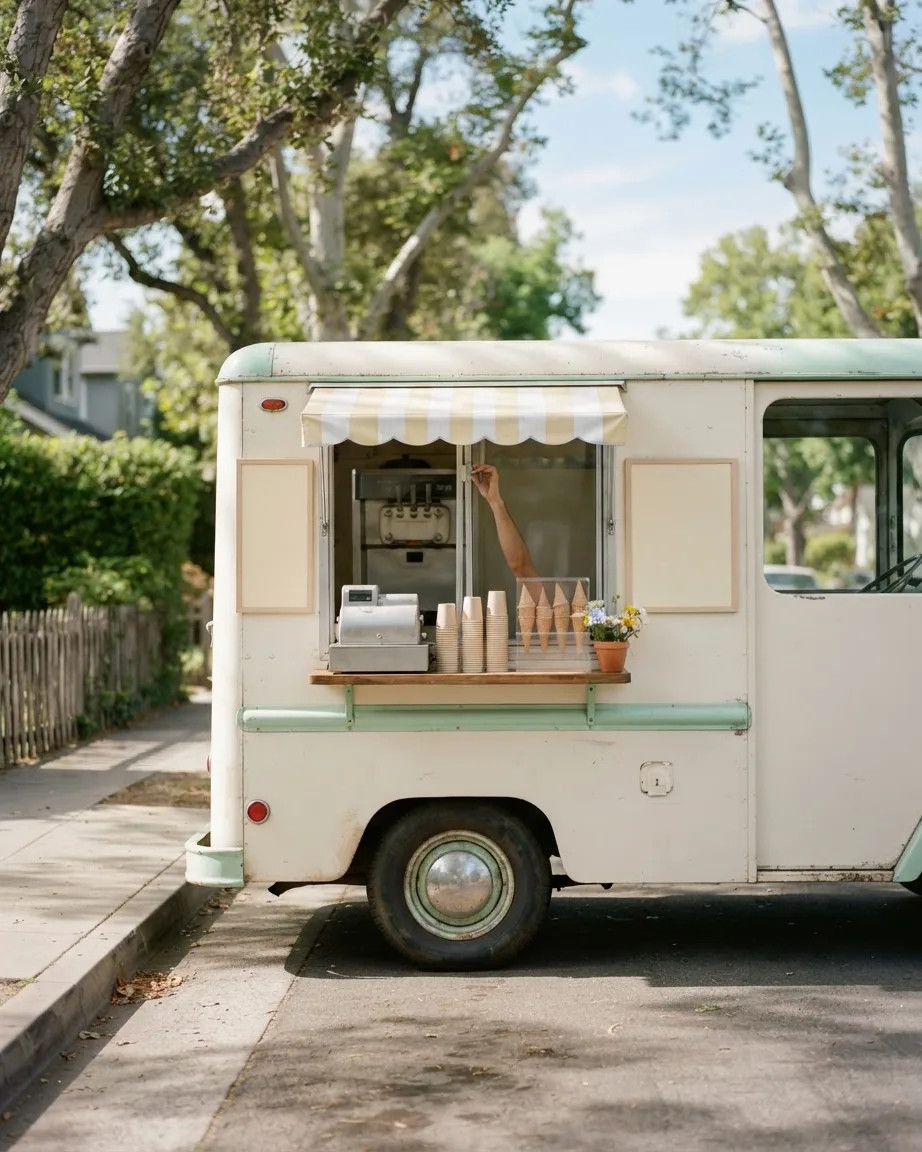
There’s no single envelope that holds every permit you need. Lightspeed lists a stack that typically includes a business license, a street-food or vending permit, and, in some jurisdictions, a peddler’s permit issued by the police department. If you buy your ice cream and supplies wholesale, you’ll likely also need a resale permit, plus an EIN and health-department registration.
Fees are hyper-local and don’t transfer. Three figures from the pack show how far apart jurisdictions sit: Lightspeed’s generic $100 to $1,000 range; the Texas DSHS state fee of $309 for Type I; and a city fee from the City of Colorado Springs, City Clerk, of $110 for the first unit and $25 for each additional unit. You can’t add these up or assume one city’s number predicts another’s. The binding rules always come from your own city and county, and you confirm them there before you commit.
Two moving pieces deserve a flag. If your route crosses more than one city, you need the appropriate permits and licenses for every city where you sell, not just your home base. And Texas changed its structure: beginning July 1, 2026, all mobile food vendors must be licensed with DSHS to operate statewide, replacing the old per-jurisdiction approach. If you’re launching in Texas, that date decides whether you’re applying under the old system or the new one. Our deeper read on the food truck permits stack lays out the paperwork order.
What an Ice Cream Truck Business Actually Makes in a Year
Here the numbers are encouraging and misleading at the same time, so read them in the right order. DeConna’s earnings guide reports that an owner can make around $200 to $400 on a busy day, which translates to roughly $5,000 to $10,000 in revenue per month during peak season. Successful owners earn anywhere from $20,000 to $100,000 per year, and ice cream trucks can hit profit margins of 30 to 50 percent. Some operators report earnings as high as $1,000 per day when positioned at major events with large crowds.
Now the reality check that the glossy range hides. DeConna spells out the low end plainly: to make about $25,000 for the year at a 50 percent margin, you’d sell around $1,000 of ice cream per week, and that $25,000 is before overhead costs and sales tax.
Set that against a wage benchmark. ZipRecruiter’s aggregated US job-posting data tracks the average annual pay for an ice cream truck worker. That’s an employee wage, not owner profit, and that distinction is the whole value here. A low-volume solo truck grossing $25,000 before overhead can gross less than the salaried driver would simply earn as a wage. The $20,000 to $100,000 owner range is real, but the bottom of it describes a business that pays its owner worse than a paycheck job, once overhead and sales tax come out.
So the honest viability test isn’t “can I hit $100,000.” It’s “can I clear enough volume, through better placement and events, to beat the employee wage after overhead.” If you can’t see a path to that, you’re buying yourself a job that pays below market.
Seasonality: Why Summer Pays the Rent and the Off-Season Bleeds

The structural failure mode of this business isn’t a bad flavor or a slow corner. It’s the calendar. DeConna states it bluntly: the summer months are by far the most profitable, and earnings during the off-season may not be worth it. Operating during school hours severely lowers profits, because your core street-selling window overlaps with kids being in class.
Southern Ice Cream points to when the money is actually on the street: weekdays from 4 p.m. to 8 p.m., and weekends. That’s the after-school-and-home window, and it’s narrow. Four productive hours a day, concentrated in roughly three warm months, is the real engine, which is why the commissary fee bleeding through winter hurts so much.
Weather compounds it. A street-only operation is exposed to every rained-out Saturday and every cool week, with no revenue floor underneath. Lightspeed’s hedge is to diversify into private events, where bookings typically carry a flat fee or a guaranteed minimum, so you make a profit regardless of individual sales. Pair that with high-crowd placement, the kind of major event where operators report up to $1,000 per day, and you replace some of the weather risk with contracted income. A booked birthday party pays whether or not it drizzles. For how those bookings get priced and what a venue permit demands, see our guide to renting an ice cream truck.
Route Zoning, School Distances, and the Rules That Move Your Truck
Where you can legally park and sell is set by local ordinance, and it can quietly erase your best corners. Lightspeed notes that some cities restrict sales within a certain distance of schools or brick-and-mortar restaurants. That’s a direct conflict with the ice cream truck playbook, since schools are exactly where the crowd is. Before you build a route around a school zone, confirm your city allows it.
Keep the menu tight enough to run fast at the window. Southern Ice Cream recommends aiming for about 20 items, enough variety without a customer standing there for half an hour deciding. A short board moves the line, which matters when your whole take comes from a four-hour evening window.
Payback Math: The Two-Year Rule Against a Used-Truck Price
Put the pieces together and you get a grounded payback sanity check instead of a vague promise. DeConna’s rule of thumb is that most businesses start to see positive ROI after 2 years, potentially sooner for a low-cost ice cream truck.
Run it against the real figures. A used truck costs $15,000 to $20,000 to buy in. A modest solo operation at a 50 percent margin, selling about $1,000 a week, clears roughly $25,000 a year before overhead. On paper that pays off the truck inside the first year of gross, but overhead is the catch that stretches the timeline: the $500 to $1,500 monthly commissary, $1,000 to $4,000 in annual insurance, and sales tax all come out before the truck is truly paid down. That’s why the two-year mark holds even when the gross math looks faster. Treat anything quicker as a best case that depends on a strong summer and a few booked events, not as the base plan.
If your concept is a single simple product rather than a full scoop line, the volume math can look very different, as our mini donut food truck breakdown shows for a one-SKU operation.
Does a prepackaged ice cream truck still need a license if it’s exempt from food-handling rules?
Yes. Skipping food preparation lightens your operational burden, but it doesn’t erase the registration itself. In Texas, a prepackaged vendor is classed Type I, the lowest-risk category, and still files for a DSHS license at $309. The exemption applies to handling rules, not to the permit. Always verify the specific requirement with your own local health department.
How much should I set aside for opening inventory before my first route?
Plan on $300 to $500 for your first product buy, per Southern Ice Cream, with $500 being the safer minimum DeConna cites. Stock the higher end so you aren’t forced into a mid-week restock during your opening stretch. Factor fuel separately at roughly $5 per hour of driving across a typical four-hour evening route.
Can I store my inventory at home to skip the commissary fee?
Usually not. Most health departments bar keeping commercial food stock at a private residence, which forces you into a licensed commissary kitchen. That rent runs $500 to $1,500 every month regardless of sales, so it hits hardest across a dead winter. Budget it as a fixed cost from day one rather than a line you can cut.
What changes for a Texas operator because of the July 1, 2026 rule?
From that date, every mobile food vendor must hold a DSHS state license to work anywhere in Texas, in place of the older city-by-city setup. Your launch timing decides which system you file under. A Type I prepackaged application runs $309 with no inspection fee, while a Type II prepared vendor pays $618 plus a $400 pre-licensing inspection.
The Real Overhead Math: Why a Low-Volume Owner Nets Less Than the Wage
DeConna’s low-end scenario, $25,000 a year at a 50% margin, is quoted before overhead and sales tax. The article stops there. Annualize the two biggest fixed costs and the gap against a plain employee paycheck becomes concrete.
- Commissary rent runs whether you sell or not: $500/month × 12 = $6,000/yr at the low end; $1,500/month × 12 = $18,000/yr at the high end.
- Add insurance ($1,000-$4,000/yr): total overhead floor is $6,000 + $1,000 = $7,000; ceiling is $18,000 + $4,000 = $22,000. Fuel, permits, and sales tax are on top of this.
- What’s left of the $25,000: best case $25,000 – $7,000 = $18,000; worst case $25,000 – $22,000 = $3,000.
Once commissary and insurance come out, a low-volume solo truck can net single-digit thousands, well behind what a comparable employee driving the same route would earn as a wage. The number that decides viability is weekly sales well above $1,000, not the margin percentage.