Funnel cake truck math is the closest thing to printing money I have seen in mobile food, and I say that after eight summers of running a flat-top out of Austin. A plate of fried batter and powdered sugar costs me under a dollar to make and sells for eight. But the batter was never the hard part. The event fees, the fryer, and the fire marshal are what decide whether you clear real money or just spin oil all weekend. Let me walk you through the whole thing the way I wish somebody had walked me through it.
The fryer and event-fee numbers below are this season’s real prices, not last year’s guesses.
The first summer I ran a dessert setup, I underpriced my plates for a solid month before I sat down and did the arithmetic. Do not be me. Here is the honest version.
A funnel cake truck costs roughly $4,000 to $13,000 to start small: the cart or trailer runs $3,000 to $10,000, a commercial fryer is $400 to $1,500, and your first supplies plus local permits add $300 to $1,400. Ingredients cost about $0.54 to $1.50 per cake, and you sell at $6 to $10, so the food itself carries an 80 to 90 percent gross margin. The trap is the booth fee. A fair space can run $150 to over $5,000, and some events take 15 percent of your gross instead. Win on volume and pick your venues, and this concept prints. Ignore the fees and you fry all day for nothing.
What a funnel cake truck actually costs to start
After eight years running trucks, the first thing I check for any new operator is whether they are buying a truck when a trailer would do the job. Start-up for a small dessert cart or trailer lands between $4,000 and $13,000, and that spread is real, not a hedge. The biggest line is the unit itself. A used concession trailer or a decent cart is $3,000 to $10,000, and a full built-out truck with a generator and a hood pushes far past that. Do not buy a truck to sell funnel cakes if a trailer will do. You are selling one fried item, not running a four-burner kitchen.
The fryer is your second real cost at $400 to $1,500 for a commercial funnel cake or donut fryer. I built my first truck around the cheapest fryer I could find, and that decision cost me more in lost sales than it saved me in cash. After that, budget $300 to $1,400 for your opening batter, oil, powdered sugar, plates, and the local permits you cannot skip. I always tell new operators to hold back a cushion on top of that number, because your first event teaches you what you forgot to buy. My first weekend I ran out of powdered sugar by noon Saturday and paid gas-station prices to finish the day.
If you need the business-plan and licensing side laid out properly, the U.S. Small Business Administration has free guidance on structuring the business and financing the trailer. Read it before you sign anything. According to the SBA, keeping your trailer financing separate from your personal credit is worth the extra paperwork if a slow season hits before you find your footing.
- Trailer or cart: $3,000 to $10,000
- Commercial fryer: $400 to $1,500
- Opening supplies and local permits: $300 to $1,400
- Cash cushion for the surprises your first event teaches you: budget extra
Five steps to open your window
- Step 1 – Pick a trailer or cart based on your menu, not your budget alone.
- Step 2 – Buy the fryer for your busiest expected day, not your slowest one.
- Step 3 – Line up your local health permit and mobile food license early.
- Step 4 – Book two or three small test events before a big fair to dial in your pour and pricing.
- Step 5 – Track your numbers after every event so the fee math stays honest.
The real margin math (and why the food cost is a lie)
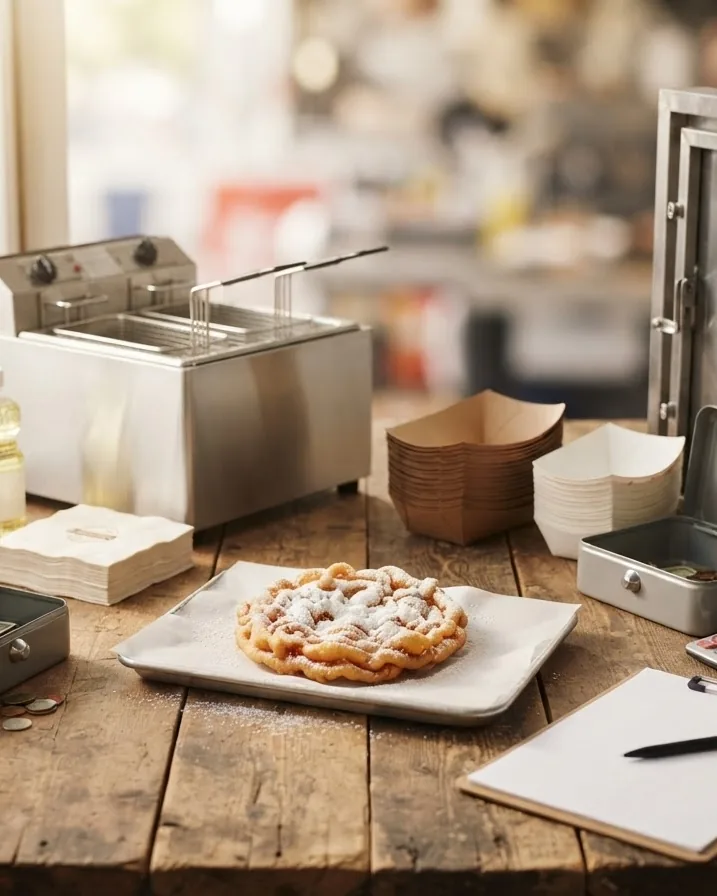
Here is where funnel cakes earn their reputation. A medium cake costs me around $0.54 to build: roughly $0.27 in batter mix, $0.07 in powdered sugar, $0.06 in frying oil, and $0.14 for an eight-inch paper plate. Larger cakes and premium mixes push that toward $1.50, but you are still under two dollars in the food. Sell that at $6 to $10, or $8 to $12 at a big fair, and the food cost is only 10 to 15 percent of the price. That is an 80 to 90 percent gross margin on the plate.
Now the honest part. That fat margin is on the food alone, and the food is not your only cost. Once you load in the event fee, your fuel, your labor, and the powdered sugar you spill, your real take drops. Buy batter mix in bulk to protect the number: a 25 lb bag runs about $43, and that makes a lot of cakes. The vendors who win treat the 85 percent gross margin as a starting point that the fees are trying to eat, not as money already in the bank.
Volume is what turns the margin into a living. One server on a good fryer can push a cake every ninety seconds once the batter is pre-portioned, which is around forty plates an hour at a rolling pace. At an $8 average with a $1 food cost, that is roughly $280 in gross margin an hour before fees, and a busy fair day is six to eight of those hours. That is the number that makes people fall in love with this concept. The mistake is assuming every hour is a rush hour, because it is not, and your slow hours still burn oil and pay the booth.
Warning: The single fastest way to kill a funnel cake truck is signing a percentage-of-gross deal without doing the division. A 15 percent gross fee on a busy fair day can be more than a flat booth rent would have cost you. Run both numbers against your realistic sales before you commit.
The fryer: BTU, watts, and what survives a Saturday rush
Your fryer is the whole operation, so buy for the crowd you expect, not the crowd you have on a slow Tuesday. Gas fryers are rated by heat output in BTU, and more BTU means the oil recovers temperature faster when you drop cold batter into it. A small 30 lb oil fryer puts out about 50,000 BTU. Step up to 40 lb of oil and you are near 75,000 BTU. A big flat-bottom funnel cake fryer holding 110 to 125 lb of oil runs around 90,000 BTU, and the largest 150 to 170 lb units hit 120,000 BTU.
If you are running off a small generator or shore power, electric fryers make more sense. Portable electric funnel cake fryers come in a 1,800 watt model on a standard 120V circuit and a 4,400 watt model on 240V. The 120V unit is fine for a slow booth, but at a busy fair it cannot recover fast enough between cakes and your line backs up. Concession vats hold 20 to 60 lb of oil, and you fry funnel cakes near 375 F, with the thermostat range usually running 200 to 400 F.
The overlooked detail on any fryer spec sheet is recovery time, not the headline BTU or wattage number, and it is the one that costs you real money. When your oil drops below temperature, the next cake soaks grease instead of crisping, and a soggy cake is a refund. On a Saturday market rush I want oil that snaps back to 375 F between plates. If you are also thinking about a colder dessert option, an ice cream truck build uses completely different power and refrigeration, so do not assume gear crosses over.
| Fryer type | Oil capacity | Heat output | Best for |
|---|---|---|---|
| Electric portable | 20-30 lb | 1,800 W (120V) | Small markets, single-server carts |
| Electric high-output | 30-40 lb | 4,400 W (240V) | Steady booths on 240V or generator |
| Gas countertop | 30-40 lb | 50,000-75,000 BTU | Mid-volume events, faster recovery |
| Gas flat-bottom | 110-170 lb | 90,000-120,000 BTU | Big fairs, all-day high volume |
Bottom line on gas vs electric: match the fryer to your power hookup and the crowd you expect, not just the price tag on the unit.
Batter, toppings, and the upsell that doubles a ticket
A plain funnel cake is powdered sugar on fried batter, and that is the plate that built the reputation. But plain is where your ticket starts, not where it ends. The toppings cost you pennies and let you charge dollars, which is the whole game. I keep the base cake cheap to make and let the add-ons carry the average sale up. Having spent six seasons at the window, I can tell you the upsell matters more than the base recipe ever will.
I run a base plain cake, then a strawberries-and-cream version, a cinnamon-sugar version, and a loaded one with chocolate drizzle and a scoop of soft-serve. The fruit and drizzle add maybe $0.40 to $0.80 to my food cost and let me charge two to four dollars more. When someone orders plain, I ask if they want it loaded, and roughly a third say yes. That one question raised my average ticket noticeably over a season.
Keep the batter simple and consistent. Bulk mix at about $43 for 25 lb keeps your cost flat and your cakes identical, which matters when you are slammed and cannot babysit a scratch recipe. If you want to build a broader dessert lineup around the cake, borrowing structure from proven food truck menu ideas keeps you from over-complicating a one-fryer setup. The donut world overlaps here too, and a donut food truck menu uses the same fryer, oil, and sugar station, so some operators run both off one rig.
Tip: Pre-portion your batter into squeeze bottles or a pitcher with a marked line before service. Consistent pour equals consistent cook time equals fewer soggy refunds. Eyeballing the pour is how you burn one cake and undercook the next during a rush.
Best venues: fairs, festivals, and the booth-fee trap
Funnel cakes are a captive-audience food, which means your venue matters more than your recipe. Fairs, festivals, county events, and big markets are where people expect to pay fair prices and where $8 to $12 a cake feels normal. A funnel cake truck parked on a quiet street corner will struggle, because the whole product runs on impulse and event energy.
The fee structures are where operators get hurt. A booth space can cost $150 at a small community event and over $5,000 at a premium fair. Some large events skip the flat fee and take a percentage of your gross instead. The Minnesota State Fair, for example, charges food and beverage concessionaires 15 percent of gross revenue. That model can be fine at a huge event with massive foot traffic, or it can gut you, so run the division first.
A planning rule I use: try to keep total event fees near 5 percent of my projected gross sales. If I expect to gross $5,000 at an event, I do not want to pay much more than $250 in fees. A rough conversion estimate many vendors lean on is that about 5 percent of daily attendance will buy from any single booth, so a fair claiming 20,000 visitors a day might send 1,000 people to your window over the day if you are visible and fast.
Pick events where the attendance math and the fee math both work. What most guides get wrong is treating the booth fee as an afterthought instead of the single biggest lever on your margin. From my years on the truck, the operators who ask a promoter for real attendance and gate numbers before they apply are the ones who stop losing money on dead events. If you want deeper venue selection strategy, the food truck festival vendor guide breaks down how to read a promoter’s numbers before you apply.
Pairing helps too. A funnel cake window next to a cold-drink option converts better, because sweet and fried makes people thirsty. Some operators run a small lemonade food truck setup alongside the fryer for exactly that reason, and the drink margin is almost as good as the cake.
Permits, hot oil, and the fire code
This is the section people skim and then regret. Hot oil is the actual danger on a funnel cake truck, not the batter, and the fire code treats a deep fryer seriously. Any mobile unit running a deep fryer that produces grease-laden vapors generally needs a UL-300 rated wet-chemical automatic fire suppression system and a Type I hood, the same coverage a fixed kitchen needs. That is spelled out in the standards the fire marshal enforces.
The governing documents come from the National Fire Protection Association: NFPA 96 covers mobile cooking operations, and NFPA 1 Fire Code section 50.7 covers mobile and temporary cooking. Your suppression system needs professional inspection every six months, and you keep a Class K extinguisher on board for grease fires, because water on a grease fire makes it worse, not better. A very small single electric fryer cart may be exempt in some places, but that call belongs to the Authority Having Jurisdiction, never to you.
Hot oil is also an OSHA workplace-safety matter, not only a fire-code one. According to OSHA, employers running fryers need a plan for burn and splash hazards and should train crew before they ever work the window. I keep a burn kit at the station and a strict no-loose-clothing rule near the oil, a habit that has kept more than one bad splash from turning into a hospital trip.
On the health side, your county or city health department is the Authority Having Jurisdiction that issues your mobile food permit, and rules vary by county. Most local departments adopt some version of the FDA Food Code for handwashing, water tanks, and holding temperatures, so read it once so you are not surprised at inspection. I cannot give you legal advice and neither can any article, so confirm your exact permits with your own city and county before you fire the oil. The one universal rule: do not assume a neighboring county’s permit covers you across a line.
Mistakes I made my first summer
My first season taught me three lessons the expensive way. First, I bought a 120V electric fryer to save money, and at my first busy fair the recovery time could not keep up, my line stalled, and I watched customers walk. I upgraded to a proper gas unit before the next event and my throughput roughly doubled. Buy the fryer for your busiest day.
Second, I signed a flat booth fee at an event with thin attendance because the number looked small, and I barely covered oil and gas. Now I ask the promoter for last year’s attendance and gate numbers before I apply, every time. A cheap booth at a dead event is more expensive than a pricey booth at a packed one.
Third, I underpriced. I was so proud of my low food cost that I priced like I was doing people a favor, and I left thousands on the table over a month. Funnel cakes are a treat with a captive audience, and pricing at $6 to $10 is not gouging, it is the market. The generator that quit on me mid-rush at a Saturday market was its own lesson, but that one just cost me a service call and a lot of sweat. Bring a backup power plan.
The fourth lesson took longer to learn: track your oil. Frying oil is cheap per cake, but it degrades over a long day and a stale-tasting cake at hour seven undoes the goodwill you built at hour one. I started logging how many cakes I got per oil change and filtering between busy stretches, and my repeat customers noticed the difference even if they could not name it. Small operators skip this because the oil is a rounding error on the spreadsheet, but the customer tastes it, and taste is the only marketing a funnel cake window really has.
Frequently asked questions
How much does it cost to start a funnel cake truck?
Plan on $4,000 to $13,000 for a small setup. The cart or trailer is $3,000 to $10,000, a commercial fryer runs $400 to $1,500, and your opening supplies plus local permits add $300 to $1,400. A full built-out truck with a generator and hood costs considerably more, which is why many funnel cake operators start with a trailer instead.
How much profit is in one funnel cake?
The food cost of a medium cake is roughly $0.54 to $1.50, and you sell it for $6 to $10, so the plate carries an 80 to 90 percent gross margin. That said, event fees, fuel, and labor eat into it, so treat that margin as your starting point and protect it by picking events where the booth fee stays near 5 percent of your projected sales.
What size fryer do I need for a funnel cake truck?
For busy fairs, a gas flat-bottom fryer holding 110 to 170 lb of oil at 90,000 to 120,000 BTU keeps up all day. For smaller markets, a 30 to 40 lb gas unit at 50,000 to 75,000 BTU works, or a 4,400 watt 240V electric fryer. Avoid a single 1,800 watt 120V fryer for high-volume events, because it cannot recover oil temperature fast enough.
Do I need fire suppression for a funnel cake fryer?
Usually yes. A deep fryer producing grease-laden vapors typically requires a UL-300 wet-chemical suppression system and a Type I hood under NFPA 96 and NFPA 1 section 50.7, plus a Class K extinguisher. Systems need inspection every six months. Whether a very small electric cart is exempt is decided by your local Authority Having Jurisdiction, so ask your fire marshal directly.
Where do funnel cake trucks make the most money?
Fairs, festivals, county events, and large markets, where the audience is captive and $8 to $12 a cake is normal. Watch the fee model: booth space runs $150 to over $5,000, and some events take 15 percent of gross instead. Pick venues where both the attendance and the fee math work in your favor before you apply.
What is the best price to sell funnel cakes?
At most fairs and festivals, $8 to $12 for a loaded cake and $6 to $8 for a plain one is the going rate. Since the food cost is only 10 to 15 percent of the price, your pricing power comes from toppings. Adding strawberries, cinnamon sugar, or soft-serve costs pennies and lets you charge several dollars more per plate.
The bottom line
A funnel cake truck is the highest-margin concept I have run, but the margin lives on the plate, not in the bank. Win it by buying a fryer that keeps up with your busiest day, pricing at what the fair market actually pays, and refusing any booth or percentage deal that does not clear the division. Nail the fire code and your health permit before you fire the oil, upsell the toppings, and this little cart will out-earn setups that cost three times as much. That is the honest math from my window to yours.