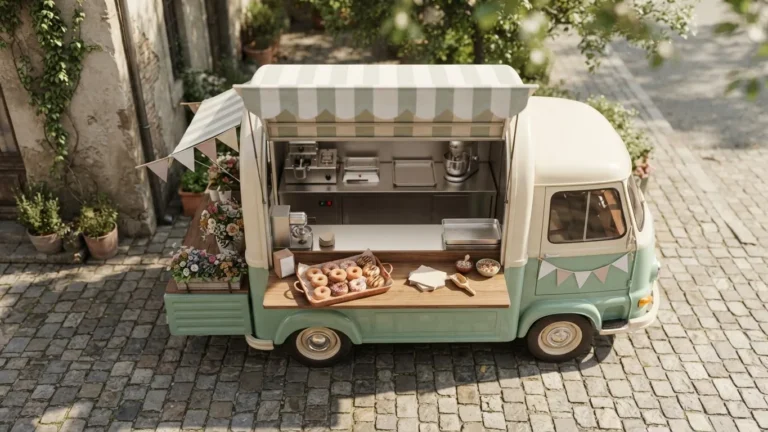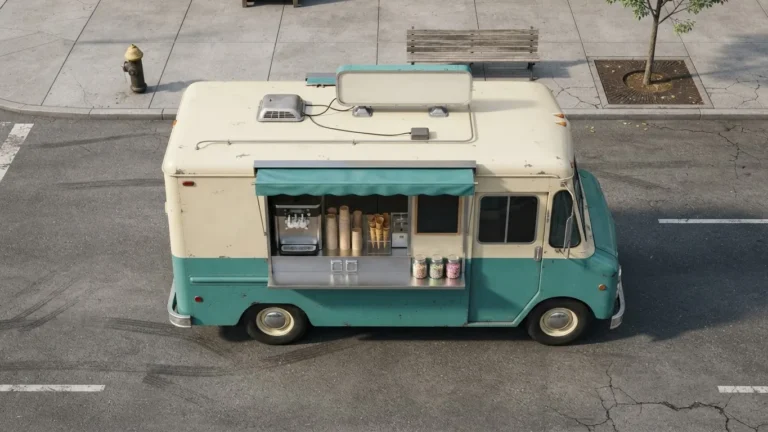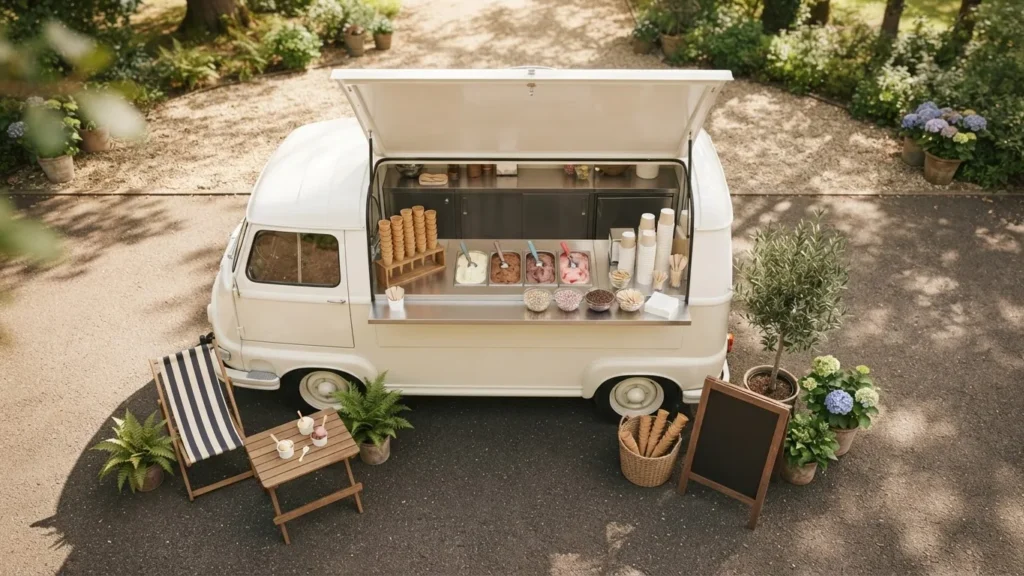
The number on the quote is almost never the number you pay. A truck that advertises “$75 to start” can finish north of $500 once you stack the service hour, the per-piece ice cream, sales tax, a card surcharge, and a travel fee for crossing a county line. Before you rent an ice cream truck, the useful move is to figure out which of three pricing structures a given vendor runs, because that choice – not the headline rate – decides whether a small backyard party or a 175-guest wedding comes out cheaper. This guide lines up the models against your actual headcount, names the fees that hide below the fold, and flags the permit questions that fall on the event location, not the truck.
According to the operating-truck pricing guide published by Lena Mae’s Ice Cream, most private bookings in the U.S. land between $300 and $1,000. Per-person service commonly runs $4 to $8. Flat hourly rates often run $150 to $400 per hour with a two-hour minimum. A minimum-spend arrangement typically guarantees the truck $300 to $500 in sales while guests order whatever they want. Pick the model that matches your crowd size: per-person and pay-per-consumption favor small or uncertain turnouts; a flat minimum favors a large, predictable one.
The Three Pricing Models, and Which One Wins at Your Headcount
The “three models” framing is a simplification worth saying out loud, because the busiest vendors blend two of them. The clean versions look like this:
- Per-person / pay-per-consumption: You pay for what gets eaten. Lena Mae’s puts the national per-person band at $4 to $8. The catering marketplace Roaming Hunger estimates ice cream truck catering at a higher band, because it’s tied to a full-service catering structure with a minimum headcount of 100 eaters per two hours, not a drop-in scoop.
- Flat hourly / package: A set fee buys a block of time; guests order freely while the truck sits. Often $150 to $400 per hour, two-hour minimum.
- Minimum-spend: The truck is guaranteed a floor – commonly $300 to $500 – and anything above that is per order.
Here is the part no single page lines up for you. Run the math two ways and the cheaper model flips depending on crowd size. For a 30-guest backyard party, pay-per-consumption keeps you honest: if only 40 scoops get eaten, you’re not subsidizing empty air. For 160 guests, a per-person rate multiplies into real money fast, and a flat package with a fixed floor often wins.
The blended structures make this concrete. OC Ice Cream charges a base – truck rentals start at $75, one hour of service at $125, extra time $25 per 30 minutes – plus $3.50 per ice cream on pay-per-consumption. Jim’s Ice Cream Truck runs an initial town fee plus $3.60 per ice cream for up to an hour, with a required minimum of 20 ice creams per hour. Both put a base fee under the per-piece rate, so neither is purely one model.
How Much to Rent an Ice Cream Truck: Quoted Ranges vs. What People Actually Paid
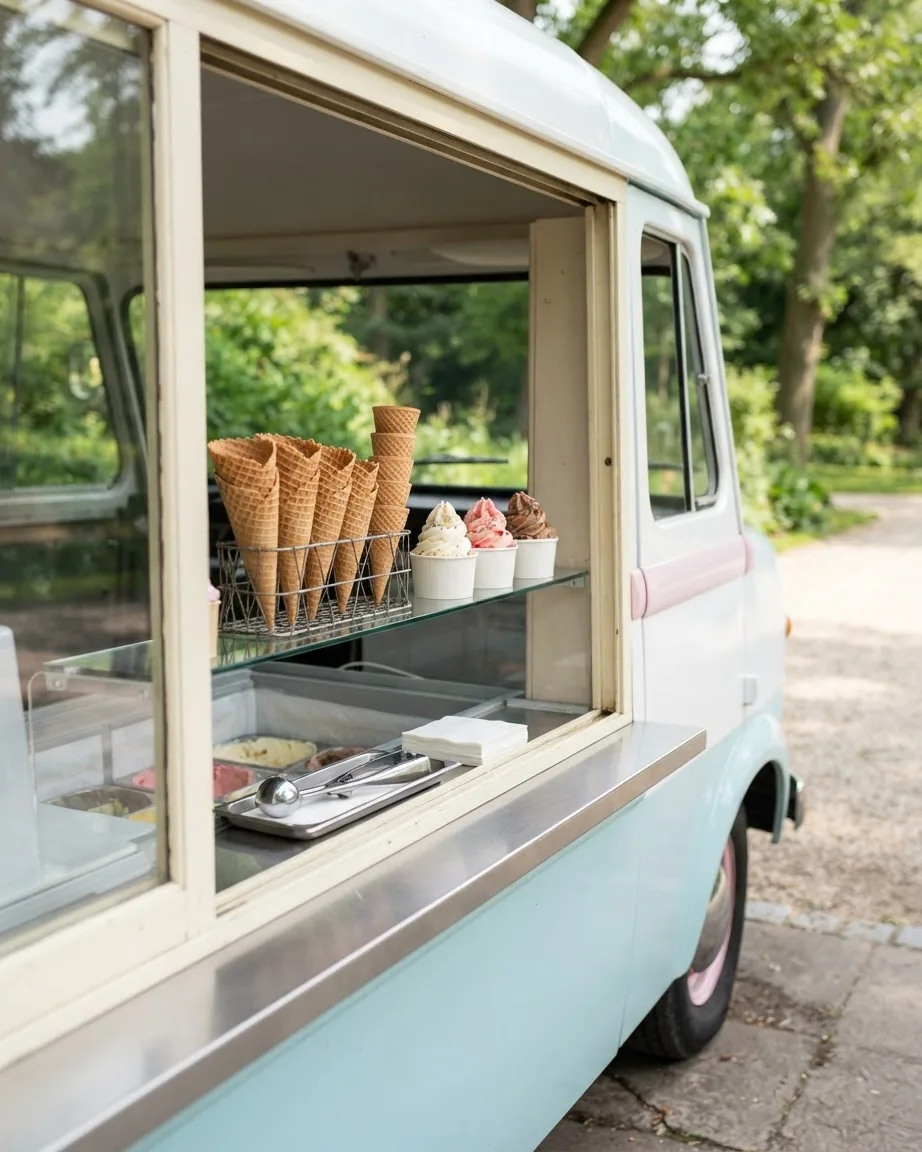
Published ranges and reported invoices don’t always sit on top of each other, and the gap is where budgets get blown. Roaming Hunger states the average minimum cost for ice cream truck catering is $800. Lena Mae’s puts most bookings at $300 to $1,000. Those are the brochure numbers.
Now the real receipts. The r/weddingplanning community shows what hosts actually report paying, with figures that sit at or above the top of the “$300 to $1,000” band, which tells you the published range assumes a smaller or simpler event than a wedding. If you’re feeding 150-plus, budget past the brochure ceiling, not inside it.
Package floors vary by vendor and aren’t interchangeable. The Ben & Jerry’s West Hartford franchise lists a cup-and-cone package with a $625 minimum serving up to 50, additional servings $7.50 each; its full sundae-bar package carries a $675 minimum for up to 50, additional servings $8.50. Albert’s Mobile Ice Cream starts its Package 1 at $375 for 50 pieces and one hour. OC requires a 50-serving minimum with no deposit to book. These floors answer different questions, so compare what each includes before you compare the dollar sign.
Quick reference: vendor pricing structures
- OC Ice Cream: truck from $75, 1-hour service $125, ice cream $3.50 each pay-per-consumption, 50-serving minimum.
- Jim’s Ice Cream Truck: initial town fee + $3.60 per ice cream plus tax, 20-per-hour minimum, $50 per additional hour.
- Albert’s Mobile Ice Cream: Package 1 $375 (50 pieces, 1 hour), additional ice cream $3.95 each.
- Ben & Jerry’s (West Hartford): cup/cone $625 minimum (up to 50), sundae bar $675 minimum (up to 50).
Why $3.50, $3.60, and $3.95 Are Not the Same Per-Scoop Price

Three vendors quote a per-piece number in the same neighborhood, and it’s tempting to rank them cheapest to priciest. Don’t. The base structure under each price is different, so the figures don’t compare directly.
OC’s $3.50 and Jim’s $3.60 are pay-per-consumption add-ons that sit on top of a time or base fee – you pay the base, then every scoop. Albert’s $3.95 is the price for pieces beyond an included package quantity; the first 50 are already baked into the $375. So a 60-guest event at Albert’s is 50 included pieces plus 10 at $3.95, while the same 60 scoops at OC is the base plus all 60 at $3.50. Same ballpark per piece, very different totals.
Jim’s adds a wrinkle worth knowing if your crowd is large: the per-piece price drops with volume. The first 200 ice creams run $3.60 each; pieces from 201 to 400 drop to $3.25 each; from 401 and beyond, $2.75 each. Jim’s also publishes a consumption-band structure where, if 201 to 400 ice creams are consumed, the truck stays up to two hours with an overall time fee of $35 plus the cost of ice cream; 401 to 600 consumed buys up to three hours at the same $35 time fee; 601 to 800 consumed buys up to four hours. Two ways of describing the same operation live on one page, so confirm which one your quote uses.
The Fees That Don’t Show Up in the Headline Number
The advertised rate is the floor of your bill, not the total. Here’s what gets added, consolidated from vendors that publish their terms:
- Travel fees, usually tiered by distance. Albert’s offers complimentary travel within a close radius of ZIP 91352, then charges rising fees as the distance grows. OC charges a $50 travel fee for LA and Inland Empire bookings. Ask for the tier that matches your address before you sign.
- Card / processing surcharges. OC adds a 4% card fee. These stack on sales tax, which several vendors note applies on top of the per-piece price.
- Late-night premiums. Albert’s applies a $50 flat late-night fee, once per event, when service starts or extends past 8:00 PM.
- Per-additional-hour fees. OC bills $25 per 30 minutes beyond the first hour; Jim’s charges $50 per additional hour.
- Deposit and refund-surcharge terms. The Ice Cream Lady NJ takes a deposit, typically $50, refundable up to 72 hours ahead – but a deposit paid by credit card carries a 3.5% surcharge if it’s refunded.
If you’re pricing a broader party, our rental for a party breakdown runs the same minimum-spend trap for the whole menu, not just dessert.
Can the Line Move Fast Enough Before the Ice Cream Melts
A truck that can’t clear your crowd inside the serve window turns into a line, and a line at a wedding is a problem. Throughput varies a lot by operation. Albert’s trucks can serve 600 to 800 ice creams per hour running prepackaged novelties. Jim’s, at top speed, hands out 300 ice creams per hour. That’s a wide spread, and it matters against Roaming Hunger’s catering minimum of 100 eaters per two hours.
Sanity-check your own window: divide your headcount by the truck’s hourly rate. A 175-guest event at Jim’s 300-per-hour pace clears in roughly 35 minutes of pure serving if everyone takes one piece – comfortable inside a three-hour booking. The same crowd at a slower hand-scoop operation, or with everyone arriving at once after the toasts, needs more buffer. Prepackaged novelty service is faster than hand-scooping because there’s no portioning at the window; that single step is what lets a novelty truck hit 600-plus pieces an hour.
Scooped, Soft-Serve, or Prepackaged: Not Every Truck Scoops
A common assumption is that renting an ice cream truck means someone scooping cones to order. It often doesn’t. Albert’s states plainly that its trucks carry prepackaged novelty treats – over 50 varieties – and that modern ice cream trucks, push carts, and VW buses carry prepackaged ice cream, not hand-scooped or soft-serve. The Ice Cream Lady NJ describes itself as a novelty truck with no soft serve, while listing kosher, gluten-free, dairy-free, and nut-free options.
Allergen warning
This changes two things. First, speed: prepackaged service moves faster, which is why the throughput numbers above run high. Second, dietary coverage: a novelty fleet with wrapped, labeled products makes it easier to accommodate allergies than an open scooping station, where cross-contact is harder to control. If you specifically want soft-serve or scoop-to-order, confirm the format before booking – the brand name on the truck doesn’t tell you.
Truck vs. Cart: When the Smaller Option Is the Right One
A cart is cheaper than a truck, and for the right event it’s the smarter spend. Roaming Hunger puts cart service at $5 to $10 per person with a rental minimum of about $300 to $600. OC’s cart rentals start at $200 and include a four-hour rental, delivery and pickup, and dry ice – which keeps product cold without a generator or shore power.
The decision comes down to access and scale. A cart fits a venue a truck can’t physically reach: a rooftop, a courtyard, an indoor hall. It also sidesteps parking and power questions entirely. A truck wins on capacity and spectacle – the music, the signage, the walk-up nostalgia – and on sheer volume for a big crowd. Lena Mae’s notes that for groups over about 30 people, renting generally beats a DIY sundae bar on both stress and total cost once you count freezers, dry ice, serving help, and cleanup. Below that, a cart or even DIY may be enough.
Will My Driveway Actually Work for the Truck
Generic “confirm parking” advice is useless. Here are the concrete disqualifiers vendors publish. The Ice Cream Lady NJ cannot park on steep inclines and requires an ample spot directly in front of the home with easy in-and-out access – no narrow driveways with low-hanging branches or eaves, and no driveway parking at all without advance approval and a photo. A loaded ice cream truck is heavy and tall; a low branch or a soft driveway is a real hazard, not a formality.
Before you book, walk the approach and check: Is there a flat, legal spot the length of a truck? Any overhead branches or wires along the path in? Is the surface something a heavy vehicle won’t sink into or scrape? Is power available if the truck needs it, or does the operation run on dry ice like OC’s cart? Send a photo if the vendor asks for one – it’s cheaper than a cancelled booking on the day.
When to Book, and Your Weather and Cancellation Exposure
Lena Mae’s calls four to eight weeks ahead a safe window for most parties, while summer weekends and wedding season fill up months out. For a national soft-serve fleet, Mister Softee asks for at least two weeks’ notice and up to one week for a response, with financial arrangements made directly with the local franchisee – so a national brand name doesn’t mean a national price; you negotiate with the operator.
Read the weather clause before you pay the deposit. The Ice Cream Lady NJ makes deposits refundable up to 72 hours in advance, tightening to six hours if your event is cancelled due to weather without being able to reschedule – and it asks you to re-confirm the booking three days ahead by text. That three-day re-confirm is a step people skip and then lose their slot over. Put it on your calendar the day you book.
One Generic Permit Won’t Cover You: Rules Live Where You Serve
Here’s the dimension the pricing pages never touch, and it’s the one that can shut a booking down. The binding rules come from the city and county where the truck serves, and they differ sharply. When you rent, your job shifts from “is this vendor licensed?” to “is this vendor cleared for my location?”
How different? Texas moved to a single state license: beginning July 1, 2026, mobile food vendors license through the Texas Department of State Health Services, where the Type I application fee is $309. Lexington, Massachusetts, by contrast, requires a permit from each Board of Health jurisdiction where sales occur – a per-town model, not a statewide one. Minneapolis issues a business license keyed to prepackaged product definitions and requires written park approval to operate in a city park. Jacksonville and Duval County reflect a Florida-specific prepackaged-ice-cream-goods exception to the state’s July 1, 2020 pre-emption. Same business, four regulatory paths.
New Orleans shows how the fees layer. Its mobile-confections (formerly ice cream) truck permit lists City fees totaling $425.25 for a new permit – $150 occupational license, $200.25 mayoralty permit, $50 application fee, $50 sales tax deposit, and a $5 ID card. Renewal City fees total $405.25 (everything except the $50 application fee). On top of that sit a $50 annual fire department application and inspection fee and a $150 annual health permit fee, both excluded from the City total. Advertised permit “fees” rarely contain all of this.
New Orleans also restricts operation in ways that affect where and when a rented truck can park: sales only between 11:00 AM and 8:00 PM, no more than 30 minutes at one location and no more than one stop per location per day, nothing within 40 feet of an intersection or a traffic-control signal, and no operating on streets with a speed limit over 25 miles per hour.
If you’re sorting through what a truck needs to carry before it rolls, our guide to food truck permits walks the stack that doesn’t arrive in one envelope.
Same 60 Scoops, Three Package Floors: What You Actually Pay
Three vendors in this guide quote a per-piece number in the same neighborhood, so it’s tempting to rank them cheapest to priciest. Work the arithmetic for one concrete crowd – 60 guests, one scoop each – and the ranking flips, because each vendor’s base fee or package floor sits under that per-piece rate. Using only the figures these vendors publish:
- OC Ice Cream – $335.00. The $125 one-hour service base plus 60 scoops at $3.50 each ($210) totals $335.00 before sales tax, the 4% card fee, and any travel fee. That works out to about $5.58 per scoop.
- Albert’s Mobile Ice Cream – $414.50. The $375 Package 1 covers the first 50 pieces; the remaining 10 run $3.95 each ($39.50), for $414.50 – roughly $6.91 per scoop, even though Albert’s $3.95 looks like the highest per-piece figure of the three.
- Ben & Jerry’s (West Hartford) – $700.00.
The lesson: at 60 guests, OC’s lower base fee beats Albert’s lower-looking package deal, and the branded package floor costs double OC despite a comparable per-serving number. Before you compare the dollar sign, run your own headcount through each structure – the floor, not the per-piece rate, decides the winner.
Frequently Asked Questions
Is a deposit always required to lock in the date?
No – it depends on the operator. OC Ice Cream books a 50-serving minimum with no deposit at all. The Ice Cream Lady NJ, by contrast, needs one to hold your slot, usually $50, and warns that a credit-card deposit picks up a 3.5% surcharge if you later cancel and get it back. Always ask whether the hold is refundable and for how long before the event.
Does the per-scoop price drop if a lot of guests order?
With some vendors, yes. Jim’s Ice Cream Truck steps its rate down by volume: the first 200 pieces at $3.60, pieces 201 through 400 at $3.25, and anything from 401 upward at $2.75. For a large wedding or company picnic, that tiering meaningfully lowers your effective cost per guest – worth confirming when you compare quotes against flat per-person rates.
What happens to my money if a storm cancels the event?
Terms are vendor-specific and tighter than you’d expect. The Ice Cream Lady NJ normally refunds a deposit up to 72 hours out, but if weather forces a cancellation and you can’t reschedule, that window shrinks to six hours. Get the weather language in writing, and ask directly whether a rain date counts as a reschedule under their policy.
Can the truck legally park right outside any venue?
Not automatically. New Orleans bars operation within 40 feet of an intersection or signal and on streets posted above 25 miles per hour, and caps each stop at 30 minutes. Minneapolis requires written approval to work a city park. Clear the specific spot and schedule with the vendor and, where needed, the local authority before you commit to a location.