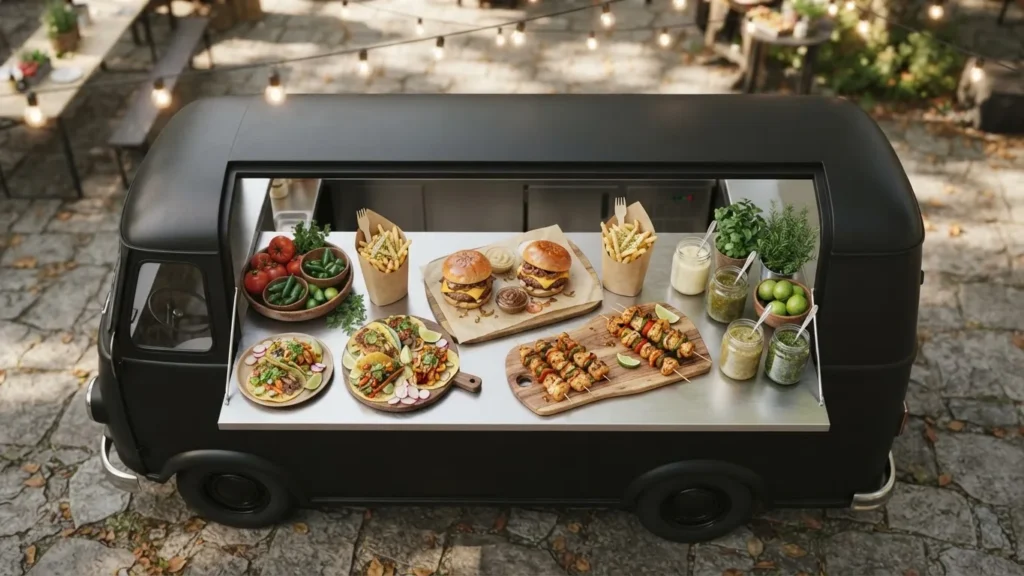
For any gathering under about 75 guests, the per-person price on the menu is not what sets your bill – the minimum spend is. That one fact flips how you should read every quote. When you plan food truck events, you are really solving three separate problems that most hosts blur into one: what the truck charges as a floor, how fast it can push meals during the rush, and which permit the city or county attaches to the gathering. Get the floor and the rush right and the per-head number mostly takes care of itself.
Food Truck Club publishes medians from 1,431 paid bookings through October 2026, and that dataset is where the clearest numbers in this guide come from.
Quick answer: Food truck events for a small private party are usually governed by a minimum spend near $750 to $1,200, not the per-person rate. Across confirmed bookings the median catering cost is $18 per person before sales tax, but under 50 guests the median jumps to $26 a head because the minimum sets the bill. Plan one truck for every 200 to 300 eaters, size capacity to your arrival window rather than the headcount, and check your city and county permit rules early – a public gathering of 75 people can trigger a permit that a backyard party never would.
Why a 40-guest party pays $26 a head and a 200-guest party pays $15
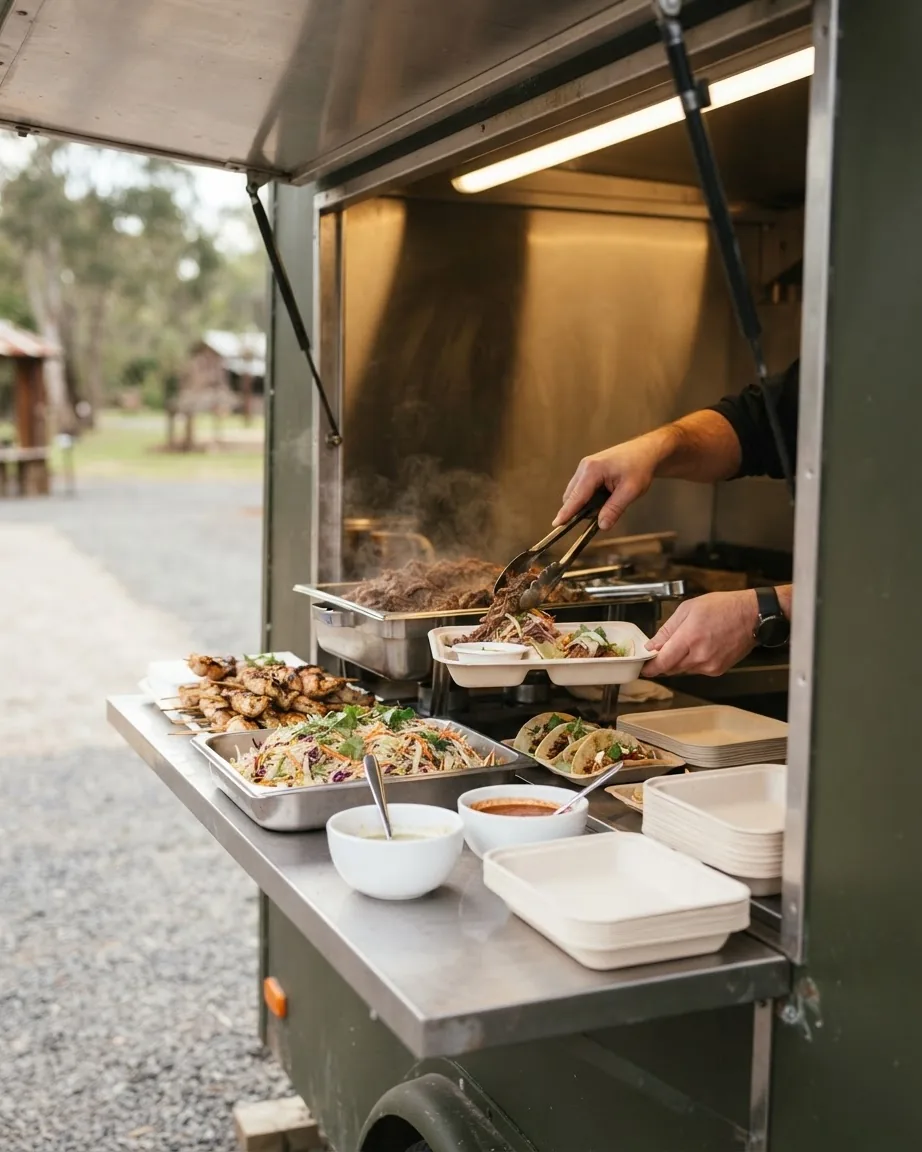
The per-person figure drops as the crowd grows, and the reason is the floor underneath it. Food Truck Club’s booking data shows the median per-person price by guest tier: $26 a head under 50 guests, $17 at 100 to 149 guests, and $15 at 200 to 299 guests. Same trucks, same food. The small event just can’t spread the minimum across enough plates.
Those floors are real and they don’t fully agree across platforms, which is worth knowing before you sign. Food Truck Club puts the typical minimum near $750, with the middle half of trucks between $600 and $900. Best Food Trucks reports most minimum spends run $800 to $1,200 for small events under 75 guests, scaling to $4,000 or more for very large ones. Truckster states a per-person rate of $10 to $20 plus a minimum typically $800 to $2,000. These are different operator pools, so treat them as overlapping bands rather than one number – but the lesson holds across all three: below roughly 75 guests, you pay the minimum whether your headcount justifies it or not.
The practical move: once your headcount times the per-person rate clears the minimum, every extra guest costs only the per-person rate. So a party sitting just under the floor often saves almost nothing by cutting guests, and sometimes saves money by adding a few. You can see the same floor at work in wedding-scale bookings in our taco truck wedding breakdown.
Drop-off at $1,108 versus full service at $2,584: what the gap buys
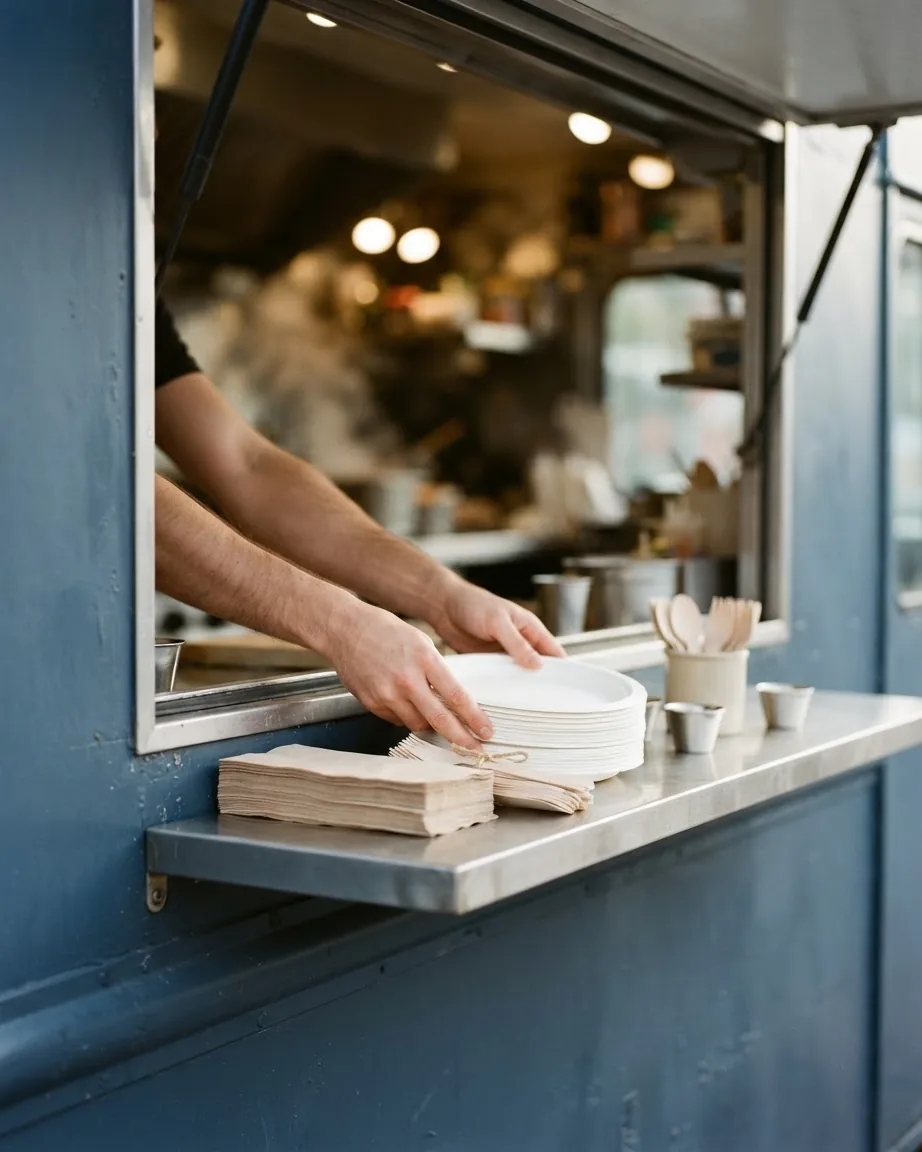
Service style changes what the same guest count costs. Best Food Trucks reports drop-off events average around $1,108, compared with $2,584 for full-service events. The spread is not markup – it is labor and inclusions.
Full-service food truck catering, per Food Truck Club, typically includes food prep, the serving crew, disposable plates, napkins, utensils and condiments, and travel within the local service area. Drop-off strips most of that back to the food. If you have your own staff, your own table setup, and a short window, drop-off is the honest choice. If you want the truck window open, a crew running it, and nothing for you to manage during service, the full-service number is what you are actually buying.
One cost note that surprises people: Food Truck Club found the same truck costs the same on a Saturday in June as on a Tuesday in February – no weekend or seasonal premium in its dataset. Other platforms disagree; Best Food Trucks and Truckster both note peak dates can lift minimums or rates. Read that conflict this way: availability tightens hard on summer weekends even where price holds flat, so the premium you pay for a June Saturday is often measured in how early you must book, not in dollars per head.
The service-window math that decides whether one truck is enough
Here is the planning error that sinks more events than price ever does: sizing the truck to the guest count instead of the arrival pattern. Food Truck ROI makes the point directly – guest arrival pattern, not total headcount, determines whether one truck can cope. A 150-person event is a different animal when everyone lines up at once.
The baseline rates, from Food Truck ROI: a well-run truck serves 60 to 100 meals per hour under normal conditions, 40 to 60 for slower custom menus, and 100 to 150 or more for fast limited menus. Now run the window. A 100-person lunch in 90 minutes requires about 67 meals per hour before you account for the rush. That math looks fine until the crowd arrives together.
Food Truck ROI’s own worked warning: if 90 guests arrive in 30 minutes and your truck serves 60 meals an hour, the line is going to build. And a stricter case – if the event needs 90 meals in 45 minutes and your truck normally moves 60 meals an hour with that menu, the quote needs to change before you say yes. That is your go/no-go check. Before booking, ask the operator two things: what is your real meals-per-hour with this exact menu, and how tight is my serving window? If the window can’t absorb the rush, the fix is a simpler menu, a longer window, or a second truck – decided now, not at noon on event day.
- Normal menu: 60 to 100 meals/hour
- Slower custom menu: 40 to 60 meals/hour
- Fast limited menu: 100 to 150+ meals/hour
- Your test: guests ÷ realistic arrival window ≤ the rate above
When you need a second truck – and why it won’t cut your per-head cost
The threshold for adding a truck depends on who you ask, and the disagreement is really about event type, not raw speed. Food Truck Club points past 150 guests; Best Food Trucks flags 200 or more; FoodtruckBooking.us advises considering multiple trucks for events over 250 to 300 guests. The Northeast Ohio Food Truck Association (NEOFTA) splits it by purpose: plan one truck for every 200 to 300 people if it is an eating event, or one per 500 to 600 when food is not the focus. The spread exists because a captive lunch crowd eats differently than a festival crowd grazing over hours.
Where hosts guess wrong is assuming a second truck is cheaper per head. It isn’t, because each truck carries its own minimum. Food Truck Club’s medians: one truck books for about $1,388, two for $3,343, and three for $5,142. Two trucks cost well over double one, not half-again. The second truck buys you throughput and menu variety, not a volume discount – so add it to beat the clock, not to beat the budget.
Food truck events versus a traditional caterer: $10 to $38 against $70
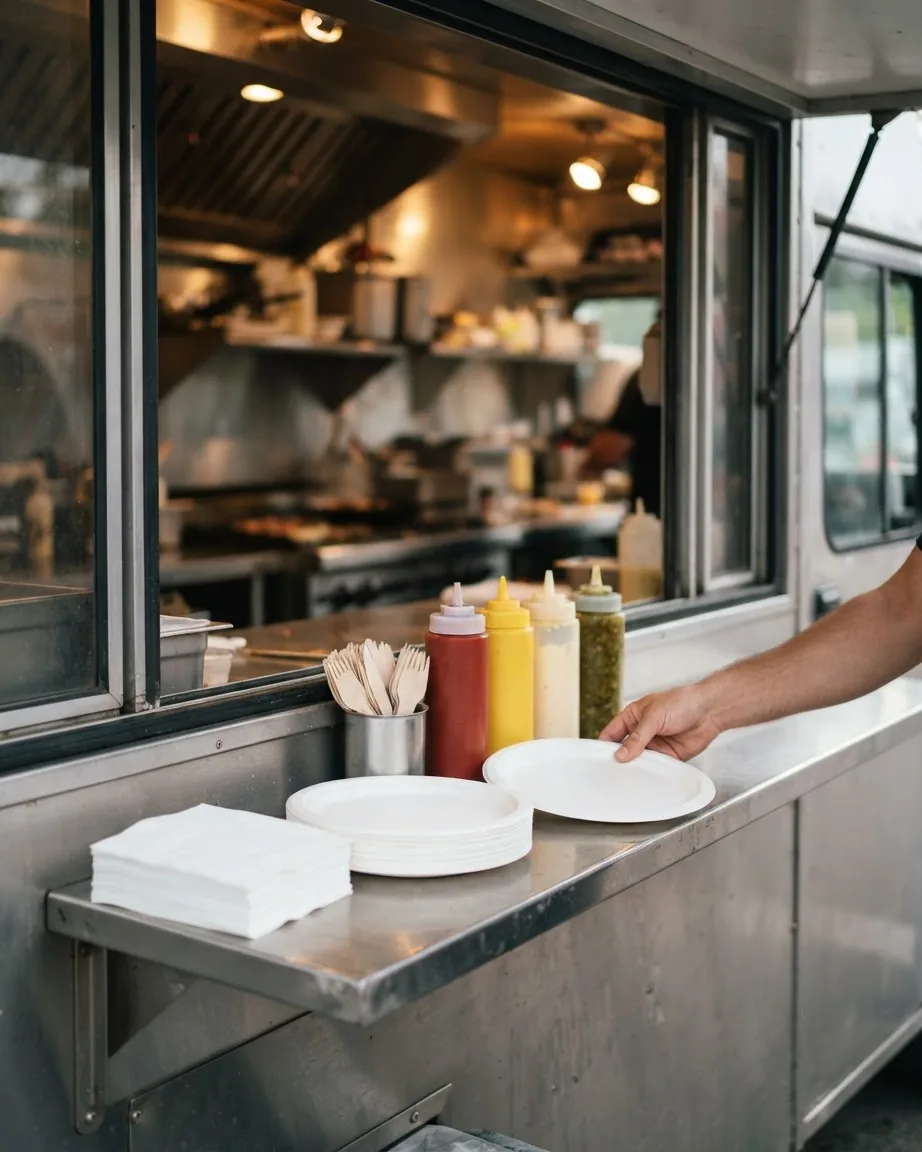
On price alone the gap is wide. Truckster puts traditional catering around $70 per person against food trucks around $10 to $25 per person, calling the truck the more budget-friendly option. Folding in Best Food Trucks’ full-service figure of $22 to $38 per person, the honest food truck range for an event runs roughly $10 to $38 a head depending on service style and menu.
The caveat that keeps this honest: at the top of that range, high-end food truck service converges toward caterer pricing. Birthday parties run highest per person at $38 average, and Best Food Trucks reports wedding receptions and holiday parties consistently land at $31 to $36 per person. So the “trucks are always cheaper” line holds for casual and mid-tier events; for a plated, formal affair the dollar gap narrows and you are choosing style, not just savings.
How booking and deposits actually work before the event
The process is quicker than most hosts expect. At Best Food Trucks you can submit a request and receive proposals from trucks in your area within 24 to 48 hours. That lets you compare real quotes against the minimums above instead of guessing.
On money: the deposit typically runs 25 to 50 percent of the total, with the balance due before or at the event. Standard catering windows run 1.5 to 2 hours; stretching to 3 or 4 hours adds cost through extra staffing or a higher minimum spend. So if your timeline is loose, pin the window down before you sign – an open-ended “we’ll just keep it running” is a line item, not a courtesy. For the wider picture on booking a truck for a private gathering, see our catering section, and for party-specific numbers our food truck rental for a party guide.
Running a public multi-truck event: ratios, spacing, and the vendor fee
Organizing a public gathering is a different job than hosting a party, and NEOFTA publishes planner guidelines built for it. Start with staging. Food trucks range from 20 to 30 or more feet in length and need about 10 feet between each truck when you lay out a multi-truck event – plan your footprint before you plan your map.
Arrival timing is written into the same guidelines: trucks should arrive one hour before the event start time, or two hours prior if pre-event health or fire inspections take place. On the money model, NEOFTA states that asking 5 to 10 percent of total sales is fair for all trucks and should guarantee that everyone makes a profit – a sales-share model, not a flat booth fee, which keeps slow-day trucks from losing on the deal.
Power is on the truck, not on you. NEOFTA notes all trucks will have the ability to be self-sufficient with onboard power and water, though organizers may offer a grid hookup to cut generator noise at long events. One forecasting warning worth repeating for ticketed events: attendance is not the same as buyers. Food Truck ROI advises forecasting expected eaters rather than crowd size, and NEOFTA asks organizers to share ticket-sales numbers with trucks one week, 48 hours, and 24 hours before the event so each truck preps to the real appetite.
| Item | Value |
|---|---|
| Truck ratio (eating event) | 1 per 200-300 people |
| Truck ratio (food not the focus) | 1 per 500-600 people |
| Spacing | ~10 ft between trucks, each 20-30+ ft long |
| Arrival | 1 hr early, or 2 hr if inspected on site |
| Vendor fee | 5-10% of total sales |
The permit that changes by city and county – and why private property isn’t a free pass
This is where generic advice fails, because the binding rule comes from your own city or county and the categories don’t match across lines. A public gathering can trigger a permit a backyard party never touches. In San Diego, California, as of July 2026, the Development Services Department requires a Special Events Permit for any mobile food truck operation that would draw an assembly of 75 people or more on public property. One useful exception there: a single permit can cover multiple trucks on one property.
Private property is not a blanket exemption, which is the misconception that catches hosts. San Diego still requires property-owner authorization for any mobile food truck activity on private property, permit or not. In Long Beach, California, for 2026, the Mobile Food Facility (MFF) category covers truck gatherings fully contained on private property – and still requires that the event organizer and all vendors hold a Long Beach Business License, with every food vendor also carrying a Health Department Permit. The MFF event fee is $102 per day, and events without entertainment may run up to 3 consecutive days with 15 days between applications.
Watch the entertainment trap in Long Beach: add entertainment and the event shifts off the MFF pathway onto an Occasional Event Permit, capped at one day with 10 days between applications. The same party plus a live band is legally a different event.
Temporary-event permits for the operator joining the lineup
If you run the truck rather than host the event, the question “do I need a permit for this event” has three possible answers – no, yes, or a different permit class – and it hinges on your license type and the county. The distinction that matters is a licensed mobile unit versus a temporary food establishment.
Weld County, Colorado, treats a temporary event as a single community event running no longer than 14 consecutive days, and its Department of Public Health and Environment generally requires no application unless you operate without the mobile unit or set up a temporary extension outside it. Mohave County, Arizona, goes the other way: its Department of Public Health requires all food and beverage vendors to complete an application whether or not fees apply. Huntington County, Indiana, draws the line by product – its $20.00-per-event Temporary Food Permit ($100.00 for unlimited annual setups) explicitly does not cover mobile food trucks, trailers, or push carts, which instead carry a $150.00 annual mobile retail permit.
Menu complexity can raise your permit class too. King County, Washington, bases its permit level on food-handling complexity, defining complex handling as cooking from raw animal products, serving raw animal products, or any cooling step. A simple reheat-and-serve menu and a cook-from-raw menu are not the same application.
Late filing isn’t a surcharge – it’s a go/no-go
Missing a filing deadline can stop your event cold, and the consequences escalate hard by jurisdiction. These are the numbers to put on your calendar, because “we’ll sort the permit that week” is how trucks get turned away at the gate.
- Weld County, CO: submit with payment at least 14 days before the event; applications received within two business days will not be processed.
- King County, WA: a $50 late fee for applications 3 to 5 days out; 2 days out requires in-person approval and a $100 late fee. Multi-day events, or single-day events with six or more food vendors, need an event coordinator who submits a checklist at least 30 days ahead.
- Mohave County, AZ: submit at least two weeks prior; a $65.00 late fee applies under 7 business days out, and vendors not permitted before the event must cease operations and leave.
- Huntington County, IN: an approved food permit must be received before opening any food service, and permits are not transferable.
Mohave County’s fee structure is the cleanest illustration of how a county prices time: a Temporary Food Service permit for one event lasting 1 to 5 days costs $108.00, with a $10.00 fee for each additional day beyond five. File early enough and you pay the base; file late and you either pay the surcharge or you don’t operate.
Because every one of these figures comes from a different county, the real takeaway isn’t any single number – it’s that you must confirm the deadline and fee with the health department that covers your event’s address before you commit to a date. The permit is issued locally, and so is the penalty for being late.
Reading a quote with confidence: a quick decision framework
Put the pieces together and a quote stops being a mystery. Run it through four checks in order, each tied to a number you can now trust.
- Floor check: Is the headcount × per-person rate above the truck’s minimum? If not, the floor sets the bill regardless.
- Window check: Does guests ÷ my realistic arrival window stay under the truck’s real meals-per-hour for this menu? If 90 arrive in 30 minutes and the truck does 60/hour, the line builds.
- Scale check: Past 200-300 eaters, am I adding a truck for throughput – knowing two run ~$3,343, not a discount?
- Permit check: Does my address, crowd size, and menu trigger a local permit, and what’s the filing deadline?
Clear all four and the per-person figure – somewhere in the $10 to $38 band depending on service style – is the easy part. For the operator-side economics of the vehicle itself, our taco truck rental breakdown sits alongside this one.
Do food trucks charge extra for weekend or summer events?
The data splits here. Food Truck Club’s bookings show no price bump for a June Saturday over a February Tuesday. Best Food Trucks and Truckster report peak dates can lift rates or minimums. The safe read: dollars may stay flat, but prime slots vanish fast, so book summer weekends months ahead rather than expecting to pay your way in late.
If my event has fewer than 75 guests, can I skip the permit entirely?
Not automatically. San Diego’s 75-person threshold applies to public property; a smaller crowd there may clear that trigger. But private-property events still need the landowner’s written authorization, and counties like Mohave require every vendor to apply regardless of fees. Crowd size is one trigger among several – address and menu matter just as much.
How fast can I get quotes once I start looking?
Through a marketplace, proposals arrive in 24 to 48 hours after you submit a request. That’s quick enough to compare several trucks against their minimums, but don’t confuse a fast quote with a locked date. Popular trucks fill summer Saturdays early, so treat the 48-hour quote as the start of booking, not the finish.
What happens if the organizer’s crowd estimate is wildly off?
For ticketed public events, headcount isn’t your buyer count – forecast expected eaters instead. Share updated ticket numbers with trucks at one week, 48 hours, and 24 hours out so each preps to the real appetite. Over-forecast and trucks waste prep; under-forecast and the line stalls during the rush that already decides your event’s success.
The real math on a second (and third) truck
Hosts assume a second truck splits the cost or earns a volume discount. Run the medians and the opposite is true. Starting from one truck at $1,388, here is exactly what each added truck costs you:
- One to two trucks: the bill goes from $1,388 to $3,343. Two trucks run 2.41x one truck, not 1.5x.
- Two to three trucks: $3,343 to $5,142. Three trucks land at $5,142 against $1,388 for one truck.
The takeaway the raw quotes hide: each truck carries its own minimum spend, so the total scales substantially per truck rather than earning a discount. That extra money buys throughput and menu variety to beat the clock, never a lower per-head rate. Add a truck because your arrival window can’t absorb the rush, not because you expect it to save money.