Food truck friday is the closest thing this business has to a salaried gig: a recurring weekly event, usually 5 to 9 p.m. on a Friday evening, where a curated lineup of trucks parks at the same zoo, park, brewery, or business district and a crowd shows up because it is Friday and they always do. Free for the crowd, fee-based for the trucks, running spring through fall in most markets.
I have held weekly slots that quietly paid the truck’s insurance for the year, and I have walked away from ones where the fee math stopped making sense, which is exactly the 2026 story, because fees are moving. This guide explains how these events actually work, who runs them, what a slot is worth, and how to get one that pays.
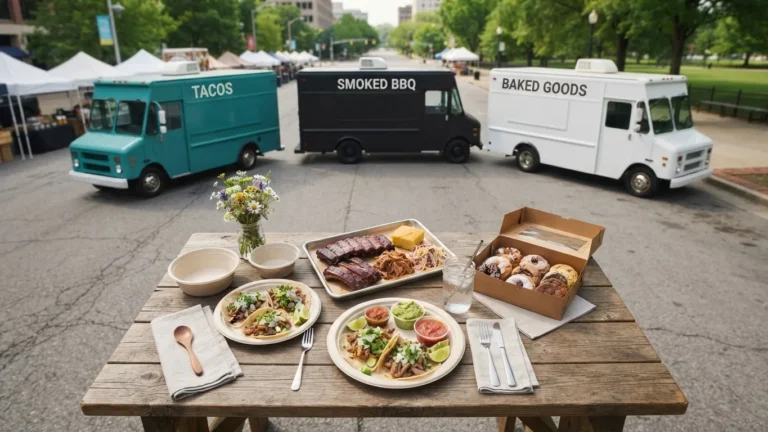
What Food Truck Friday is, and why it works
The format is simple and nearly universal. A host site clears space for somewhere between 3 and 12 trucks. The event runs a fixed evening window, most commonly 5 to 9 p.m., with lunchtime variants running around 11 a.m. to 2 p.m. in office districts. Entry is free; the crowd pays for food. Live music or family activities often anchor the site, and the lineup rotates week to week so regulars see new menus. The season follows the weather: weekly from spring through fall in most of the country, year-round in the Sun Belt.
Why the format took over is worth one honest paragraph, because it explains everything about how to work it. A one-off festival is a spike: huge crowd, huge prep gamble, then nothing. A weekly series is a habit. The same families, office crews, and dog-walkers come back every Friday, and habit is the most valuable thing a small food business can attach itself to. For the host, trucks turn a parking lot or lawn into a Friday destination at almost no cost. For the city, it is downtown activity nobody has to subsidize. Everyone’s incentives line up, which is why the model spread to nearly every metro in the country.
The three organizer models, side by side
Every Food Truck Friday belongs to one of three structures, and knowing which one you are dealing with tells you who picks the trucks, who sets the fees, and how stable the gig is.
- Municipal series. A city, park district, or downtown partnership runs the event on public space. Spots are assigned through a city application, fees tend to be modest and published, and the series survives staff turnover because it belongs to a department, not a person. Slower to get into, steadier once you are in.
- Professional organizers. Companies like the Food Truck League (foodtruckleague.com) build weekly calendars across many venues and curate lineups from their roster. One application covers a whole season of events, scheduling runs through their portal, and the organizer handles the venue relationship. The fee is how they get paid, so read it closely.
- Venue-hosted. A zoo, brewery, mall, or office campus runs its own night. Roger Williams Park Zoo’s long-running Food Truck Friday in Providence, produced with PVD Food Truck Events (rwpzoo.org), is the canonical example: an institution with a built-in audience turning its grounds into a Friday event. Access runs through the venue or its event partner, and these slots track the venue’s own draw.
Truck-side associations add a fourth path in some cities: groups like the Syracuse Food Truck Association (syrfoodtrucks.com) organize their own event calendars, which flips the power dynamic, the trucks collectively are the organizer, and fee money stays in the pool.
What a weekly slot is worth to a truck
Here is the math I actually run before committing a Friday for a season, because a weekly slot is a portfolio decision: you are trading your best night of the week for one location, twenty-plus times a year.
Start with the revenue side. A decent suburban Food Truck Friday with 6 trucks and a steady crowd supports $900 to $2,000 gross per truck for the 4-hour window, depending on the market, the lineup size, and your ticket average. Take a $1,400 night as the working middle. Across a 24-week season, that Friday alone grosses around $33,600, call it a third of many trucks’ annual revenue, from one recurring booking. That is why these slots matter: not because one Friday is huge, but because 24 predictable Fridays change how you buy, prep, and staff.
The predictability compounds off the books too. When I held the same Friday slot for two full seasons, the change I noticed first was in prep waste, it fell hard, because after six weeks I knew that crowd’s volume within 10 percent either way. The second change was catering inquiries: the weekly crowd is the same neighborhood every time, and the wedding, office, and block-party bookings that came off that window were worth nearly as much as the Fridays themselves. A weekly slot is a marketing channel that pays you to run it, the same dynamic that makes a food truck park residency valuable.
Against that sit the costs: the fee (next section), the opportunity cost of your Friday, and lineup risk, a curator who books two menus like yours into the same night just cut your gross by a third. The overlooked detail in weekly-slot math is the weather portfolio: across 24 weeks you will eat three or four washouts, and most series do not refund fees for rain. Price your season assuming 15 percent of the nights disappoint, and the good slots still clear the bar comfortably.
Fees in 2026: the numbers, and the fight over them
The fee conversation moved in 2026, and it moved against the trucks in several markets. The traditional structures are three: a flat day fee, a percentage of the night’s sales, or a hybrid with a modest flat fee plus a smaller percentage. On top of those, organizers increasingly layer application fees for the season and refundable security deposits against no-shows and site damage.
What changed this year is venues discovering their leverage. According to June 2026 reporting in the Jefferson City News-Tribune, new fees at that market’s Food Truck Friday, application fees, deposits, and daily or monthly lot-use charges where vendors had historically parked free under informal agreements, split the vendor community, with some trucks accepting the new terms and others pulling out of the event entirely. That story is repeating in smaller markets across the country as hosts formalize what used to be handshakes.
The operator response is arithmetic, not outrage. Total all charges for the season, fees, deposits at their cash-flow cost, commissions at your expected gross, and divide by expected season revenue from the slot.
In my experience the slot works clean when the all-in take stays under 10 percent of gross, gets uncomfortable at 15 percent, and past that you are working Fridays for the organizer. A $150 flat fee against a $1,400 night is 11 percent, workable. The same fee against a 10-truck lineup diluting you to $800 a night is 19 percent, and that is a slot to renegotiate or walk from. Walking away from a bad Friday is not losing a gig; it is freeing your best night for a better one.
A season on paper: sample numbers for one Friday slot
To make the portfolio math concrete, here is a 24-week season sketched at three realistic performance levels for a truck running a $12 average ticket in a 6-truck weekly lineup, with a $150 flat fee per night and four rained-out or dead nights assumed across the season.
| Season quality | Average night gross | 20 good nights | Season fees (24 nights) | Fee share of gross |
|---|---|---|---|---|
| Slow slot | $800 | $16,000 | $3,600 | 22.5% – walk away |
| Steady slot | $1,400 | $28,000 | $3,600 | 12.9% – workable |
| Strong slot | $2,000 | $40,000 | $3,600 | 9% – keep it forever |
Two things jump out of that table every time I run it for someone. First, the fee is fixed but the gross is not, so the identical $150 night is either a rounding error or a fifth of your revenue depending on the crowd the organizer actually delivers. That is why the first season at any new series should be treated as paid market research. Second, the rained-out nights matter more than they look: they pay full fees against zero gross at most series, which is exactly why the all-in percentage, not the sticker fee, is the number to negotiate on.
How to win a slot
Curated lineups mean you are pitching, and having managed applications from both sides, cooking in the lineups and helping a small series pick its trucks one season, the pattern of what wins is consistent.
- Pitch a lane, not a range. Curators build a balanced night: one taco truck, one burger truck, one dessert truck. The application that says smash burgers, three items, 90-second tickets beats the one that says we can do anything.
- Have the paperwork ready before applying. County health permit, fire inspection where required, and a certificate of insurance naming the organizer or venue as additional insured. Organizers rank reliability above menu, because the no-show truck is their nightmare, and clean paperwork signals reliability.
- Photos sell. A sharp truck wrap and appetizing food photos do real work in a curation stack. It is the same investment case as the wrap itself.
- Commit to the season. Weekly series want trucks that show up every assigned week. Offering full-season availability, and meaning it, moves you up the list and into the better date assignments.
- Start with the association if your city has one. Truck-run event calendars are the friendliest first booking, and the network effect from other operators feeds every other series in town.
Working the slot: a Friday playbook
A 4-hour evening window rewards a different rhythm than a festival. The crowd arrives in two waves, the 5:30 after-work wave and the 7:00 family-and-music wave, and the night is short enough that a stalled line at 6:15 never recovers. The playbook I settled on after enough Fridays: menu trimmed to four items that share stations; everything batchable, sauces, slaws, proteins that hold, done at the commissary that afternoon; the griddle and fryer doing finish work only. Arrive at load-in an hour before the posted start, because the first wave shows up fifteen minutes early every single week, and the trucks still leveling their rigs at 5:00 hand those tickets to their neighbors.
Ticket velocity beats ticket size on a short window. A $12 average moving at 60 tickets an hour outearns a $16 average at 40, and the line psychology feeds itself, a moving line attracts walkers, a stalled one repels them. Post the menu big enough to read from 30 feet so decisions happen before the window, batch the card reader’s offline mode before signal gets crowded, and keep one person floating for restock so the cook never leaves the flat-top.
Then work the recurring-audience angle that makes weekly slots special: learn the regulars’ orders. By week six of my best season, a third of the 5:30 wave were repeat faces, and repeat faces with remembered orders are the fastest tickets you will ever serve, and the ones that book the catering.
Launching a Food Truck Friday: for venues and districts
Plenty of readers of this site end up on the organizing side, a brewery, a church lot, a downtown association. I launched a small Friday night with a brewery owner one spring, six trucks on a gravel lot, and most of what follows is the checklist we wished we had written before week one, because the series that fail usually fail on things trucks could have told them.
You need four things before the first truck confirms: legal space with the city’s blessing (private lots need zoning tolerance, public space needs a park or street permit), power or a generator policy, trash and restroom answers, and a fee structure trucks can say yes to in year one. Underprice the first season deliberately, a modest flat fee or a low percentage, because your product is the crowd, and you do not have one yet.
Book 4 to 6 trucks with non-overlapping menus rather than 10 with duplicates; thin crowds spread across too many windows kill every truck’s night and nobody returns. Add one anchor beyond food, live music is the standard because it gives non-eaters a reason to linger, and lingering crowds order twice. Publish the season calendar and lineup weekly on social, since that is where attendees check schedules.
And pay attention to the same math from the truck side. Having spent seasons on the paying end of those fee schedules, I can promise the arithmetic gets checked in every truck’s commissary: if your fees exceed 10 to 15 percent of a realistic truck gross, your lineup will be whoever could not get a better Friday, and the series will taste like it.
Frequently asked questions
What time do Food Truck Friday events run?
Most run 5 to 9 p.m., a 4-hour evening window. Office-district variants run lunch, roughly 11 a.m. to 2 p.m. Seasons typically run weekly from spring through fall, with year-round series in warm markets.
Do attendees pay to get in?
Almost never. The standard model is free admission with pay-as-you-go food, which is what builds the weekly habit the whole format depends on.
What does a truck pay to participate?
A flat day fee, a percentage of sales, or a hybrid, plus increasingly an application fee and a security deposit. In 2026 several venues added or raised charges, including lot-use fees where parking was previously informal, per Jefferson City News-Tribune reporting, so read the full fee schedule before committing a season.
How profitable is a weekly slot?
A steady suburban Friday supports roughly $900 to $2,000 gross per truck per night depending on market and lineup size. Across a 20-plus-week season that compounds into a meaningful share of annual revenue, provided all-in fees stay near or under 10 to 15 percent of gross and the curator does not overload the lineup with duplicate menus.
How do I find Food Truck Friday events near me?
Check your city or park district’s event calendar, regional organizers’ schedules, venue pages like zoos and breweries, and local truck association calendars. Most series post weekly lineups on their social accounts, which is also the fastest way to see which trucks are working which night.
About the author and sources
Sal Bendetti cooks on food trucks and writes the operational guides on The Truck Chef, from batch prep to event service. Format and fee reporting in this guide draws on organizer and venue pages including the Food Truck League and Roger Williams Park Zoo’s series with PVD Food Truck Events, truck association calendars including Syracuse’s, and June 2026 Jefferson City News-Tribune reporting on vendor fee changes. Revenue figures are operating ranges from event service practice; your market, lineup, and menu move them.
Event formats, fees, and requirements vary by organizer and city and change season to season; confirm terms with the specific series before committing. Nothing here is legal or financial advice, check permits and contracts with your county and, where real money rides on a season, someone qualified to read the contract.