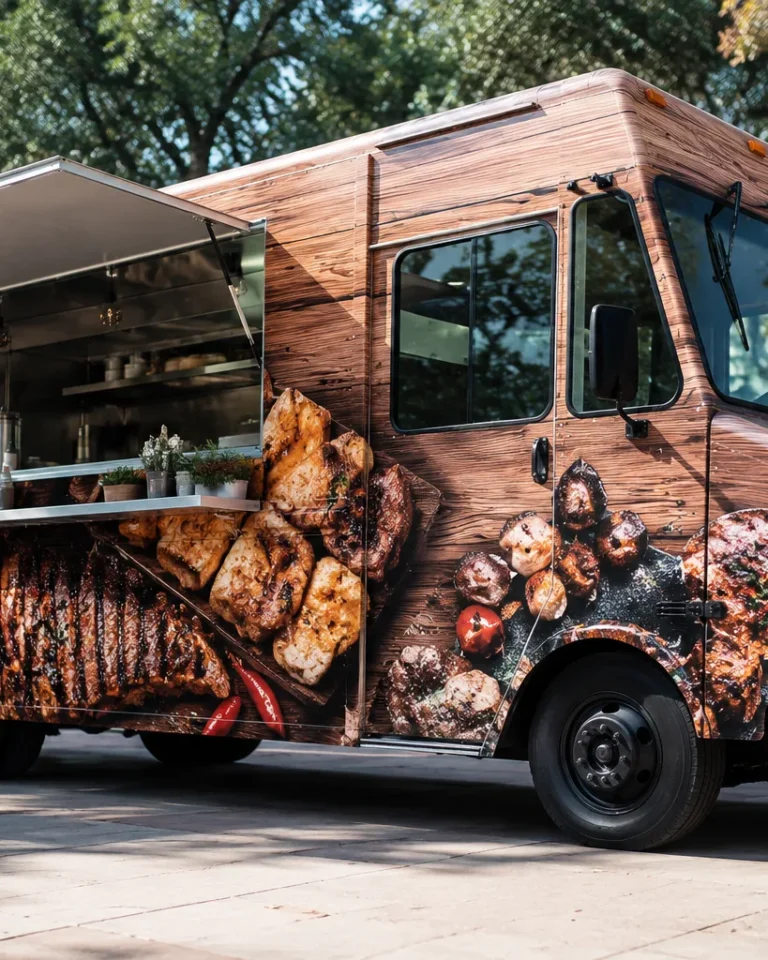
Boston charges a food vendor $17,066 in fees; Indianapolis charges $590 for a comparable setup. That spread – same truck, same menu, $17,066 against $590 – is the first thing a mobile food truck owner learns that the sticker price never tells them. Both figures come from the U.S. Chamber Food Truck Index, reported through Square, and they explain why two operators with identical rigs can face wildly different first years. This guide puts the vehicle price, the recurring fees, and the revenue math side by side so you can decide what your city actually demands before you sign anything.
Quick answer: A new made-to-order mobile food truck runs $75,000 to $150,000; a used one runs $40,000 to $80,000. On top of the vehicle, first-year permits, licenses, and legal compliance average $28,276, though city fees alone range from $590 to $17,066. Commissary kitchen access adds $250 to $3,000 a month. Food trucks gross an average of $250,000 to $500,000 a year, but operating costs eat 85 to 90 percent of monthly sales once profitable, leaving owners earning $24,000 to $153,000 annually.
Truck vs. cart vs. trailer: the format decision that changes your equipment list
Before any cost makes sense, you have to know which category you’re buying into, because the label changes what the health department requires on board. A food truck is a self-contained motorized vehicle with an onboard kitchen built to cook full menus; a food cart is a small non-motorized unit, per the comparison published by Restaurantware. The distinction isn’t branding. It’s the trigger for an entirely different compliance burden.
San Bernardino County Environmental Health Services draws the same line under California code: a cart is an unenclosed, nonmotorized mobile food facility, while trucks and trailers are either motorized or towed by a motor vehicle. Why that matters for your budget: carts handling unpackaged or potentially hazardous foods may still be required to carry multiple sinks with hot and cold running water plus mechanical refrigeration. In other words, “I’ll just run a cart to save money” can quietly land you with a sink-and-fridge build anyway.
The practical read: if your menu holds or cooks potentially hazardous food, the format you pick doesn’t let you skip the sinks and refrigeration – it only changes whether you’re pushing the unit or driving it. Pick the truck when the menu needs real cooking line space; pick the cart only when the menu is simple enough to dodge the hazardous-food rules, and confirm that with your own county before you commit.
Mobile food truck startup cost: where the sources actually disagree
Here’s where you have to read carefully, because the vehicle price depends on who’s counting. Square puts a brand-new, made-to-order truck at $75,000 to $150,000 and a used truck at $40,000 to $80,000. Restaurantware, citing Square’s 2025 cost guide, describes “the truck alone” at $40,000 to $150,000 – a wider single band that collapses the new/used split. The U.S. Chamber of Commerce (CO – ) reports a different figure entirely: about $55,000 on average to open a food truck, which bundles the truck with permits, point-of-sale, and legal setup rather than pricing the vehicle by itself.
Those three numbers aren’t contradictory so much as answers to three different questions. If you want the metal only, use the new/used brackets. If you want total startup capital, Restaurantware pegs the realistic range at $50,000 to $200,000, driven by heavy permitting. The U.S. Chamber’s roughly $55,000 average sits near the low end of that span because it describes a lean opening, not a loaded one.
Opening inventory is the line most first-timers forget: Square’s 2025 guide, through Restaurantware, puts it at $2,000 to $3,000 before you sell a single plate. Build sheets for a specific concept matter here – our costed proteins guide works through the per-item side of that inventory for one menu. For the wider build, see our equipment section.
- Vehicle, new (made-to-order): $75,000 – $150,000 (Square)
- Vehicle, used: $40,000 – $80,000 (Square)
- Truck alone, single band: $40,000 – $150,000 (Restaurantware, citing Square 2025)
- Average to open, loaded: about $55,000 (U.S. Chamber of Commerce)
- Total startup capital: $50,000 – $200,000 (Restaurantware)
- Opening inventory: $2,000 – $3,000 (Square 2025, via Restaurantware)
Renting instead of buying: the $2,000 – $3,000 monthly path
If a six-figure purchase isn’t on the table yet, renting is the slower-bleed route. On a lease of six months or more, Square puts the cost at roughly $2,000 to $3,000 per month. That keeps your capital intact and lets you test a concept before you commit the truck price, but it’s a recurring drain that never builds equity.
Rent-to-own sits between leasing and buying, and the contract terms are where people get hurt. If you’re weighing that path, read our contract traps guide before you sign, because the monthly figure is rarely the whole deal.
Permit and license fees: the budget line your city controls
This is the number no national average can predict for you, and it’s the one that separates a survivable first year from a crushing one. Across the U.S., an entrepreneur spends an average of $28,276 on permits, licenses, and legal compliance in a food truck’s first year, per the U.S. Chamber Food Truck Index reported by Square. But the city-level fees inside that number swing enormously: $590 in Indianapolis, $6,211 in Seattle, and $17,066 in Boston.
Restaurantware, drawing on Square’s 2025 guide, frames the licensing-and-permit line as $1,864 to $28,276 depending on the city – a lower floor than any single-city figure above, because it captures leaner jurisdictions. Don’t sum these numbers or average them. They measure different things: a citywide fee total, a first-year compliance average, and a permit-line range are not the same bucket, and adding them produces a figure that describes no real operator.
The decision this hands you is concrete: price your target city’s fees before you lock a location. A $590 permit market and a $17,066 permit market can both be profitable, but they demand different revenue to break even, and the gap is bigger than most menu decisions you’ll make all year.
Texas is changing the rules on July 1, 2026 – and it won’t be the last state to
Permit regimes are not frozen, and Texas is the live example. Beginning July 1, 2026, all mobile food vendors in Texas must be licensed with the Texas Department of State Health Services at the state level, rather than permit-by-permit through each local jurisdiction. Under that structure, a Type III mobile food vendor pays an $876 application fee plus a $500 pre-licensing inspection fee.
The lesson travels beyond Texas: the rules you research this year may be rewritten before your renewal. Any permit figure you plan around should carry an expiration date in your own head. The binding requirements come from your city, your county, and – increasingly – your state, so confirm them directly rather than trusting a number you read, including the ones here.
The commissary kitchen fee most first-timers leave out
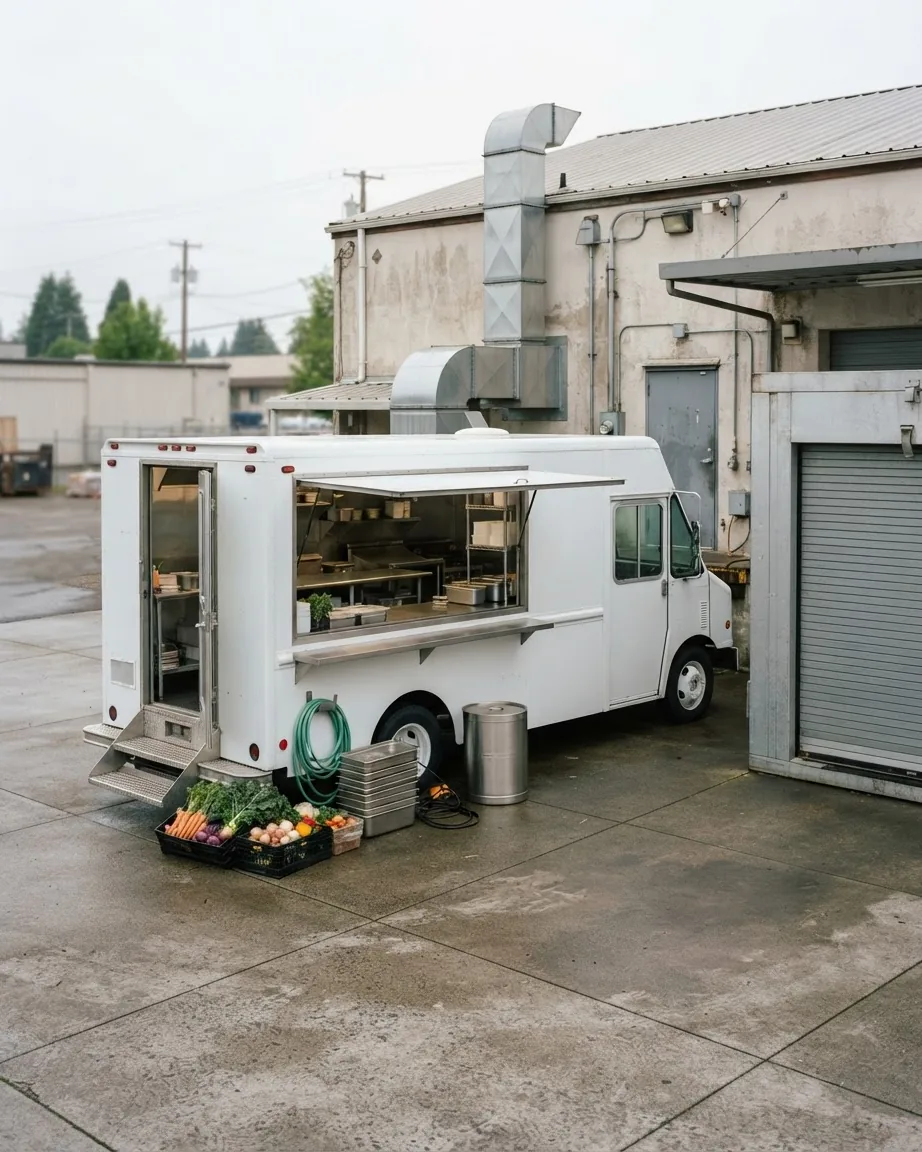
Most jurisdictions won’t let a mobile food truck prep, store, or clean out of a home kitchen. You need a commissary – a licensed base kitchen – and it’s a recurring cost that too many budgets omit entirely. According to The Food Corridor, basic shared-kitchen access runs $250 to $1,000 a month, while a full-service commissary with parking and storage runs $1,000 to $3,000 a month. Pay-as-you-go hourly use is commonly $15 to $45 per hour.
Which tier fits depends on your volume. A five-day truck that needs overnight parking and bulk cold storage almost always comes out ahead on the full-service tier. Run your prep hours both ways before you sign – the crossover point is usually somewhere between 20 and 60 kitchen hours a month, and the wrong choice costs you a four-figure sum a year.
On-board water and the hand-sink rule the FDA changed
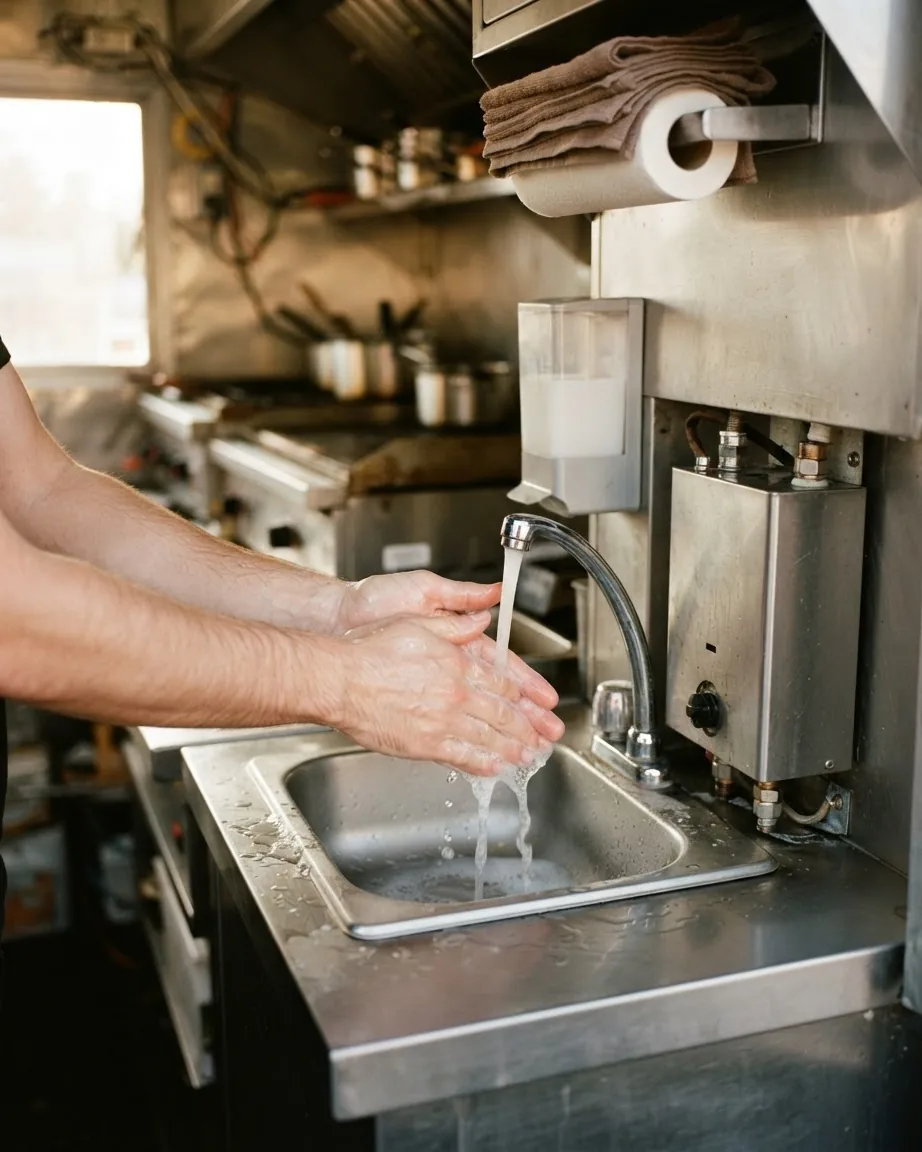
Your truck has to carry its own plumbing, and the single clearest sourced change in recent food-safety rules concerns the hand-washing sink. The 2022 FDA Food Code revised the minimum hot-water temperature at a handwashing sink from 100°F down to 85°F, according to the U.S. Food and Drug Administration. That lower threshold eases the demand on your water heater and generator, because getting a tank to 85°F draws less load than holding it at 100°F through a lunch rush.
The Food Code also governs cold handling, and one revision matters for prepped items you cut or open on board. The FDA specifies that hermetically sealed food rendered temperature/time-control-for-safety upon cutting or opening must begin at 70°F or less and remain at 70°F or less within a maximum of 4 hours. Once cooled, such food moves to 34°F, then to a 41°F holding temperature, and may be held for a maximum of 7 days.
Treat those figures as the floor, not a guarantee. The Food Code is a model; your county enforces its own adopted version, and the exact temperatures and timelines are checked by your local health inspector, not by a national document. For the physical build that makes these temperatures holdable under a rush, the kitchen that actually works guide handles the dimensioned side.
Revenue and profit: why $250,000 in sales can still mean a $24,000 paycheck
This is the number that reframes the whole business. Food trucks make an average of $250,000 to $500,000 annually, or $20,000 to $42,000 monthly, according to Toast. That top line reads like prosperity until you see what it costs to earn. Toast reports that monthly operating expenses total 85 to 90 percent of monthly sales once the business is profitable, with food cost alone running 30 to 35 percent of sales.
Run that against the gross and the gap closes fast. Toast puts actual owner earnings at $24,000 to $153,000 per year, typically less than 50 percent of profit after the owner’s own draw and reinvestment. A truck can gross a quarter-million dollars and still hand its operator a modest wage, because the margin band Toast’s expense figures imply sits around 10 to 15 percent.
Timing matters too: most food trucks become profitable within the first year and a half to two years, per Toast. Budget to lose money before you make it, and size your startup capital to cover that runway – not just the truck.
A worked example: Lou’s Chicken Truck
Toast illustrates the capacity-to-revenue relationship with one operation. Lou’s Chicken Truck of New Orleans starts with a loan of $350,000, repaid over 5 years. At an average of 50 percent capacity, Lou’s can gross $143,403 annually – monthly revenue of $11,950. During a strong festival-season second quarter, Lou’s ran at 70 to 85 percent capacity and pulled about $65,398 in total revenue for the quarter.
The takeaway you can act on: capacity, not menu price, is the lever. The jump from 50 percent to festival-level utilization roughly doubled the quarter’s take. Where you park and how often you fill the window moves your revenue more than any single pricing tweak.
Sequencing: the order these decisions should happen in
Most first-year pain comes from doing these steps out of order – buying the truck before pricing the city’s permits, or skipping the commissary line until an inspector asks where you prep. A workable sequence based on the figures above:
- Price your city first. City fees swing from $590 to $17,066; this changes your break-even before you spend a dollar on metal.
- Confirm your state’s regime and its dates. Texas moves to state-level DSHS licensing on July 1, 2026 at $876 plus $500 for a Type III vendor; check whether your state is mid-change.
- Lock a commissary. Budget $250 to $3,000 a month, or $15 to $45 hourly, and decide the tier by your real prep hours.
- Choose format against the menu. A cart handling hazardous food may still need multiple sinks and refrigeration, so it may not save what you think.
- Then buy or rent. $40,000 to $150,000 to buy, or $2,000 to $3,000 a month to rent on a six-month-plus lease.
- Size capital for the runway. Plan to reach profit in a year and a half to two years, with operating costs at 85 to 90 percent of sales.
Insurance belongs early in that list too, and it isn’t a single off-the-shelf policy – our coverage and compliance guide handles that piece.
Boston vs. Indianapolis: the same food truck, 29× the permit bill
The article quotes two city-level permit figures from the U.S. Chamber Food Truck Index: $590 in Indianapolis and $17,066 in Boston. Put side by side, they measure the same thing – city permit and license fees for a comparable setup – so the arithmetic between them is the one number that shows how much location alone decides your first year.
- The raw gap: the difference in extra fees for an identical rig, paid before you sell a single plate.
- The multiple: $17,066 ÷ $590 ≈ 28.9× – Boston charges nearly 29 times what Indianapolis does.
That difference is larger than any single menu, equipment, or supplier decision most operators will make all year. It’s also why no national average can price your permit line for you: confirm your own city’s fees before you lock a location.
FAQ
Is a food truck or a food cart cheaper to start?
A cart looks cheaper until the menu forces an upgrade. If you serve unpackaged or potentially hazardous items, San Bernardino County rules may require multiple sinks and mechanical refrigeration on the cart anyway. For a simple packaged menu, a cart genuinely saves money; for anything cooked to order, the equipment gap narrows quickly.
Why do permit costs vary so much between cities?
Each city sets its own fee schedule and its own number of required procedures, so the amounts aren’t comparable across jurisdictions. Reported city fees range from $590 to $17,066. That’s why a national average can’t tell you your real cost – you have to pull your own city and county figures before committing to a location.
How long before a food truck turns a profit?
Expect a year and a half to two years, per Toast’s benchmarks. Plan startup capital to survive that stretch, since operating expenses run 85 to 90 percent of sales even after you’re profitable. Undercapitalized trucks often fail not from weak sales but from running out of cash during the runway before margins stabilize.
Do I really need a commissary kitchen?
In most jurisdictions, yes – home prep is typically prohibited for licensed mobile vendors. A low-volume weekend truck often saves going hourly; a daily operation needing cold storage and parking usually wins on a full-service monthly contract.
Will the Texas licensing change affect vendors outside Texas?
Not directly, but it signals a pattern. States periodically centralize or revise mobile-vendor rules, so a figure that’s accurate today can expire. Texas vendors move to DSHS state licensing on July 1, 2026, at $876 plus $500 for Type III. Wherever you operate, verify permit rules at renewal rather than assuming last year’s numbers still hold.