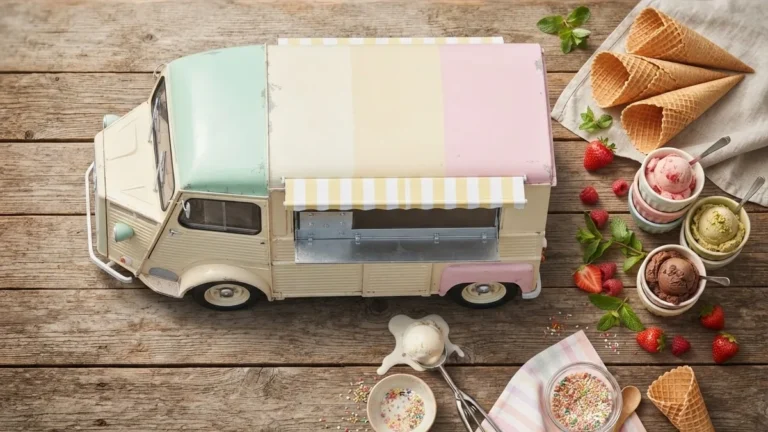
Soft serve ice cream truck operators sell something that looks simple and is hard to copy: a light, cold swirl most home cooks cannot reproduce. The gap is not skill. It is fat percentage, air, and a machine built for one job. This guide bridges both sides. It covers how the truck hits that texture, what the law calls the product, and how you can get close at home. If your interest is booking rather than building, our breakdown of what dessert food trucks cost handles the money side. Everything below is the food-science and operations side, sourced and specific.
Quick answer: a soft serve ice cream truck runs a low-fat dairy mix, roughly 3 to 6 percent milkfat, through a freezing cylinder that whips in air. That air, measured as overrun, is what makes the product light instead of dense. The mix is dispensed near 18 F to 21 F and held in the hopper at or below 41 F for safety. True soft serve needs freeze-point control, continuous air, and immediate serving. No-churn condensed-milk recipes skip all three, which makes them semifreddo. The truck version is a different structure built by the freezer itself.
What Actually Makes Soft Serve Soft
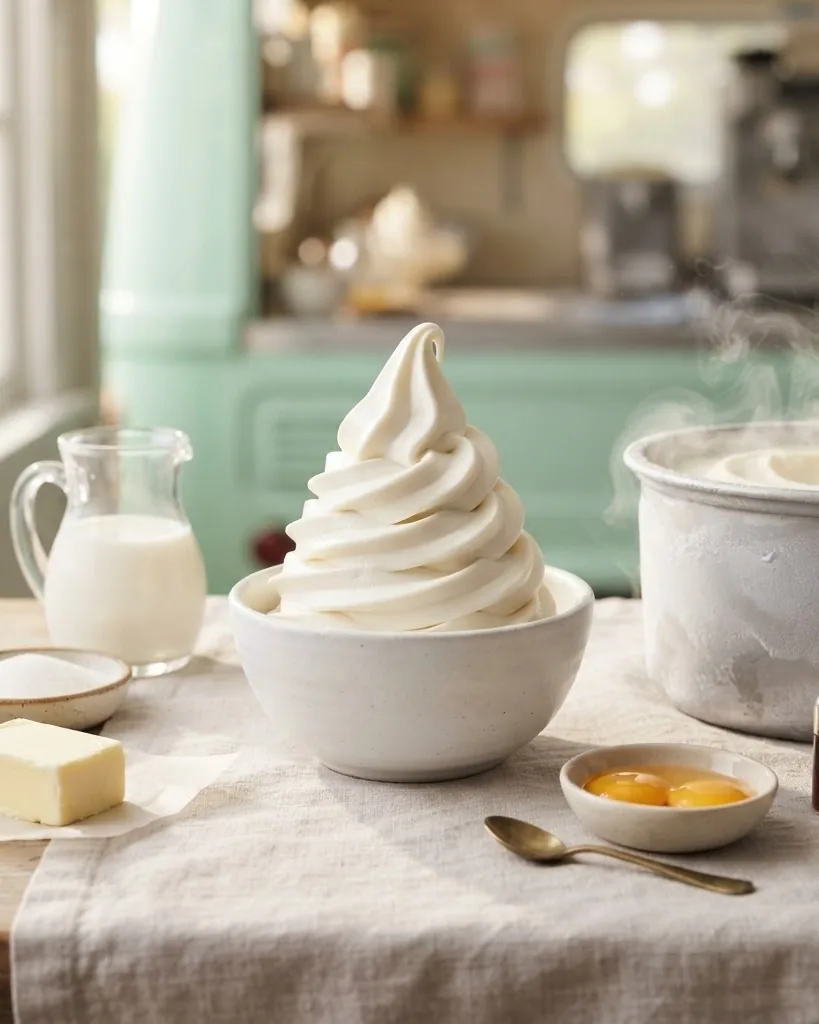
Soft serve is soft for two reasons: less fat and more air. A standard mix carries only 3 to 6 percent milkfat, well below the 10 percent minimum the U.S. Food and Drug Administration (FDA) sets under 21 CFR 135.110 for a product to be labeled ice cream. That single rule is why many truck products are legally frozen dairy dessert. Lower fat means smaller fat globules and less richness, so the mouthfeel reads light. Nonfat milk solids do quiet work here. They add body and protein without piling on fat, and they help the swirl hold its shape on the cone.
Overrun: the air that does the work
Overrun is the star. It is the percentage volume increase from air whipped in during freezing. The math is plain: overrun equals volume of finished product minus volume of mix, divided by volume of mix, times 100 percent. Soft serve commonly runs higher than premium hard ice cream on this measure. Premium hard ice cream runs lower, roughly 20 to 25 percent. More air, lighter body. That is the lever the truck pulls.
Sugar matters too. It sweetens, and it depresses the freezing point, which keeps the product scoopable and soft at serving temperature instead of rock hard. Harold McGee, in On Food and Cooking, explains the same physics behind ice cream: keep the ice crystals tiny and keep enough unfrozen water, and the texture stays smooth.
Stabilizers and emulsifiers
Stabilizers control water and slow ice crystal growth. Emulsifiers manage the fat and air interface so the foam holds. The University of Guelph chapter on ice cream stabilizers walks through how each gum holds water and limits recrystallization in storage.
- Guar gum and locust bean gum thicken the water phase and blunt iciness during storage.
- Carrageenan pairs with those gums to stop whey separation.
- Mono- and diglycerides plus polysorbate 80 help air distribute and give a drier, stiffer swirl.
Inside the Machine: Hopper, Cylinder, Dasher
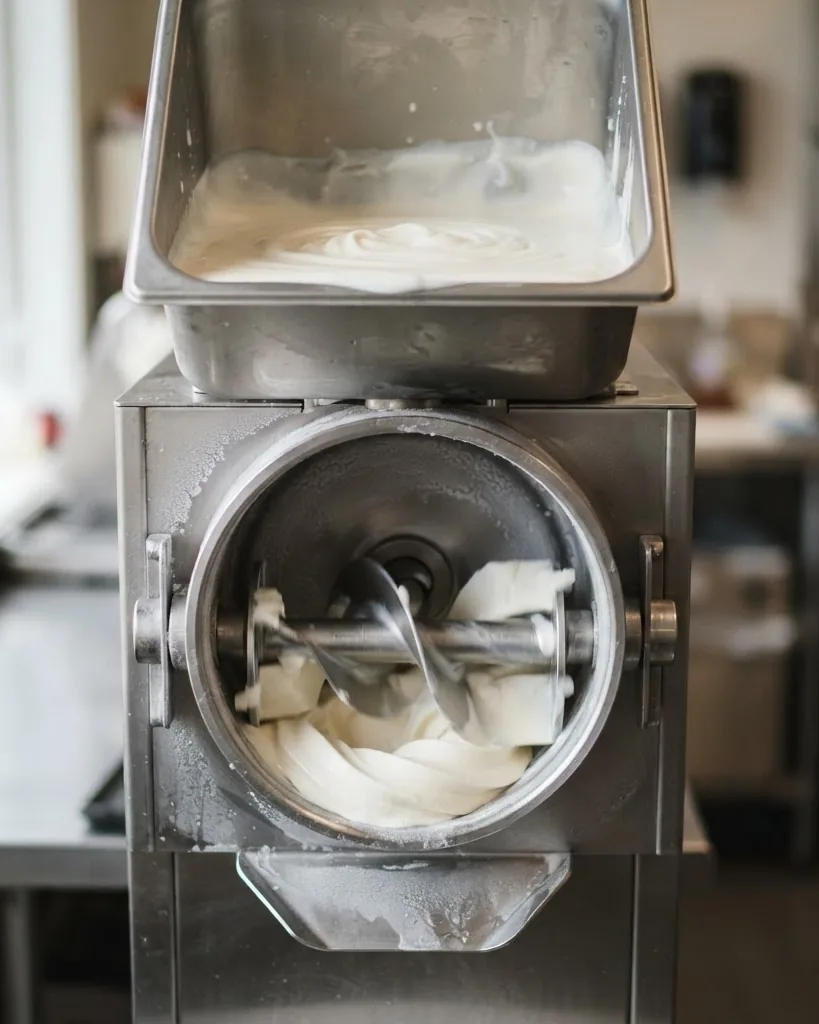
A soft-serve machine has three core parts: a hopper, a freezing cylinder, and a dasher. Liquid mix sits in the refrigerated hopper. It feeds into the cylinder, where a refrigerant-chilled wall freezes a thin layer against the metal. The dasher, a rotating beater, scrapes that frozen layer free and folds in air at the same time. That scrape-and-whip cycle is the whole trick. It builds overrun and keeps crystals small. Viscosity and hardness controls tell the freezer how stiff to hold the product before it dispenses.
There are two feed systems, and the choice shapes texture. Gravity-fed units let mix drop into the cylinder on its own, which tends to run lower overrun and a denser swirl. Pump or pressurized systems inject air on purpose, which pushes overrun higher and gives that dry, standing peak. Taylor Company and Carpigiani Group dominate this equipment, and their published spec sheets are the honest source for how a given model behaves. Read the spec sheet before you assume a number.
Powering a Soft Serve Ice Cream Truck
Running a soft-serve freezer on a truck comes down to power and heat. These machines generally need single-phase power in the 208 to 230 volt range, which drives your generator size and your electrical build. Get that wrong and the compressor starves. Then the sun works against you. On a hot day, ambient heat warms the mix and makes the compressor run harder to hold serving temperature, so throughput drops right when the line is longest. Airflow around the condenser and shade over the service window are not decoration. They protect texture.
Certification is the other gate. Commercial food equipment, including soft-serve freezers, is generally required to carry NSF/ANSI 2 (Food Equipment) certification under most local codes, so an uncertified unit can fail inspection outright. If you are pricing a rig around a used chassis, our checklist of checks before buying a used truck flags the electrical and refrigeration traps that bite soft-serve builds specifically. Confirm amperage against the Taylor Company or Carpigiani Group sheet, not a forum guess.
Permits, Inspections, and Food-Safety Compliance
Selling frozen dairy from a truck puts you under several overlapping food-safety authorities. The FDA Food Code, adopted in whole or adapted form by all 50 states, classifies liquid soft-serve mix as a Time/Temperature Control for Safety (TCS) food. That means the mix in the hopper must stay at or below 41 F (5 C). Cross that line and the mix becomes a bacterial risk, not just a quality problem. This is the rule inspectors check first, and it is the rule that governs your whole cold chain from commissary to service window.
Who governs what
- The U.S. Food and Drug Administration (FDA) owns the ice cream Standard of Identity at 21 CFR 135.110 and the model Food Code. See the FDA model Food Code for the retail sanitation framework your inspector works from.
- The U.S. Department of Agriculture (USDA), through the Agricultural Marketing Service (AMS) and the Food Safety and Inspection Service (FSIS), sets Grade A milk standards and publishes safe cold-storage guidance for dairy.
- The Centers for Disease Control and Prevention (CDC) tracks foodborne outbreaks, including cases tied to frozen-dairy equipment. Its Foodborne Disease Outbreak Surveillance System publishes the reported outbreaks, the foods involved, and the contributing factors.
- NSF International runs the equipment certification standard, NSF/ANSI 2, written with the American National Standards Institute (ANSI).
- Your county or city health department issues the mobile food unit permit, sets the commissary-kitchen requirement, and schedules inspections.
Cleaning, pasteurization, and outbreaks
Sanitation cadence is where soft serve gets caught. The mix contact surfaces, the dasher, and the dispensing valve all need regular breakdown and sanitizing, because biofilm loves a warm, sugary machine left overnight. Pasteurization is the upstream defense. Standard HTST dairy pasteurization heats milk for a set time and temperature combination designed to kill pathogens of concern before the mix ever reaches the machine. On the market side, the International Dairy Foods Association (IDFA) has historically reported U.S. frozen-dessert output and retail sales figures, though those should be checked against the latest IDFA report before you quote them as current.
Carvel vs Dairy Queen: The Contested Origin
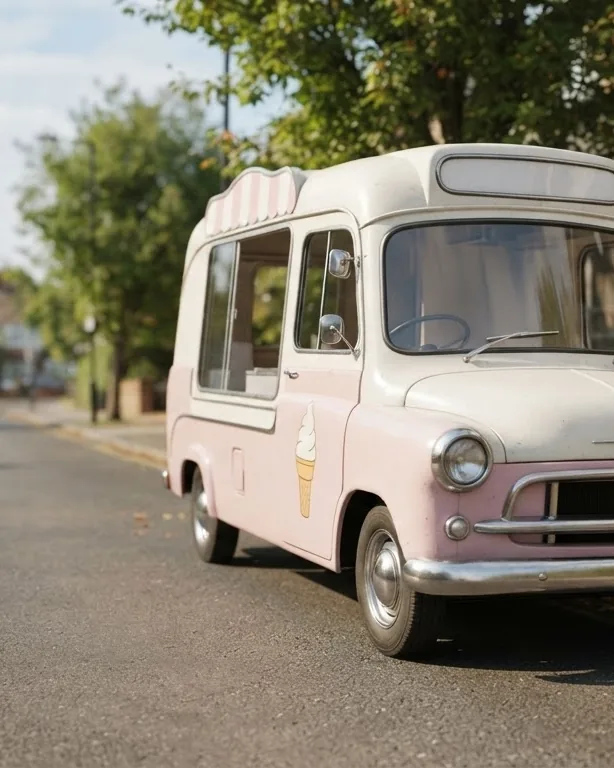
Two credible stories claim the invention of commercial soft serve, and honest history keeps both. Tom Carvel is commonly credited with an early origin story involving a flat tire that forced him to sell melting ice cream from a truck, after which he noticed customers liked the softer texture. Separately, J.F. McCullough is credited with developing a soft-serve formula that led to the opening of the first Dairy Queen store. Both can be true as parallel developments. Add the United Kingdom’s Mr. Whippy tradition and the American Mr. Softee trucks, and you get a shared lineage rather than one inventor.
A From-Scratch Base and Dairy-Free Swaps
A from-scratch base for truck-style texture starts with the fat target: hold milkfat in the 3 to 6 percent band so the mix freezes soft and whips light. Build it from whole milk and a little cream for fat, nonfat dry milk for solids, sugar for sweetness and freeze-point depression, and one hydrocolloid stabilizer. Skip the extra cream a normal ice cream base wants. That richness is what blocks overrun. The whole point is a lean mix the freezer can inflate.
A percentage-based base
Work in percentages so the recipe scales cleanly. Dose the stabilizer, guar gum or xanthan gum, as a small percentage of total base weight. Hydrate the gum in the sugar before mixing so it does not clump. H. Douglas Goff and Richard W. Hartel, in their reference text Ice Cream from Springer, treat this stabilizer-and-solids balance as the backbone of smooth frozen structure, and university dairy programs at Penn State, Cornell University, and the University of Wisconsin-Madison teach the same freeze-point logic.
Dairy-free swaps
Coconut, oat, and cashew bases all work, but they shift the stabilizer job. Coconut brings its own fat and can whip well; oat runs lean and icy and needs more gum and solids; cashew sits in between with good body. Push the stabilizer higher for the leaner plant milks, and lean on nonfat-style solids or a little starch to rebuild the mouthfeel dairy gives for free.
Home Replication and the Semifreddo Trap
The most common home version is not soft serve at all. No-churn recipes that fold whipped cream into sweetened condensed milk produce a semifreddo, because they miss the three things that define the real product: freeze-point control, continuous air incorporation from a dasher, and immediate serving from a chilled cylinder. It tastes fine. It is a different structure. Say so, because most blogs do not.
Your real options fall into a short list, each with a trade-off.
- Standard compressor churns freeze and beat, but they add far less air than a pressurized truck freezer, so overrun stays low and the swirl runs dense.
- Dedicated home soft-serve machines get much closer, since they dispense straight from a freezing cylinder the way a truck does.
- No-machine dry-ice methods can force a fast freeze and a lighter body, but they need care and immediate serving.
Whatever the tool, the rule holds: freeze fast, serve fast. Soft serve is built to be eaten the minute it leaves the machine, not stored.
Flavors, Toppings, and the Nutrition Trade-Off
The classic vanilla-chocolate twist comes from two mix lines meeting at one valve, so a single pull braids both. Modern trucks push past that with Dole Whip, matcha, ube, black sesame, and mochi soft serve. Finishing is its own craft. A magic-shell dip is tempered chocolate thinned with oil that snaps as it hits the cold surface, and the iconic peaked cone is a piping move, a steady pull with a clean lift. On nutrition, the lever is the same fat you already tuned.
Troubleshooting Truck-Style Texture
Most soft-serve failures trace back to crystals, air, or oxidation. Iciness and graininess mean the ice crystals grew too large. That happens with too little fat, too few milk solids, weak stabilizer dosing, or a freeze that runs too slow. The fix is a hydrocolloid stabilizer, more nonfat solids, and a faster freeze. A swirl that collapses or melts too fast usually carries too much overrun for a weak stabilizer, so tighten the gum or dial the air back.
Off-flavors are a warning, not a quirk.
- A cardboard or painty note points to oxidized fat, often from old mix or poor storage.
- A sour or dirty edge points to sanitation, biofilm in the cylinder or valve.
- A metallic taste can follow prolonged mix contact with worn surfaces.
Cold-holding covers the safety layer. Keep hopper mix at or below 41 F, dispense near 18 F to 21 F, and break the machine down on schedule. Sanitation is the cheapest quality control you own.
Frequently Asked Questions
Why doesn’t my soft serve look like the truck’s?
Most home setups miss the low-fat, high-air combination. Trucks run a low-fat mix and whip in a substantial amount of overrun through a freezing cylinder and dasher. Home churns add far less air and often use richer bases, so the result sits denser and heavier instead of forming a light, standing peak on the cone.
Can I use a regular ice cream recipe in a soft-serve machine?
You can, but expect a dense, heavy result. Standard ice cream bases carry around 10 percent or more milkfat, well above the 3 to 6 percent that keeps soft serve light. That extra fat resists the airy overrun these machines are built to create. Cut the fat first, add nonfat milk solids for body, and the texture improves fast.
Is no-churn soft serve real soft serve?
No. Folding whipped cream into sweetened condensed milk makes a semifreddo. It skips freeze-point control, continuous air incorporation, and immediate serving from a chilled cylinder, which are the three things that define true soft serve. It can taste great, but the structure and mouthfeel are a different dessert, and most recipes never mention the difference.
What temperature does a soft-serve truck serve at?
Commercial product dispenses cold enough to hold its shape without melting immediately. The liquid mix waiting in the hopper must stay at or below 41 F, which is 5 C, to remain a safe Time/Temperature Control for Safety food under the FDA Food Code. Those two numbers, hopper and dispense, drive both safety and texture.
Why is my soft serve icy or grainy?
Iciness traces to large ice crystals. Too little fat, too few milk solids, weak stabilizer dosing, or slow freezing all grow bigger crystals. Dose a hydrocolloid such as guar gum or xanthan gum, freeze as fast as your machine allows, and serve right away so the crystals never get a chance to coarsen.
Is soft serve legally ice cream?
Often not. Under the U.S. Food and Drug Administration standard at 21 CFR 135.110, a product labeled ice cream needs at least 10 percent milkfat before bulky flavors. Since most mixes run 3 to 6 percent, many truck products are labeled frozen dairy dessert instead. The name change is a fat-content rule, not a quality judgment.
Where to Take It Next
The truck version and the home version chase the same target from opposite directions. The truck starts with a lean, engineered mix and a freezer built to inflate it. You start in a kitchen and work backward toward that fat percentage, that overrun, and that fast freeze. Get the fat percentage, the stabilizer dose, and the serve-it-now discipline right, and the swirl stops being a mystery. If you would rather rent a rig for one event than build a program, our guide to renting an ice cream truck lays out prices and deposits so you can compare that path against buying and running your own.