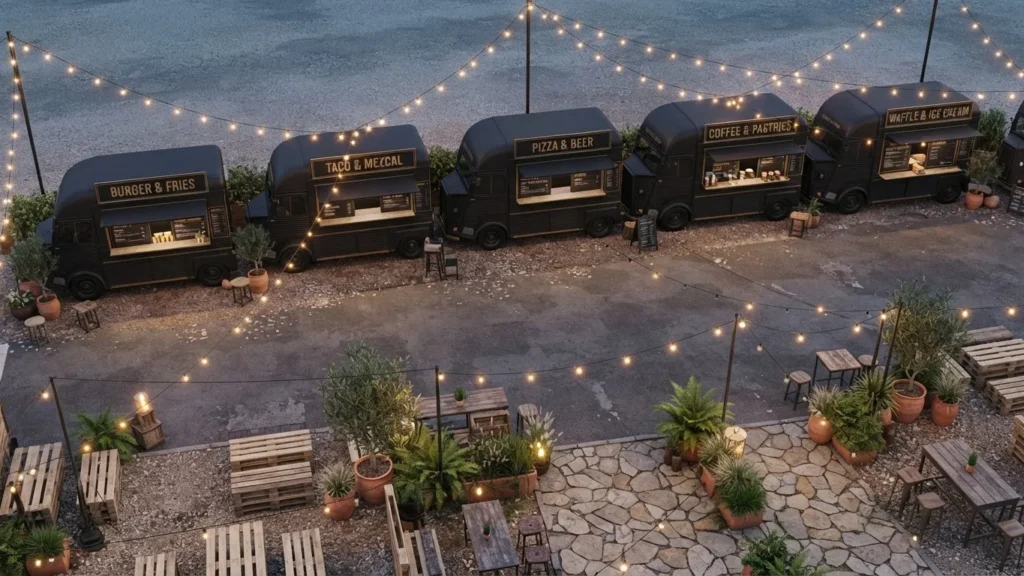
Your ticket does not buy you a single bite of food. That one fact reshapes how you budget the whole day, and it comes straight from the organizer: every published edition of the Black Food Truck Festival sells admission to the gates, the games, and the live entertainment, while the food itself gets paid for truck by truck once you are inside. If you walk in expecting a wristband that covers your plate, you will have planned your cash wrong. This guide splits into two halves on purpose – one for the person buying a ticket to the Charleston-area event, and one for the operator who wants to park a truck at an event like it and stay on the right side of South Carolina’s rules.
Both the organizer FAQ and ABC News 4 (WCIV) agree that admission covers entry, games, and live entertainment only. Children 12 and under get in free. Parking is free. Pets stay home. General admission has been published at $20 and at $25 depending on the edition, and VIP has run from $125 up to $140. The event has been held at the Exchange Park Fairgrounds, 9850 Highway 78, Ladson, South Carolina 29456, on an April weekend. Prices rise as the date nears, so buying early is the only lever you control.
What $20 at the gate actually gets you – and what you still pay for
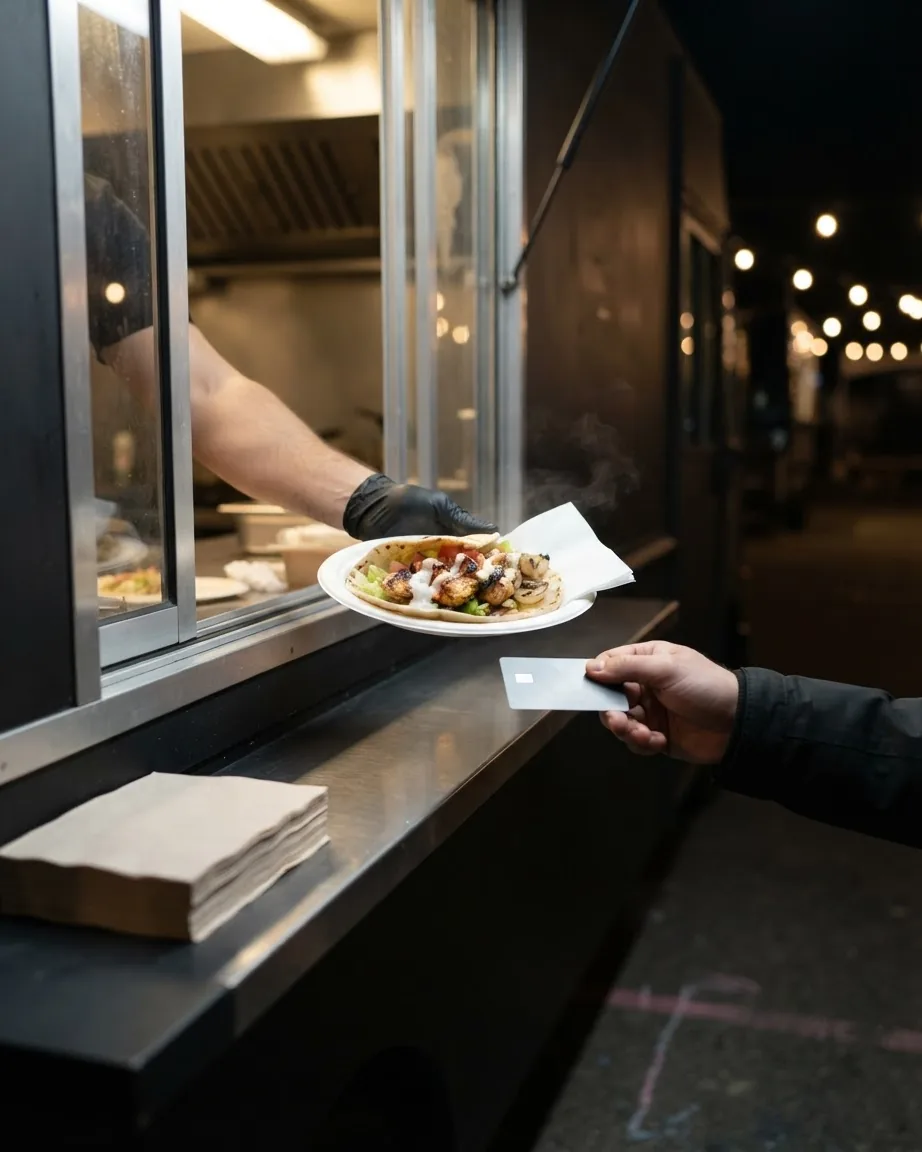
Start with the number that trips people up. The organizer’s FAQ states plainly that tickets “only include entry to the festival, games, and live entertainment.” No food credit. No drink credit. You carry cash or a card for the trucks, and each truck prices its own plate.
On the paid-versus-free split, the published facts are clean. Parking is free – the Journal Scene reported that directly for its covered edition. Children 12 and under are admitted free of charge, corroborated by both ABC News 4 and the Journal Scene. Everything you eat and drink is out of pocket at the window.
Here is how the ticket math has actually appeared across editions, each price tied to the announcement that carried it:
- General admission: “starts at $20” per ABC News 4 (WCIV); “$25” per the Journal Scene. Different editions, both real.
- Two-day: $45 per the Journal Scene.
- VIP: “start at $140” per ABC News 4; “$125 or $225 for a two-day ticket” per Charleston Business. VIP extras in the Charleston Business edition included a swag bag and access to the VIP container bar.
Do not average these. A $20 announcement and a $25 announcement are not the same thing – they are two different years. The number you should trust is whichever price is live on the ticketing page for the edition you are attending. Prices increased on April 1 for the edition the Journal Scene covered, which tells you the direction of travel: buy early or pay more.
When and where the Black Food Truck Festival lands in Ladson
The venue is settled. The Black Food Truck Festival has been held at the Exchange Park Fairgrounds in Ladson – the whatnow Charleston writeup gives the full address as 9850 Highway 78, Ladson, SC 29456. The weekend has consistently fallen in late April.
The dates themselves need a caveat. The Post and Courier (Moultrie News) described the fifth annual event “taking place the weekend of April 24 to 26,” and the organizer FAQ states “the weekend of April 24-26, 2026.” But whatnow reported a different edition “held on April 26 and 27.” Those are different years, so they do not actually conflict – they just prove the exact dates shift edition to edition. Confirm the specific weekend on the organizer’s page before you book anything.
The hours problem nobody has cleaned up
This is where the published record contradicts itself, and you should know it before you drive out. ABC News 4 reported that general admission tickets are good from 12 p.m. to 7 p.m., while VIP ticketholders get in earlier, from 11 a.m. to 7 p.m. That is a clean, two-tier schedule: VIP buys you an extra hour before the gates open to everyone.
The organizer’s own FAQ, however, states the festival is “open to ticket holders during festival hours of 12pm-6pm on April 23-24th.” That internal mismatch has not been corrected publicly. It may be a stale typo left over from an earlier edition, or it may describe a different component of the weekend. Until the organizer updates it, assume nothing: plan around the VIP-gets-in-early structure from ABC News 4, and verify the closing time on your ticket. If you are a VIP buyer, that early entry window is the one concrete reason the upcharge pays for itself – you hit the popular trucks before the noon line forms.
45+ trucks and what the lineup actually spans
The scale is the draw. Live 5 News (WCSC) reported one edition “featuring more than 40 food trucks, offering everything from Black American soul food to West African delicacies.” The organizer’s sponsor page puts it at “45+ of the finest food trucks in Charleston and the surrounding region,” and Charleston Business counted “over forty-five food trucks” for a weekend that also carried live music, a cigar and hookah lounge, 21+ bar areas, an Afro artisan marketplace, a kids’ play zone, a mobile bowling alley, and lawn games.
The truck count has grown with the event. Live 5 News reported that the third installment “saw over 40 food trucks,” so the climb from 40-plus to 45-plus tracks the festival maturing rather than any single year being definitive. For planning purposes: expect a few dozen trucks minimum, a cuisine range wide enough that you should come hungry and skip breakfast, and enough non-food programming that a family can spend the full window there. The alcohol, cigar, and hookah areas are gated to 21+, so that part of the day is not a kids’ activity.
If festival-scale catering logistics interest you beyond attending, our site’s catering section goes wider on the money side of large bookings.
On-site rules: coolers, pets, re-entry, and the ticket you can’t buy at the door
Safety warning
The organizer’s FAQ is the authority on what you can bring, and the banned list is specific: “Coolers, pets, alcohol, cigars, outside food and weapons (i.e. knives, mace) are not permitted.” That cooler ban matters more than it sounds – with no outside food allowed either, there is no workaround for feeding a group cheaply. You eat from the trucks or you do not eat.
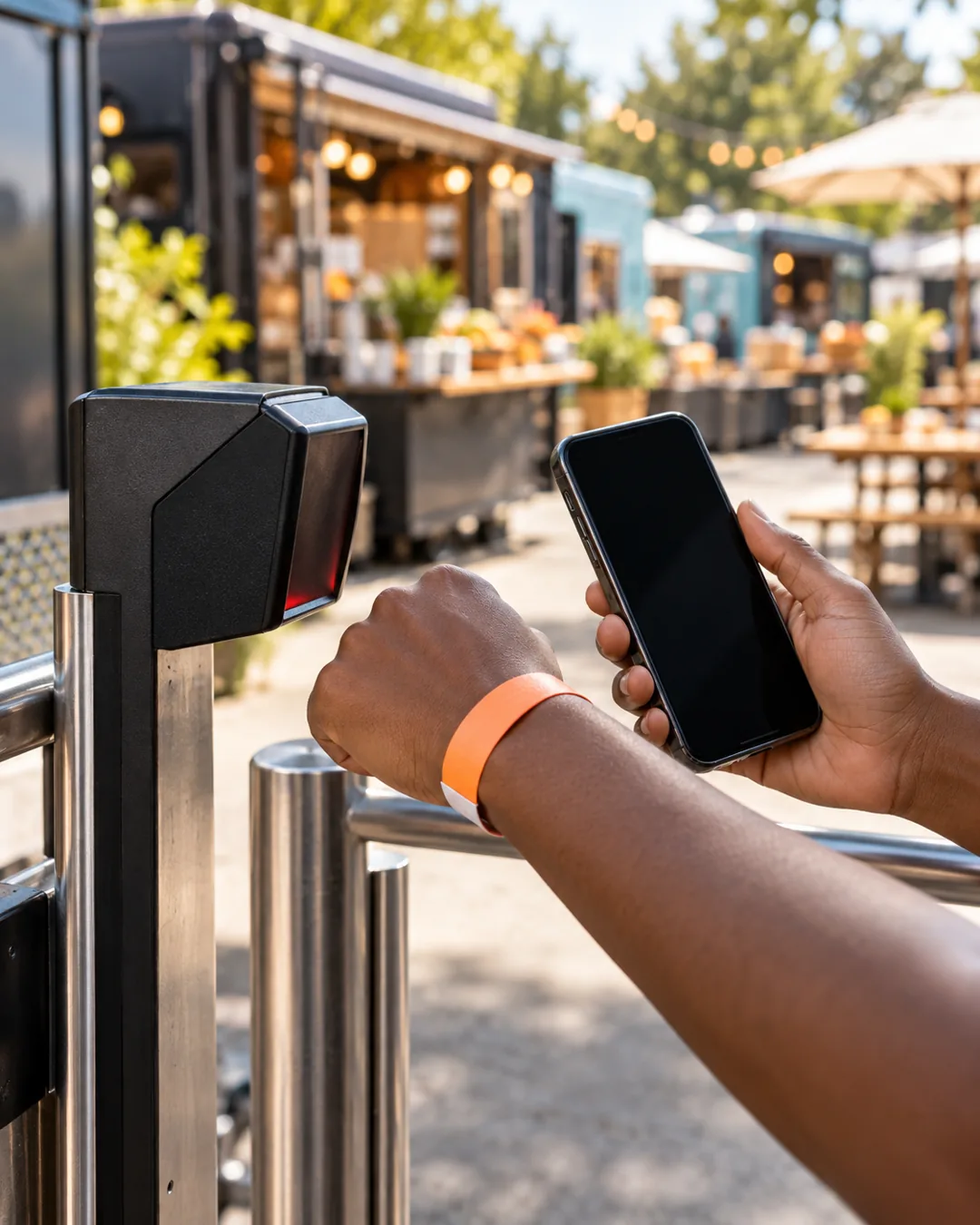
Two more rules save headaches. Re-entry is allowed: the FAQ confirms ticket holders can leave and return, and wristbands are issued at the gate to make that work. And tickets are not sold at the venue – “tickets will not be available on site. However, you may purchase tickets online the day of the festival.” So you can still buy the morning of, but only through your phone, and at the higher as-the-date-nears price, not a walk-up rate.
- Leave at home: coolers, pets, alcohol, cigars, outside food, weapons including knives and mace.
- Bring: a payment method for every bite, a phone to buy or show tickets, and sun cover – this is an April fairgrounds event.
- Good to know: re-entry is fine with your wristband; parking costs nothing.
Who built it and what it moves: Marcus Hammond and the impact numbers
The festival is Marcus Hammond’s. Travel Noire reports that “Marcus Hammond created the festival in 2022 and quickly rose to popularity for his relentless support of Black-owned food trucks and eateries in South Carolina.” There is a wrinkle on the founding year worth flagging: Live 5 News quoted Hammond in 2022 saying the festival “started in 2021.” So you will see both years cited, and neither has been formally reconciled – the mission, not the exact founding date, is the throughline.
The economic figures are large and worth citing precisely. SCBiz News reported that “the inaugural springtime festival in 2022 drew more than 15,000 people from all around the Carolinas” and “generated more than $1 million for Black-owned businesses in the Charleston region.” On cumulative or single-year impact, two outlets land a hair apart: Live 5 News states the festival “has contributed $10.3 million to the local economy,” while the Post and Courier (Moultrie News) reports “last year alone, the festival generated a staggering $10.2 million economic impact.”
Do not merge those into one number. The $10.2 million and $10.3 million figures come from different communications, and the published methodology behind either one is not public. Quote whichever matches the outlet you are citing, and treat the gap as what it is – two close estimates, not a contradiction to resolve.
Charleston SC is not Greensboro NC: two festivals, one name
If you searched the event name and got confused, there is a reason. At least two distinct events carry this name. The one covered above is the Charleston-area event founded by Marcus Hammond, held in April at the Exchange Park Fairgrounds in Ladson.
The other is in North Carolina. WFMY News 2 reported that “on Saturday, June 15, 2024, more than 20 black-owned food trucks will line the streets of downtown” Greensboro for a Juneteenth Black Food Truck Festival, running 5 to 11 p.m. Different state, different month, different scale – a single Saturday evening in June versus a late-April weekend in South Carolina. Check the city and the date before you buy; a ticket to one does not get you into the other.
Parking a truck at an event like this: the SC permit layer attendees never see
Everything above is for the person holding a ticket. If you want to be on the other side of the window, South Carolina adds a compliance layer that none of the attendee coverage touches, and it runs on three separate clocks. The binding rules are set by the state and your county, not by the festival, so read this as orientation and confirm with the agencies named.
First, the truck itself. Per the South Carolina Department of Agriculture, “a mobile food establishment consists of a commissary and mobile food unit(s),” and “both the commissary and all mobile units must be permitted separately.” The physical specs are concrete: all units must use an approved drinking water source; wastewater “must be stored in a tank that is 15% larger than the unit’s/cart’s drinking water storage capacity,” with removable tanks capped at 10 gallons; and the service window “may be no more than 576 square inches,” covered with solid material and either screened, self-closing, or protected by an air curtain. Size your water and wastewater before you build, because the 15 percent rule is not negotiable at inspection.
Second, the event clock. SCDA’s event authorization application states that an “applicant shall submit a completed application for authorization and receive authorization from SCDA prior to the event,” and “it is recommended that applications be submitted 14 days in advance.” Miss that and your spot is at risk: the same document warns that failure to meet Regulation 61-25 “may be subject to enforcement action, which may include civil penalties pursuant to Section 44-1-150(B) of the South Carolina Code of Laws and/or permit suspension/revocation.”
Third, the permit and inspection clock. SCDA’s planning guide says to apply “at least thirty (30) calendar days before the planned opening date,” paying “the Initial Permit/First Year Operational fees of one-hundred dollars ($100) plus the applicable annual inspection fee.” An inspection “must be requested by the permit holder at least fourteen (14) calendar days prior” to issue a permit. And the person in charge “must have at the minimum an accredited food handler training certificate.” So you are tracking a 30-day permit window, a 14-day inspection request, and a 14-day event authorization – three different lead times, not one.
The annual inspection fee scales with your sales. Per SCDA’s fee schedule, “fee amount is based on gross food and food product sales for the previous calendar year,” so the amount you owe depends on which sales bracket your truck falls into. Pay late and it compounds – 30 to 59 days past due adds $50.00, and 60 or more days past due adds $100.00.
There is also a county layer, with a caveat. Charleston County Government’s Revenue Collections states that “if one realizes any income from a business activity… that person is required to purchase a license,” and that “April 30th is the last day to renew without penalties,” after which “a 5 percent per month penalty will be assessed on the license fee due.” Important: do not assume every vendor at 9850 Highway 78 owes Charleston County specifically – your business-license obligation depends on your own jurisdiction, and that is not established for every festival vendor. Confirm which municipality or county you file with before writing a check.
Operators weighing which concept to run into a crowd like this can compare the window-speed and food-cost math in our halal food truck playbook and the plate-boldness notes in the Filipino food truck guide.
What the second VIP day actually costs you
In the Charleston Business edition, VIP ran at $125 for one day and $225 for the two-day pass. Doing the subtraction tells you the real decision: the second VIP day adds $100, not another full $125. If you were already planning to attend both days as a VIP, the two-day pass saves you $25 versus buying two single-day VIP tickets; if you were only ever going to show up once, that extra $100 buys nothing. Note these are figures from one past edition quoted by Charleston Business, so confirm the live price on the ticketing page before you buy.
- Second VIP day costs $100 ($225 – $125), less than the $125 a standalone VIP day runs.
FAQ
Does my festival ticket include any food?
No. Admission opens the gates to games and live performances, nothing edible. Budget separately for meals, since each vendor charges its own prices at the window and there is no plate credit baked into any tier. With coolers and outside food both banned, a cheap group picnic is off the table – plan to spend at the trucks.
Can I show up and pay cash at the entrance?
There is no walk-up box office. You buy online, even on the morning of the event, straight from your phone. Same-day purchases are allowed but typically land at the higher near-date price rather than any early rate. Load your ticket before you leave home so a weak signal at the fairgrounds does not strand you outside.
Is this the same as the Greensboro Juneteenth event?
No – they only share a name. The North Carolina version runs a single June evening, 5 to 11 p.m., in downtown Greensboro with roughly 20-plus trucks. The Charleston-area one is a late-April weekend at a Ladson fairgrounds with 45-plus trucks. Verify the city, month, and date on your ticket so you don’t arrive at the wrong one.
As a vendor, which deadline hits first?
Three separate ones. Budget 30 calendar days ahead for your initial permit, 14 days ahead to request the inspection that issues it, and 14 days ahead for SCDA event authorization. Line them up early, because the event clock and the permit clock run independently, and a missed authorization can trigger civil penalties under Regulation 61-25.
How big does my wastewater tank need to be?
Sized to your fresh water, not to a fixed number. South Carolina requires wastewater storage 15 percent larger than your drinking-water capacity, and removable tanks cannot exceed 10 gallons. Spec this during the build, not after – swapping tanks on a finished truck is costly, and an undersized gray-water tank fails inspection on the spot.