Only 4% of the nearly 10,000 newlyweds surveyed by The Knot had a food truck at their celebration, which tells you something useful right away: the people quoting you prices do not do a hundred of these a week, and the advertised per-plate number is the smallest line on the invoice. Food truck wedding catering gets sold on a figure like “$10 to $25 per person,” but a single truck carries fixed costs that do not shrink with your guest list. Below is how to rebuild a real total from that teaser number, how to check whether one window can actually feed your headcount in the time you have, and the permitting trap that catches couples whose truck is already licensed.
What does food truck wedding catering actually cost and seat? Food-only quotes run roughly $10 to $25 per person; all-in totals, including staffing and permits, run about $20 to $35 per person. Food Truck Club contrasts the all-in food truck figure with a far higher range for a traditional caterer. One truck serves 50 to 65 plates per hour by Honeyfund’s count, so 100 guests need about 90 minutes of service. Most trucks also set a minimum spend and a travel radius, which makes small weddings the worst value per head.
Rebuilding a true all-in number from a per-plate teaser
The per-plate figures floating around are not the same animal, and stacking them is how couples blow a budget. The Knot lists food trucks at $10 to $25 per person against a sit-down caterer’s $85-per-person average on its wedding food truck guide. Wedding Spot, relaying Social Tables pricing, widens that to $10 to $35 depending on cuisine. Honeyfund’s 2026 guide quotes $18 to $45 per guest, but that figure is entrée-only, a main plus one side. The St. Pete Taco Lady, relayed by Marry Me Tampa Bay, tells couples to budget $18 to $30 per person.
Those ranges are not interchangeable. The low numbers are food or booking only. The entrée-only range is a main-plus-side that still has fixed fees sitting outside it. The $20 to $35 that Food Truck Club calls all-in already folds staffing and permits in. So before you compare quotes, ask each operator which one they mean.
To build the real total, start with the food figure, then add the pieces that ride on top. Honeyfund puts service-time blocks, staffing charges, and permit fees at another $300 to $1,000 on your total. Gratuity is typically 15 to 20 percent, charged on top of the food figure. Travel runs roughly $1 to $3 a mile once you clear the base radius. Weekend and peak-season pricing climbs on top of that again.
- Food: the food-only quote multiplied by your guest count, whichever rate the operator is actually quoting.
- Fixed fees: $300 to $1,000 for service blocks, staffing, and permits (Honeyfund).
- Minimum spend: the floor you pay even if your food total lands under it.
- Gratuity: 15 to 20 percent of the food figure.
- Travel: about $1 to $3 per mile past the standard radius.
- Weekend premium: a peak-season bump on Saturday evenings June through October.
Run that stack and the “$10 a head” truck is often a $25-to-$35 reality, which is where Food Truck Club lands when it calls the all-in number still 50 to 70 percent below a traditional caterer. The savings are real. The teaser was just never the whole figure. For the wider topic, we keep a running section on catering.
Why 100 guests is cheap and 40 guests is the trap
A food truck’s cost structure punishes small headcounts, which is the opposite of what most couples assume. The truck shows up, burns a day of staff time, and hits a fixed break-even whether it plates 40 or 140. That is why almost every operator sets a minimum spend regardless of your actual guest count, as Food Truck Club states flatly.
Honeyfund expresses that floor in guests: most trucks require minimums of 46 to 100 guests, no matter your real number. The same idea can be told in dollars as a per-truck floor. Both framings point the same way. If you are hosting 40 people and the minimum is 60, you are paying for 60 plates. Your effective per-head cost jumps, and the small intimate wedding you pictured as the budget option becomes the expensive one per guest.
The fix is to flip the comparison. Do not ask “what’s the per-plate rate.” Ask “what’s the minimum spend, and how many guests does that cover.” If your count sits below the floor, either accept the higher per-head math, add guests you were already inviting, or price a caterer who charges strictly by the plate. The per-truck minimum is also why a food truck can quietly cost more than a seated option at very low counts. For how the same minimum shapes a smaller booking, see our food truck rental for a party breakdown.
The capacity math: guests divided by plates-per-hour times your service window
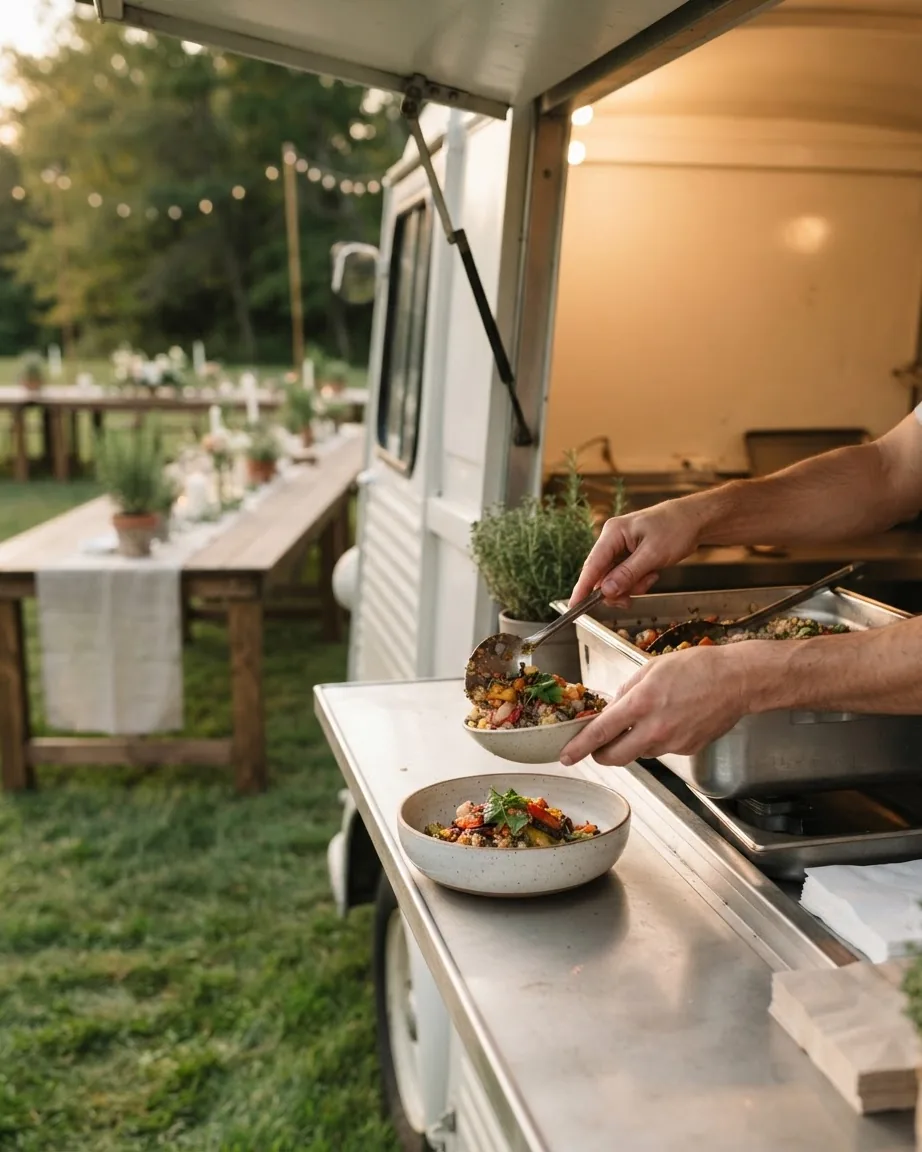
The right question is not “how many guests can one truck feed,” because that number means nothing without a clock attached. The Knot offers the flat rule of thumb that a single truck serves 100 to 150 people. Honeyfund and Food Truck Club instead give you a rate, which is more honest, because it exposes the variable The Knot hides: your service window.
Honeyfund puts a single truck at 50 to 65 plates per hour, meaning 100 guests need about 90 minutes of service. Food Truck Club gives a slightly wider standard serving rate of 50 to 75 plates per hour per truck. The gap in the upper bound, 65 versus 75, is not a contradiction. It depends on your menu: an assembly line (tacos, bowls, scoop-and-go) runs faster than made-to-order, where every plate waits on the grill. Ask your operator which their rate assumes.
The calculation you actually want: guests ÷ (plates per hour × service hours). Most weddings run 2 to 3 hours of service time, per Honeyfund. Run 100 guests at 55 plates an hour across a 2-hour window and you clear them comfortably. Compress that same 100 into a 45-minute photo-break line and you have a queue and cold food. The service window is the lever, not the truck count.
- 100 guests, 90-minute window: one truck at 50 to 65 plates/hour handles it (Honeyfund).
- 150 guests, tight window: The Knot’s 100-to-150 ceiling assumes a full service block, not a 45-minute rush.
- Made-to-order menu: lean toward the slower end of the rate; assembly-line menus toward the fast end.
Decide your service window first, then your menu style, then back into whether one truck covers it. Doing it in the other order is how couples end up booking a second truck they did not need, or starving the one they have.
What the truck does not do, and what you are quietly renting on the side

A food truck plates food through a window. That is the deliverable. Everything a seated caterer bundles invisibly, you are now sourcing yourself, and that is where surprise line items come from. The truck typically does not provide servers working the floor, bussing, linens, tables, or the cleanup and breakdown a full-service caterer handles. It also does not pour alcohol.
Honeyfund is blunt about the physical demands too: trucks need level parking within 100 feet of your reception area, access to power, and proper permits. If your venue is a field, that means a generator or a run of heavy cable and a planner to coordinate it. None of that appears on the per-plate quote. It appears on your day-of to-do list or on a separate rental invoice.
Build a quick side budget before you sign: who buses tables, who provides plates and seating, who runs the bar, and who hauls trash after the window closes. A taco truck that quotes you $12 a head has not quoted you the rental tables under your guests. The gap between a truck and a seated caterer is real value, but only once you have priced what you are covering yourself. For the operator’s view of these same event logistics, our taco truck rental guide walks the daily and monthly side.
Insurance, venue approval, and the preferred-truck list
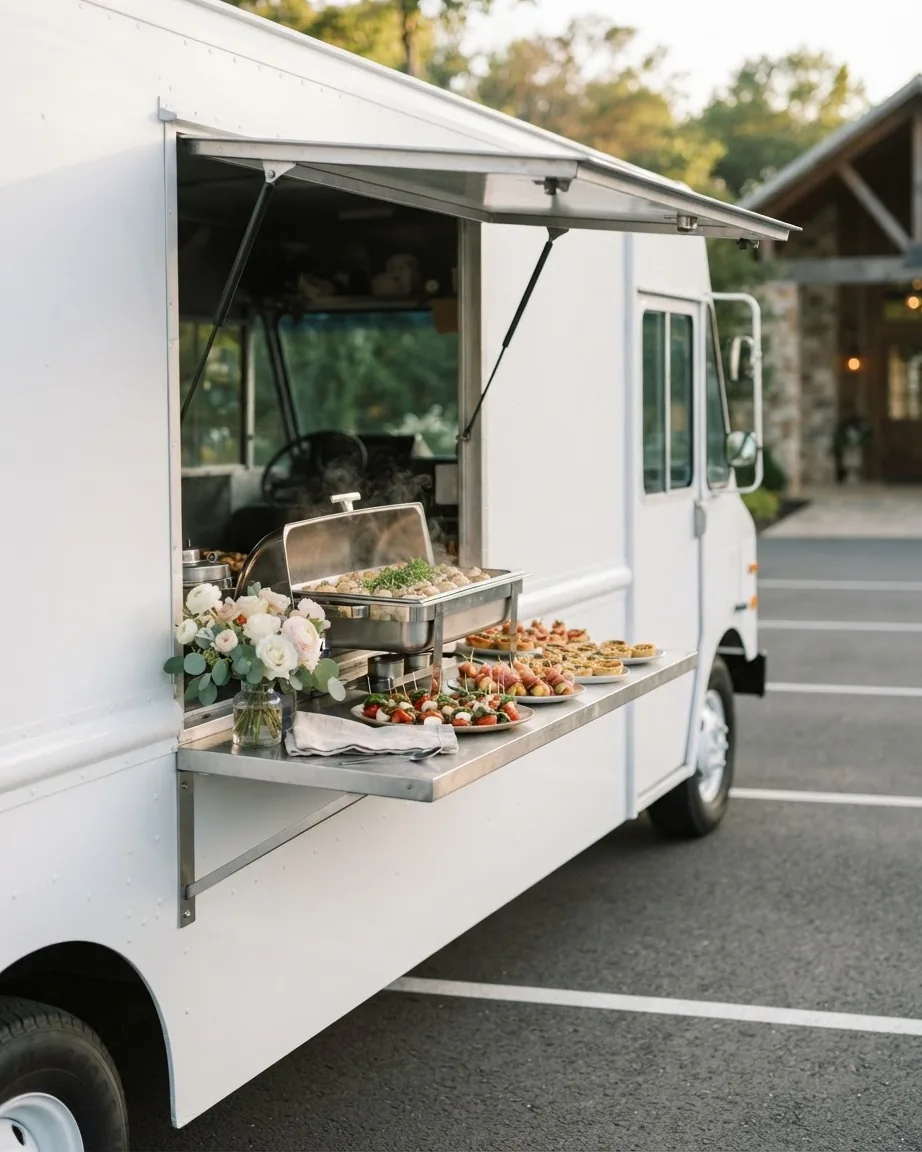
Before any of the money matters, the venue has to let the truck in. Food Truck Club notes that most venues require the truck to carry $1 million in general liability, and many require the venue itself to be named as an additional insured on that policy. That is a document request, a certificate of insurance, and it takes an operator a few days to produce. Ask for it the week you book, not the week of the wedding.
A venue may also keep a preferred-vendor or preferred-truck list, and booking off it can mean extra fees or a flat no. Confirm three things with the venue before you put down a deposit: whether outside food trucks are allowed at all, what insurance limits and additional-insured language they demand, and whether there is level parking within that 100-foot reach of power. A truck you love that cannot legally or physically set up at your site is not a bargain.
The permitting branch generic wedding advice skips
Here is the part the big wedding publishers leave out: a truck that is already licensed to operate is not automatically cleared to cater your specific wedding. Event and temporary-food permitting is set locally, it varies sharply by jurisdiction, and the lead times are long enough to be a vendor-selection factor, not a final-week errand. You cannot infer one place’s rules from another’s.
In Texas, the state tightened statewide licensing. The Texas Constitution and Statutes specify that a separate license is required for each food vending vehicle a mobile food vendor operates, and the department conducts a health inspection of each listed vehicle within 14 days of a complete application. One operator running two trucks at your wedding needs two licenses.
Jurisdictions diverge hard on the private-wedding question. The City of Albuquerque Environmental Health Department carves out an exception for small invitation-only gatherings: on its special event vendor page, the private-event path applies where the number of participants is limited to twenty-five (25) persons or less. Most weddings blow past that, so the exemption rarely helps, but it exists. Do not assume another city offers the same carve-out.
Lead time is where this becomes a selection criterion. The County of San Diego Department of Environmental Health and Quality asks vendors to submit a complete Temporary Food Facility application and fees at least 30 days before the event, with late fees once it arrives under 14 days out. The Virginia Department of Health requires a completed application and a $40 fee submitted to the local health department at least ten calendar days before the event. Thirty days versus ten calendar days is a real gap. Build the longer one into your booking calendar.
- Texas: one license per food vending vehicle; health inspection within 14 days of a complete application.
- San Diego County: apply at least 30 days out; late fees under 14 days.
- Virginia: $40 fee, application at least ten calendar days prior to the local health department.
- Albuquerque: private-event exemption only at twenty-five persons or less.
One more trap inside the permit: scope. Satellite tables, a dessert spread, or any prep happening outside the truck can fall outside what the truck’s existing permit covers. If your setup grows beyond the window, confirm the permit stretches to cover it. Our food truck permits piece tracks the stack more broadly, including the Texas change taking effect.
Booking lead time and de-risking the no-show
Couples underbook on time. The Knot reports that couples don’t start working with their caterer until about five or six months before their weddings, which is already late for a truck when you add the permit lead times above. Saturday evenings June through October are, as Food Truck Club puts it, prime wedding territory and prime food truck territory at the same time. The good trucks on the best dates go first.
Desireé Dent, founder of Dejanae Events and a 12-year recipient of the Best of Weddings award from The Knot, is the kind of planner these publishers lean on precisely because food trucks carry a risk a banquet hall does not: a single vehicle can break down, and there is no back-of-house to cover. De-risk it on paper. Favor established operators with a track record, require that $1 million COI in writing, confirm the deposit and cancellation terms, and get the service window and guest minimum spelled out in the contract. None of this is legal advice; it is the standard event-vendor practice that keeps a booking from becoming a crisis.
The benchmark year nobody agrees on
When you read that a food truck saves you money against a “traditional” wedding, check which year’s catering number the comparison uses, because the sources do not line up. The Knot’s live cost page discusses how the cost per guest has shifted year over year on its average wedding cost report. That per-guest figure, paired with its $85-per-person catering average, is the benchmark The Knot’s own current page supports.
Separately, a different per-guest figure has circulated attributed to a newer Knot study, but that number is not confirmed on the page text, so treat the figure on The Knot’s current page as the solid one and the newer figure as unverified. The gap matters less than the lesson: a quote’s “you save X” claim is only as current as the caterer benchmark it leans on. Pin the comparison to a number you can see on the source, not one relayed secondhand.
Is a food truck really cheaper than a sit-down caterer?
Food Truck Club puts an all-in truck well below a traditional caterer, framing it as a 50-to-70 percent saving. But that edge shrinks at low headcounts where the per-truck minimum dominates, and it assumes you are separately covering tables, servers, and cleanup the caterer would have bundled.
How many food trucks do I need for 200 guests?
Work it as guests divided by plates-per-hour times service hours. At 55 plates an hour across a two-hour window, one truck clears roughly 110 plates, so 200 guests point toward two trucks or a longer window. Made-to-order menus plate slower than assembly-line ones, so lean toward two if the kitchen cooks each order fresh.
When should I send the venue details to the truck?
The week you book, not the month of. In San Diego County the vendor files at least 30 days ahead; Virginia wants the application ten calendar days out with its $40 fee. The truck also needs time to issue a $1 million certificate of insurance naming your venue, which no operator produces overnight.
Does an already-licensed truck need anything extra for my wedding?
Often, yes. Many places treat a private event as its own temporary-food permit, and Texas requires one license per vehicle. Albuquerque only exempts invitation-only gatherings capped at twenty-five people. Scope matters too: dessert tables or prep outside the truck can fall beyond what the existing permit covers, so confirm it reaches your full setup.
What the $3,000 ‘cheap’ truck actually invoices
Food Truck Club puts gratuity on a food truck bill at the standard 15 to 20 percent, charged on top of the food figure. That is the only part of the invoice that scales cleanly off the food figure. The rest does not.
Honeyfund puts service blocks, staffing, and permit fees at another $300 to $1,000 regardless of your headcount. Stack those fixed fees and the gratuity onto a $3,000 food total and the real bill climbs well past $3,000. Those additions never appeared in the per-plate teaser, and they land before a single travel mile or weekend premium is added.
- Gratuity, decoded: at 15 to 20 percent, the dollar quote and the percentage rule are the same number said two ways.
- Fixed fees: $300 to $1,000 for service blocks, staffing, and permits sit on top of the food total regardless of headcount.
- Weekend and travel: both climb on top of the stacked total before you reach a final figure.
- Sanity check against the all-in rate: Food Truck Club’s $20 – $35 all-in per plate across 100 guests shows how quickly a food-only total can approach the top of what the all-in rate predicts once fees stack on.