A standard serving of shaved ice costs roughly $0.35 to $0.50 to make and sells for $3.00 to $7.00, per Sno Biz, and that spread is why so many people look at a shaved ice truck and see easy money. The spread is real. The catch is everything between buying a machine and taking that first dollar: the right ice shaver, a commissary address, insurance minimums, and a few siting rules that can kill your best corner. This guide puts the independent build and the franchise route side by side so you can pick before you spend.
Quick answer: A mobile cart runs about $8,000 to $10,000; a food trailer, $18,000 to $30,000. A quality NSF ice shaver alone is $2,000 to $4,000. Permits typically land between $200 and $1,000. Daily sales for a shaved ice truck swing widely, from $100 to $2,000. The Kona Ice franchise starts far higher, with total investment from $102,365 to $226,841. Margins are strong because the cost of goods per cup is pennies, but your real number depends on volume, location, and local rules.
Startup cost for a shaved ice truck by vehicle class

Your first fork is the vehicle. A mobile cart lands at $8,000 to $10,000 and a food trailer at $18,000 to $30,000. WebstaurantStore looks at the same question from a wider lens: a small concessions trailer “as little as $10,000” up to a custom food truck at $50,000 to $150,000. These ranges do not contradict each other; they describe different builds, so do not average them. A cart is the cheapest way to test demand before you commit to a truck.
| Build type | Startup cost | Source |
|---|---|---|
| Mobile cart | $8,000, $10,000 | Sno Biz |
| Food trailer | $18,000, $30,000 | Sno Biz |
| Concessions trailer | from $10,000 | WebstaurantStore |
| Custom food truck | $50,000, $150,000 | WebstaurantStore |
See also: our serving window guide.
Ice shaver vs. snow cone machine: buy the right one

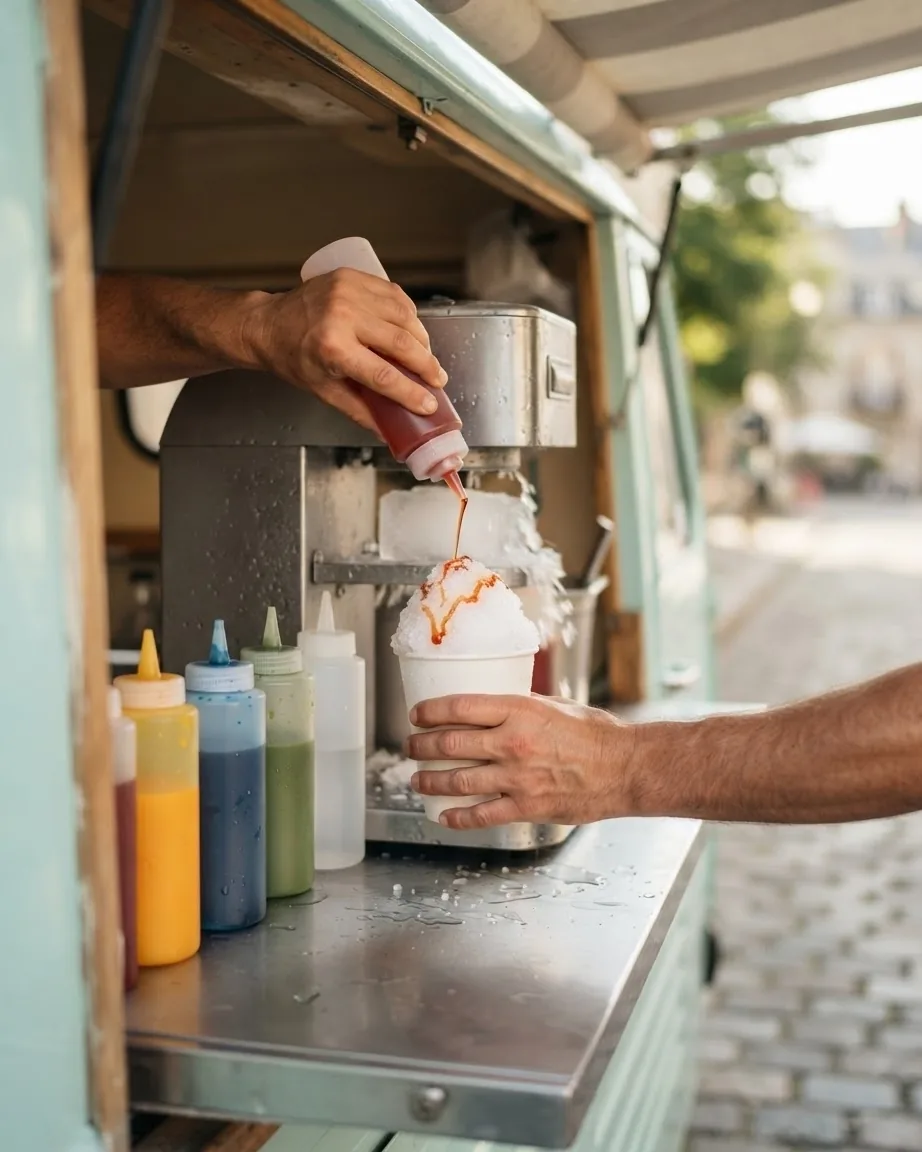
These are not the same machine, and the wrong buy shows up at the window. A snow cone machine is designed to make crushed ice for holding, while an ice shaver creates fluffy snow-like ice to order. The feed stock differs too: snow cone machines take bags of cubed ice, while shaved ice machines can take ice blocks. That matters for a truck. Block ice shaved to order gives you the fluffy, snow-like texture customers expect, and you make it per cup instead of holding a bin of crushed ice that melts between rushes.
A high-quality NSF ice shaver runs $2,000 to $4,000 depending on brand and features. On a cart budget of $8,000 to $10,000, that shaver is a quarter to half your spend, so it is the line item to get right before anything decorative.
Shaved ice vs. snow cone: which product suits the truck

The product decision drives your cup size, your syrup cost, and your texture. Good Vices defines it cleanly: “Shaved ice is fluffy, freshly-shaved ice with flavored syrup poured on top. A snow cone is crushed ice in a paper cone with syrup poured over.” Syrup behaves differently on each. On a snow cone the flavor is strong on top, then fades as it soaks through the coarse ice. Shaved ice holds syrup more evenly because the shave is finer. For a truck, shaved-to-order wins on texture and on the per-cup pricing power that comes with it.
How long does shaved ice last
Shaved ice is made to order, so it is shaved fresh at the window for each customer rather than held in advance. The variable you control is your ice stock and syrups.
Per-cup cost of goods and realistic daily profit

This is where optimistic margin talk meets the itemized bill. A 12 oz shaved ice breaks down to $0.37 total: shaved ice $0.09, syrup $0.17, foam cup $0.07, spoon $0.03, and napkin $0.01. A 6 oz snow cone comes to $0.15: cup $0.05, syrup $0.06, ice $0.03, napkin $0.01.
| Line item | 12 oz shaved ice | 6 oz snow cone |
|---|---|---|
| Ice | $0.09 | $0.03 |
| Syrup | $0.17 | $0.06 |
| Cup | $0.07 | $0.05 |
| Spoon | $0.03 | |
| Napkin | $0.01 | $0.01 |
| Total | $0.37 | $0.15 |
Sno Biz cites a wider per-serving figure of $0.35 to $0.50, with no cup size stated. Do not merge these: WebstaurantStore’s $0.37 is one itemized 12 oz number, while the Sno Biz range covers an unspecified size. Both land in pennies, which is the point.
Are shaved ice trucks profitable
The margin math is genuinely strong, but daily sales swing from $100 to $2,000, so a single number lies to you. A clean example makes the point: 200 servings at $5.00 each brings in $1000 revenue and over $910 in profit after cost of goods. Pennies in, dollars out. What that example does not carry is labor, fuel, your commissary, insurance, or the slow days, so treat $910 as gross over goods, not take-home.
The Kona Ice franchise route
If you would rather buy a system than build one, Kona Ice is the named franchise path, and the numbers sit in a different class. Per Own A Kona, the two primary investment elements are a $15,000 franchise fee and a $151,950 truck, but those are components, not the full bill: the estimated total initial investment ranges from $102,365 to $226,841. Do not add the fee and truck to reproduce that range; it includes more.
The brand charges fixed annual royalties rather than a cut of revenue: $3,000 per year in Years 1-2, $4,000 in Years 3-6, and $5,000 in Years 7-10. Prospective partners are advised to have liquidity of $25,000 to get started. On the equipment side, the Kona Entertainment Vehicle is completely self-contained, requiring no external power or water, and can serve 500+ guests per hour. A fixed royalty favors high-volume operators; a percentage model would scale down on slow seasons, and this one does not.
Permits, licensing, and the mobile-vendor rules that surprise people
Permits and licenses usually cost $200 to $1,000, per Sno Biz, but that is a national ballpark. The binding rules come from your own city and county, and two jurisdictions show how specific they get. In Clark County, Nevada, the Department of Business License charges a $45.00 one-time application plus a $25.00 license fee for a mobile food vendor, and the application wants a passport-size color photo taken within the past 6 months and the places you have lived for the past 10 years.
Insurance, commissary, and work card
The same county also sets insurance floors: public liability of not less than $100,000 per person, three hundred thousand dollars per accident, and property damage of not less than twenty-five thousand dollars. The county requires the commissary address on your health permit, and every vendor and employee who handles food must obtain a work identification card. Budget for these beyond equipment and syrups, or your first inspection stops you cold.
The 500-foot school rule
An obvious high-traffic spot can be off-limits by code. Under local code, no mobile food vendor may sell, solicit, or park within five hundred feet of any school property while school is in session or for one-half hour after the final session. Check your local setback before you build a route around a school; these distances are enforced locally and vary.
Health-risk classification and why your syrup choice decides it
Here is a decision input most guides skip. The Grant County Health District in Washington classifies sno-cones and shaved ice as low-risk, non-potentially-hazardous food, but it conditions that status on “using commercially prepared syrups and commercial ice.” That classification is why your inspection burden stays light. Switch to homemade syrups or self-made ice and you may push yourself into a higher risk tier with more process controls and inspection. For a truck running fast at the window, commercial syrups and commercial ice keep both your prep simple and your paperwork low. Confirm the tier with your own health department, since classifications are set locally.
See also: our ice cream truck menu guide.
Own A Kona lists Kona Ice’s fixed annual royalties as $3,000 in each of Years 1-2, $4,000 in each of Years 3-6, and $5,000 in each of Years 7-10.
Shaved ice truck FAQ
How much does a shaved ice truck cost
Entry depends on the build. A cart sits near $8,000, a trailer reaches $30,000, and a custom truck can hit $150,000. The Kona franchise opens higher, with a $151,950 truck inside a total investment that tops out at $226,841. The NSF shaver inside any of them accounts for $2,000 to $4,000 on its own.